
Archive for 2008
welcome to the ultimate blog party!
 It’s that time of year again–The Ultimate Blog Party is here!
The wonderful women of 5 Minutes for Mom are our hosts. There will be prizes and, best of all, lots of great blogs to discover, so get on over there and sign up!
I participated last year as well (you can read my welcome post here), but for those of you visiting for the first time:
I am an American who has been living in southern Italy for, oh my goodness, almost five years already. I have a P (my fiancé), a Luna and a Stella (my adorable pooches), and you can read plenty more about me here.
This blog is a place for me to keep family and friends up to date on my life as well as share my observations on Italian curiosities from governments collapsing to plastic ball protests to*big* mistakes in ordering shoes for policewomen to pasta strikes.
No, it’s never boring in Italia.
Especially with all the great food. Need a recipe? I’ve got plenty here, but how about some bruschetta al pomodoro to start off this party?
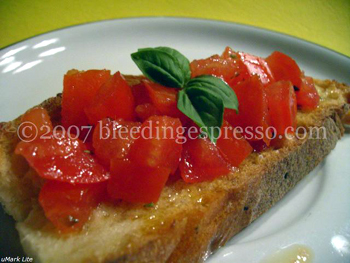
Please feel free to make yourself at home and have a look around–some of my favorite posts are here. And be sure to let me know you’ve stopped by!
Now I don’t know about you, but I have some serious blog-hopping to do.
P.S. For those looking for a post on Sicily, there are lots more Sicilian adventures on the way. Remember to keep an eye on my Sicily 2008 Flickr set for updated photos!
Love Thursday: Hearts in Palermo, Sicily
How perfectly appropriate that my dad‘s 60th birthday falls on a Thursday . . .
a Love Thursday.
Auguri Dad, and lots of love via these hearts from Palermo’s Villa Garibaldi:
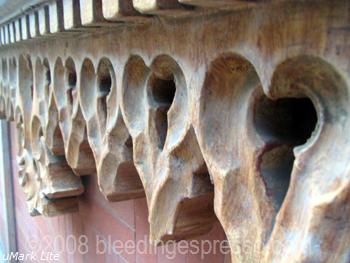
Happy Love Thursday everyone!
what’s cooking wednesday: calabrian prickly zucchini
 I hope you don’t mind, but we’re taking a break from Sicily to come back to Calabria for a moment.
Today’s What’s Cooking Wednesday recipe probably isn’t one you’re going to rush out and try, but I couldn’t let another week go by without writing about:
Prickly zucchini
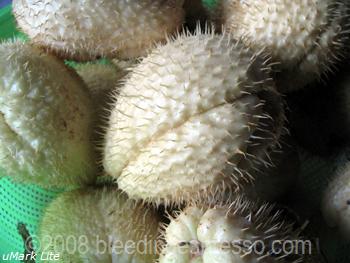
Actually I didn’t even know that would be an acceptable name in English for them, but it was my guess, so that’s what I typed into Google, and found a post by Rowena at Rubber Slippers in Italy (Great blog! Go read it!) entitled: Prickly Zucchini from Calabria.
Bingo!
I asked around a bit here, and no one even knows the name of these spiny little things in Italian; in Calabrese they are “cucuzze spinusi” where cucuzze is a general name for zucchini/pumpkins and spinosi (spinusi in Calabrese) means spiny or prickly.
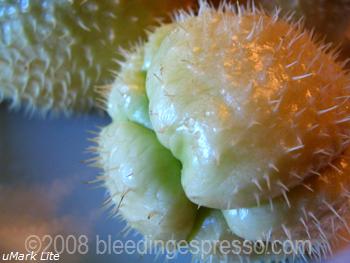
And because of Rowena’s commenters, I learned that our cucuzze spinusi are better-known as chayote, popular in many parts of the world, particularly Mexico. Also, Wikipedia tells me that the Italian name is zucca centeneria, but I’ll stick with cucuzze spinusi since no one around these parts would know what I’m talking about otherwise.
That same Wikipedia page gives some serving suggestions, which are basically all the things you’d do with un-prickly zucchini (yes, I was tempted to write “prickless”), but I’m going to share the way everyone eats them here–this according to a very informal survey at the local grocery store.
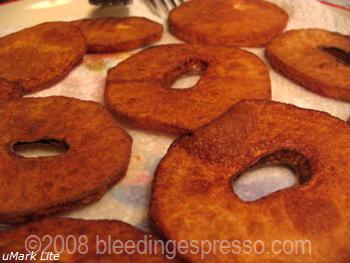
Fried Prickly Zucchini
Prickly zucchini
Flour
Salt
Olive oil for frying
So you’re probably wondering how to get the spines off.
First, these are real spines, not like the baby ones that prickly pears have. So first trim off the spines with a sharp knife and then peel it “come la mela” (like an apple) as P says.
Slice the zucchini to your desired thickness, discarding the innards along the way.
Mix a bit of salt with flour in a shallow bowl, and get dredging.
Fry them up until they’re a light golden brown (P left the ones in the photo in the oil *a tad* too long but they were still delicious), and you can taste your very first fried prickly zucchini.
Buon appetito!
Savoca, Sicily – The Godfather Village
Last Thursday, I teased you with some heart-themed photos from the village of Savoca. Now it’s time for the rest of the tour. First, may I suggest you cue la musica to set the mood?
Now, remember to keep an eye on my Sicily 2008 Flickr collection for *all* my photos from our recent trip (updated daily!); also click on any of the photos below to be taken to the larger version on Flickr, and note that some of the words in pink will take you to other photos not featured here.
Il Padrino B&B
As I’ve mentioned, Savoca (in the province of Messina) is probably most famous for providing scenery for Il Padrino, or The Godfather. In fact, if you’re looking to stay in Savoca, there’s even a bed & breakfast that bears the film’s name (see left).
Now you may be saying to yourself, “Self, wasn’t The Godfather set in Corleone?”
Well, yes, but through Hollywood magic, the quaint town of Savoca became the filming location for some scenes in the movie, as further explained by Cherrye, my travel companion, at My Bella Vita.
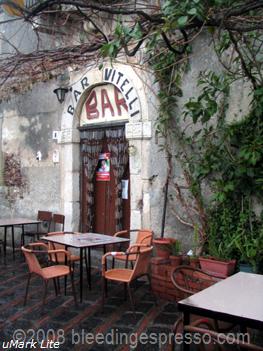
So instead of Corleone, you got to visit Savoca’s Bar Vitelli:
Bar Vitelli, Savoca, Sicily
where Michael Corleone asks for Apollonia’s hand in marriage from her father.
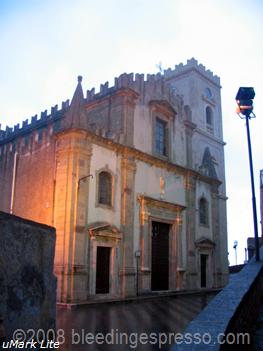
The other major scene filmed in Savoca is the wedding of Michael and Apollonia, which takes place at the Chiesa di Santa Lucia or Chiesa di San Nicolò:
Chiesa di Santa Lucia, Savoca, Sicily on Flickr
But wait! There’s so much more to see in the 12th century village of Savoca!
Come on in through the Porta della Città:
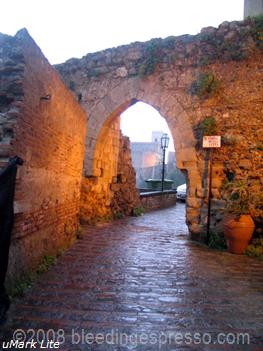
Porta della Città, Savoca, Sicily on Flickr
This impressive arch is all that remains of the medieval gates that used to lock up the village at night–until 1918.
We arrived in Savoca as the sun was going down in a light rain, which meant that there was next to no one around. This sentiment comes across so poetically in Italian as I later told P, “Non c’era un’anima.”
There wasn’t a soul.
And then I asked him, jokingly, if that was a coincidence, given the town’s notoriety as the setting for Il Padrino. Hah!
Speaking of, ahem, dead bodies, there are catacombs in Savoca, but they were closed when we were there; we did, however, make it to the Capuchin Catacombs in Palermo.
Here is a view overlooking the Chiesa Madre of Savoca:
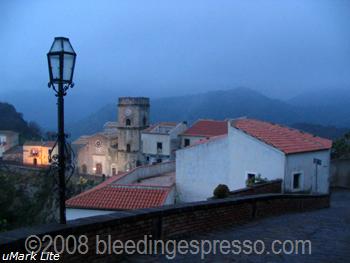
Chiesa Madre, Savoca, Sicily
Do you see the house that seems to be glowing on the left? It’s a “Casa medioevale con finestra a Bifora,” a medieval house with a peculiar style of window that gives “two lights” that is quite common in Sicily.
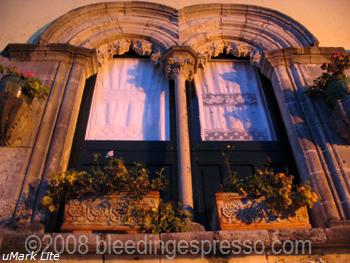
Bifora Quattrocentesca, Savoca, Sicily on Flickr
Savoca is also known as the Città d’Arte, the City of Art; this was represented in various forms of art throughout the village:
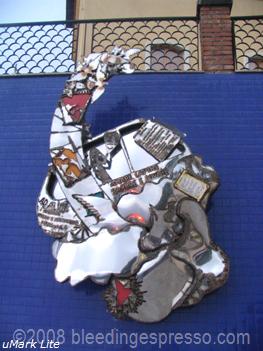
Città d’Arte, Savoca, Sicily on Flickr
As well as plenty of religious representations such as this one above a door:
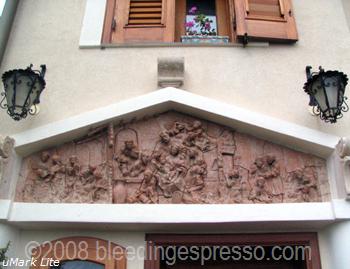
Detail above door, Savoca, Sicily on Flickr
The Stations of the Cross and several shrines also decorate the main street that runs through Savoca, and even ordinary houses are extraordinary.
And of course we can’t forget about natural beauty, which is truly everywhere.
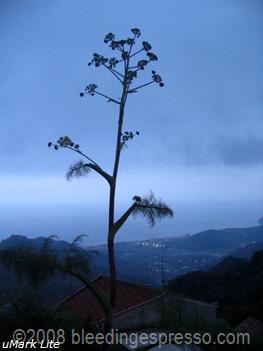
Savoca, Sicily on Flickr
Savoca is well-worth a trip if you’re in the area (it’s 37 km from Messina), especially if you love medieval villages like I do.
And while The Godfather settings are must-sees, definitely leave time to walk around and really soak up the atmosphere of this hidden Sicilian treasure–all the better if you’re there on a clear day when some of the attractions are open.
A Quick Stop in Messina, Sicily
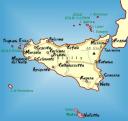
Some guidebooks I’ve seen advise readers to pass quickly through Messina, the port city at the northeastern tip of Sicily and your likely first stop if you’re coming from Calabria across the Strait of Messina.
I got a different impression of this bruised and battered place, though, and I plan on going back for a more thorough look around; lucky for me I know a few people, including one of P’s sisters, who live there.
In case you’re wondering, we got to Messina pretty easily, taking the train from Lamezia Terme to Villa San Giovanni for the traghetto–no thanks to the conductor on the train, mind you. As our tickets only said “Messina” with no information on changing trains, etc., I asked him what we’d have to do to get to Messina. He said to get off the train, walk under the “sottopassaggio” and get on the boat. Or swim.
Witty, wasn’t he?
He neglected to mention, of course, *where* we’d have to get off that train, but luckily we knew that the ferries ran from Villa San Giovanni, so everything went smoothly from there; we even made fast friends with a nice Italian man who, upon hearing us speaking English, told us that he had lived in Connecticut for 17 years.
We only spent a morning touring Messina and my camera batteries were dead, so I don’t have *too* much photographic evidence for you (at least not of my own), but I hope you enjoy this quick virtual tour through Messina anyway.
* Basic facts about Messina *
Messina was founded way back in the 8th century B.C. by the Siculans who named the city “Zancle” or sickle because of its peculiarly-shaped harbor. The Greeks took over in the 5th century, and later, Anaxilas, tyrant of Reggio, gained control and changed the city’s name to Messene in honor of his homeland, Messenia.
As all of southern Italy, Messina endured many rulers including Carthaginians, Romans, Goths, Greeks, Arabs, and Normans, but the history of the city is probably best summed up in one word: disaster.
From the Bubonic Plague (1743) to cholera (1854) to earthquakes (1747, 1894, 1908) to war-time leveling (1848, 1943), Messina has been the victim of an enormous amount of malocchio. See, and you wonder why guys grabbing their crotches for protection is such a big deal round these parts.
Other protection is Messina comes in the form of its patron saint, the Madonna della Lettera (Madonna of the Letter), who is said to have sent the citizens of Messina a letter promising them eternal protection for their recent conversion to Christianity.
A gilded Madonna blesses each new arrival into the port of Messina from her spot of honor atop one of the towers of Forte San Salvatore, built in 1546 by Spanish viceroys.
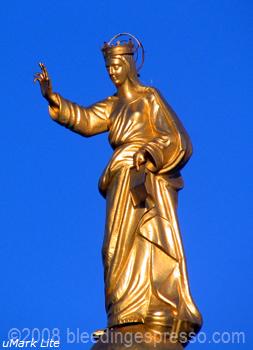
You can read more about the Madonna della Lettera at Cherrye’s place.
* Favorite things I saw in Messina *
OK, like I said, we didn’t get to see too much, but here are three of my favorite things that I saw in Messina:
* The Bell Tower of the Cathedral of Messina *
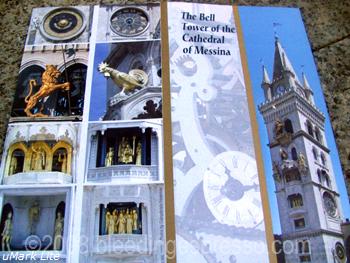
Yes, that’s a brochure (remember: dead camera batteries), and no, we weren’t allowed to go up inside “the biggest and most complex mechanical and astronomical clock in the world” because we were told it was too windy (was a perfectly lovely day). It was still pretty cool from the outside, though, especially at noon when the theatrics started.
The lion roared, the cock crowed (or at least he tried to–technical difficulties), and all of the biblical scenes were set into motion, including one representing the Madonna della Lettera, to the tune of “Ave Maria.” Every inch of this clock, which was installed in 1933, symbolizes something.
If you’d like to read more about our clock experience, check out Cherrye’s post “The Ding Dong, The Lion’s Roar, and the Ave Maria.” Also feel free to contact me and I can send you a scan of the brochure with all the details.
* The Fountain of Orion & the Fountain of Neptune *
OK, these are really two things, but since they’re both fountains, I’ve grouped them together.
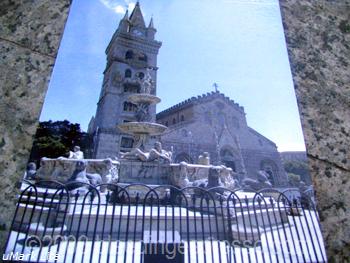
La Fontana di Orione, the Fountain of Orion, is found in front of the Cathedral and was done by Florentine Giovanni Angelo Montorsoli in 1547. Orion is Messina’s mythical founder, and the fountain was built to honor both him and the city’s first aqueduct.
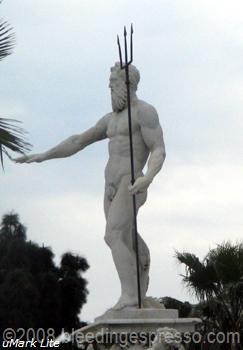
La Fontana di Nettuno, the Fountain of Neptune, is found, not surprisingly, overlooking the sea. If it looks to you like he’s telling the waters in front of him to calm down, well, your eyes aren’t deceiving you–that’s precisely his role in this disaster-ridden city.
The current fountain is actually a replica of Montorsoli’s original one, created in 1557, that has been heavily damaged. You can find the original marble Neptune at Messina’s Museo Regionale.
* La Galleria Vittorio Emanuele III *

La Galleria Vittorio Emanuele III was constructed between 1924 and 1929 under the guise of Messina’s own Camillo Puglisi Allegra. It’s a one of a kind building in the south of Italy with shops and restaurants surrounded by beautiful architectural and decorative elements.
A very special grazie to Vanessa for playing tour guide and hostess, and a ciao to our new friend Hilary (she of the *delicious* cheesecake)!
Also be sure to check out my Flickr Sicily 2008 Photo Collection; I’ll be adding photos daily!
————–
[tags]messina, sicily, sicilia, neptune, madonna della lettera, bell towers, campanile, fontana di Orione, fontana di nettuno, galleria vittorio emanuele III[/tags]
 Michelle Kaminsky is an American attorney-turned-freelance writer who lived in her family's ancestral village in Calabria, Italy for 15 years. This blog is now archived.
Calabria Guidebook
Recipes


