
Author Archive
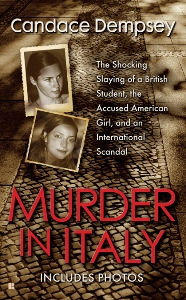
Murder in Italy by Candace Dempsey: Amanda Knox Trial
 One of the biggest and most tragic stories to emerge from Italy in the past few years is the murder of Meredith Kercher, a 21-year-old English woman studying in Perugia. Kercher died in a pool of her own blood after being stabbed in the neck. And those are about all the details of this case that everyone can agree about.
What has captured the attention and intrigue of many outside of Italy is the fact that an American student and Kercher’s roommate, Amanda Knox, was convicted of playing a role in Kercher’s death. Knox is currently serving a 26-year prison sentence along with Raffaele Sollecito, her Pugliese friend (I just can’t call him her “boyfriend” as he’s often called; they had been seeing each other for about a week before the murder), and Rudy Guede, a native of the Ivory Coast who had been adopted into an Italian family at a young age. Sollecito is serving 25 years in prison and Guede 16. All have upcoming appeals.
*
Candace Dempsey‘s book Murder in Italy: The Shocking Slaying of a British Student, the Accused American Girl, and an International Scandal sets out to tell the real story beyond the “media frenzy,” according to the backcover blurb.
Full disclosure: I received a review copy of the book and have known Candace since before Kercher’s murder (Candace’s family comes from Calabria so that is how we initially “met” online). In fact, Candace and I exchanged several emails about the case throughout the investigation. Candace soon began writing about the case on her blog Italian Woman at the Table, and it’s no secret that Candace has been an *extremely* strong supporter of Knox from early on — and although I know Candace tried hard to be objective, that support continues in this book.
I’m sorry to say that Murder in Italy wouldn’t be my first choice to get a balanced account of the facts of this case, although to be fair, I’m not sure if one exists anywhere as there are strong emotions on all sides. In Murder in Italy, the choice of evidence discussed, the way it’s presented, phrasing, and word choice all paint Amanda as innocent and the Italian police and judicial system as idiots at best, intentionally framing innocent people at worst.
 That said, the book covers the main events of the case well, offers details in matters that haven’t been greatly publicized, and delves into the personal backgrounds of many of the major players. For anyone interested in this case, you can find a lot of background information and become familiar with one perspective of what happened. To be honest, I didn’t read anything in the book that I hadn’t heard before, but I had been following the case fairly closely as a legal geek.
Aside from that, though, some little things bothered me throughout the book — misspelled/misused Italian words, sweeping generalizations about Italians and their beliefs, inconsistencies in Knox’s and Sollecito’s statements that were never addressed let alone explained, repeated themes without proof behind them (Knox’s Italian is described as very basic and even poor, but I’ve heard her speak Italian, and it’s not) and various phrases in quotes that aren’t attributed to any sources. To put it mildly, the editing should have been much tighter, and I chalk that up to the publisher wanting to get this out as fast as possible.
But the final verdict: would I recommend this book? Yes, I would, largely because of its most promising quality that I haven’t touched upon yet: readability.
Murder in Italy reads like a novel with so many plot twists and turns and complex characters, you won’t want to put it down. In fact, I read this in a couple days, never losing interest even though I already knew the essentials of the story. Candace has said that she wanted to write about the story as a dream turned into a nightmare, and she accomplished that. She also did a great job of painting the scene in Perugia and giving readers a little peek into this unique corner of Italy where a new crop of young foreigners pass through all the time.
So if you’re interested in the Amanda Knox case and/or enjoy true crime books, give Murder in Italy a look, knowing that you’re in for an engaging although not impartial read.
*
If you’d like to hear Candace talk about her book, Perugia, and more, check out our latest Eye on Italy podcast in which we also discuss the possible death of Nutella and blue mozzarella.
*

Subscribe to my Book Reviews feed — book reviews ONLY, which aren’t published to the main feed — by visiting Feedburner.
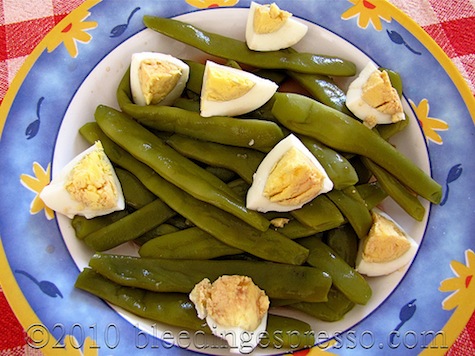
Insalata di Fagiolini: Calabrian Green Bean Salad
We’re eating lots of fagiolini (green beans) now as they’re in season. The other day on the Bleeding Espresso Facebook page, I re-shared the link to my recipe for Green Beans, Pancetta, and Potatoes — one of my absolute favorites — and remember I also posted a similar recipe with tomato sauce and pork.
But you know what I haven’t told you about yet? A delicious, traditional Calabrian recipe for a green bean salad that I never had until I came here. P introduced me to it several years ago, and we eat it often throughout the summer — and I love it more every time I have it.
Note that the traditional Calabrian green bean salad doesn’t include an egg like in the photo below, but if I’m having this for lunch (as opposed to as a side dish), I’ll add an egg for some protein. Notice, incidentally, the yolk color of this egg (from a neighbor) as opposed to ours. Just sayin’.
Insalata di Fagiolini
- 1/2 kilo of green beans
- 3 tablespoons of olive oil
- 2 tablespoons red wine vinegar (or to taste)
- 4 cloves of garlic, cut in half
- Salt to taste
1. Prepare beans by washing and snapping off the stem ends.
2. Parboil beans in salted water for 5-10 minutes until they are no longer crunchy; Calabrians don’t like much crunch in their veggies, but you might, so feel free to adjust for your taste.
3. Strain and let cool.
4. In the meantime, mix together olive oil, garlic, and salt in a small bowl.
5. When the beans are cool, toss them with the dressing (minus the garlic) and let sit for at least 10 minutes so the beans soak up all that goodness.
6. Adjust for seasoning and serve.
Buon appetito!
P.S. Note that you can also freeze parboiled green beans, so if you find yourself with lots of fresh beans and you’re not sure what to do, just clean them, parboil, and freeze and decide later!
Do Italians Eat Pasta Every Day?
 One question I get from many people is whether Italians eat pasta every day. Of course answering such a question would require an enormous generalization, so I’m going to give you the experience in my house, which consists of a Calabrian and an American with Italian, Lithuanian, and German blood.
Do we eat pasta every day?
Pretty much, yes. Usually either lunch or dinner — but hardly ever both — contains some kind of pasta for us.
I’m sure for some of you the thought of eating pasta every day sounds boring, and you’re positive you’d get sick of it within a week or so. This actually did cross my mind as I considered moving here — would I just get sick of eating pasta? And if so, then what would I do?
Well, seven years in, and I’m still having some pasta on most days. Don’t get me wrong; there are days when I just don’t want pasta. So I don’t eat it, easy peasy.
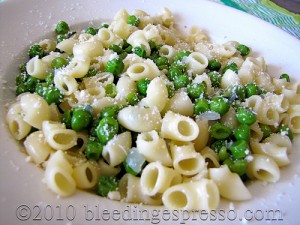 “Pasta” Does Not Equal Spaghetti and Meatballs
One important thing to remember is that Italians don’t eat pasta with “red sauce” and meatballs every day; in fact, the rumors you’ve heard about Italians not eating “spaghetti and meatballs” are true; if there are meatballs, they are often huge and served after the pasta course, so you’ll have one, *maybe* two at the most.
That “red sauce” is often a ragù, made with meat (often pork and for us, rabbit or chicken); in our house, that’s probably a once every two weeks kind of dish, often on a weekend.
Also? Italians don’t just eat spaghetti. As I’m sure you know, pasta comes in all shapes and sizes, and part of the fun is matching what kind of sauce or accompaniment best suits a certain kind of pasta, so there’s a lot more than spaghetti going on around here.
So what else are we eating with pasta? Well I have a list of recipes to give you some ideas, and you’ll see everything from tuna (with or without tomatoes) to broccoli (no tomatoes) to ricotta fresca to fresh tomatoes and basil to prawns. We eat pasta cold in a salad in the summer and hot in minestrone in the winter — and with legumes like peas, ceci, and lentils year round.
Pasta is very versatile, and as always, I do encourage you to experiment.
But Pasta Makes You Fat!
Another misconception regarding pasta is that some people believe that if they ate pasta every day, they’d be the size of a house. The answer to that is, well, it depends on how much pasta you eat and what you’re eating with it.
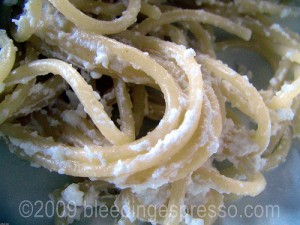 Pasta and carbohydrates have gotten a bad rap in health circles, but you *do* need them in your diet — in moderation, just like everything else that helps your body function the way it should.
Italians seem to know instinctively that 100-200 grams of pasta a day falls well within the recommended daily allowances of carbs. You just have to not load up on carbs the rest of the day in order to keep a good balance.
Other health issues like diabetes may cause concern with carbs, but if you’re an otherwise healthy person, eating a bit of pasta a day is one of the common features of the Mediterranean Diet, which we know can offer great health benefits — but know that is not a “diet” as the word has come to be understood. It is a way of life.
Yeah, I’m Still Not Buying that I Could Eat Pasta Every Day and Not Get Sick of It
If you still can’t imagine eating pasta every day, think of it this way: do you eat bread every day? Many people do, in one form or another. Well you can think of pasta as our bread. It accompanies other ingredients and isn’t really the “point” of the meal — although it’s still an important part to be sure (see the discussion of matching pasta with sauce above).
Note also that Italians will generally *not* eat bread and pasta together, so don’t be surprised if you’re in an Italian restaurant and they swipe any bread off the table just as the pasta is served.
But hey, we’re not all created the same, so it very well may be that you would get bored with an Italian diet and with eating pasta every day. So why not come over here and find out?
How often do you eat pasta?
Enrich Your Italian Vacation with Milano Summer School
Would you like to learn more about Italian history, culture, opera, or fashion while on vacation here in the Bel Paese?
Read on for more information from Alexandra of the Milano Summer School.
—————
 Milan is the beating economic heart of Italy, and home to a number of the country’s most prestigious study institutions – Bocconi University for economics, Domus Academy for design and architecture and Istituto Moda Burgo for one of the city’s most famous exports, fashion. And this summer, from June 14th to August 7th, these institutions are opening their doors to students and culture fans alike from all over the world.
The event, co-ordinated by the newly founded Milano Summer School, is a world first. Whether you fancy lessons in opera at La Scala Theatre, or workshops on International Relations, there is a summer course to meet every need and most of the big institutions are getting involved.
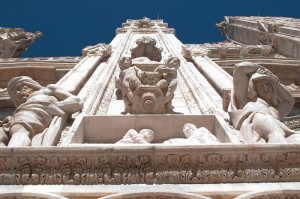 The courses generally last one or two weeks, and you can choose from a range of themes including Fashion, Design, Theatre, Music, Art, Italian Culture and Language, Artistry, Tourism, International Relations, Medicine and Surgery, and Italian for Foreigners.
The course organisation will also help visitors to find accommodation in the city and will implement a programme of social events so that participants on the various courses can interact and feel part of a larger summer school community.
There are a number of useful links you can have a look at to find out more:
- Milano Summer School
- VisitMilano.it and Turismo.milano.it for tourist information about Milan
- The current issue of Néo News online magazine, which is dedicated to the Milano Summer School
If you’re looking for a novel way to visit Italy this summer and learn more about the rich culture of the Bel Paese, this might just be it!
—————
Thanks so much Alexandra!
If you have questions, please get in touch with Milano Summer School,
and in any event, have a great summer!
Excerpt from BAROLO by Matthew Gavin Frank
 For all you Italy, wine, and book lovers out there, I’m pleased to present an excerpt from Matthew Gavin Frank‘s new book BAROLO, a memoir about Frank’s illegal work in the Piemontese Italian food and wine industry.
I’ve been hankering to get myself to Piemonte ever since “meeting” Diana of Creative Structures and the Baur B&B, and Frank’s book may be just what I need to hold myself over until I can get there.
The following piece originally appears, in slightly different form, in the food-and-wine memoir, BAROLO (The University of Nebraska Press, 2010), by Matthew Gavin Frank.
Coming to Temperature
I run my hand over my hair, spitting rain as cracked carbonation, and make for the indoors. The indoors takes the form of Alba, Italy’s Caffé Calissano, its cream awnings and shrub-lined exterior nearly kissing the orange stones of the Duomo.
Soon, I am drying off at a mother-of-pearl cafe table, my snifter of rosolio reflecting its oval pinkness in the white-tiled ceiling, as if assuring itself of its own existence before I pour it down my throat. This liqueur, which I’ve found only in Italy’s Piedmont, wears its rose-oil roots proudly in both smell and taste.
I sip and, petal-tongued, watch two raindrops race down Calissano’s window. I bet on the one on the right. It has a fatter bottom. It wins. Behind the window-rain, a helmetless boy passes on a rickety moped, disappears around the Duomo’s hip. Then, an elderly woman in a red plastic kerchief limps past grasping an armful of rolled bathmats to her chest.
If Alba is a body, I can’t tell if I’m the artificial heart or a virus. It exists around me, with me, despite me. It includes a young waitress, twentysomething, curly brown hair, green butterfly barrettes, who sets a small white plate of meat and mushrooms in front of me. She has a full face and short fingers. I didn’t order this.
 “Um,” I say, “Io no…uh…”
“You are American, yes?” she says in a voice steeped as if in rosolio.
“I wear it like an overcoat, huh?”
“Aah,” she says, dismissing my ridiculousness, this is salami with the, uh, truffle, and the porcini in the, uh, vinegar.”
“Truffled salami?” I say on an inhale, my words sputtering as if spoken through a floor fan on high.
“Yes, this here,” she says, the face of her left pointer hovering dove-wise over the plate.
“And these…” I say, sniffing the dome smell of delicacy eight inches above the table, “Pickled porcinis?”
“Yes. Uh, you can not have a drink and, uh, not have something to eat. This is a rule.”
“Really? Just here, or in all of Italy?”
“Oh, everywhere.”
“Well, these are the best bar snacks I’ve ever seen,” I say, “This is a good law.”
She laughs, I think, because she feels she should.
“Mille grazie,” I say.
“Prego,” she says and returns to the masses.
Northern Italy is a region of wine and chandeliers and I sit as if in a crib, beneath yet another dangling mobile of crystal, shedding a gauzy orange light. I imagine that Piemontese writers Beppe Fenoglio and Cesare Pavese often sat beneath Calissano’s chandeliers with other local artists, eating, drinking, forging World War II’s partisan movement before playing bocce ball in the piazza.
Now, the Cinzano mirrors reflect the mostly businesses-suited patrons and waitstaff, clad in tuxedo shirts, loose bowties, black pants and black aprons.
The bar, stretching the length of the north wall, is patrolled by a young blond man, forever pacing its expanse, playing guard to the thousands of light-spitting bottles, filled with elixirs of red, white, clear, green, rose, yellow. The ceiling’s thick white tile is carved with oak leaves and wine grapes, fish flanks, and the occasional seraph. Calissano indeed seems a museum-turned-cafe and the staff roves among its tables so cleanly as if curators, no, sculptures come to life. Their hands and feet trace the nooks and bottles of their region.
I know, mouth now greased with truffle salami, cheeks now aglow with a post-porcini sting, that this is going to be my place in Alba. For the first time since arriving in Italy nearly a month ago, I’m infected with a sense of home. Uncommonly warm, I raise my snifter to an especially chubby ceiling angel, swear I see it wink, and swallow the thick last. At the bar, the young blond man rolls a raw porcini mushroom to the center of a wooden cutting board and hacks it in half with a meat cleaver. Even split, its stem is as thick as an arm.
Interested in more? Check out BAROLO for yourself!
 Michelle Kaminsky is an American attorney-turned-freelance writer who lived in her family's ancestral village in Calabria, Italy for 15 years. This blog is now archived.
Calabria Guidebook
Recipes


