
Author Archive
One (Wo)man’s Poison Is Another’s Delicacy
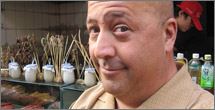 Do you know the television show Bizarre Foods with Andrew Zimmern? We love it, and I may or may not have a secret crush on the host.
Ahem.
In Italy, the show is called Orrori da gustare, literally Horrors to try/taste.
Sure they could’ve used the word bizzarro to describe the food, but the translators went one step further to demonstrate just how, um, eeeeeeew some of the things that Andrew eats really are–bites of lamb’s eyeballs, beating frog hearts, all kinds of rotting meat and fish and more. YUM!
So you would think that P and I wouldn’t have too much of a culture clash regarding this show because we *all* agree these foods are bizarre, if not true horrors? Right? Right? Hmm….
Through my recipes, I think I’ve demonstrated here that I like an awful lot of Calabrian food–I can get with wild boar (cinghiale) and rabbit (coniglio)–but I make no secret of my dislike of many traditional Calabrian foods, i.e., those you probably won’t be seeing on What’s Cooking Wednesday, such as:
- u suzzu: random pig parts (tongue, lungs, heart, stomach, etc.) in gelatin with peperoncino and vinegar. I like my gelatin in Jell-O thankyouverymuch.
- e frittule: boiled pig parts, especially the skin, that give off a smell I won’t even begin to describe to you because it’s turning my stomach just thinking of it.
- u sanguinazzu: a dessert made with cinnamon, orange zest, vino cotto . . . and boiled pig’s blood.
- ghiro: dormouse, usually in a tomato sauce (illegal to capture, actually).
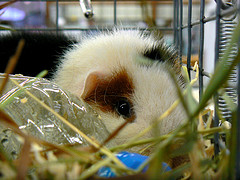
- porcellino d’india: guinea pig. Yes, cute little guinea pigs like this:
I should be perfectly clear that I have tried three of the five on the list (care to guess?) and will probably eventually try them all if/when they are presented. I’m proud to say I’m quite Andrew Zimmern in that respect.
I *hate* when people say they don’t like something without trying it, so I practice what I preach.
And then I spit into my napkin if necessary.
Just kidding.
Sort of.
All of this is a lead-in to a conversation that P and I had the other night:
We were starving and only starting to prepare dinner as I flipped the channel to Orrori da gustare.
I quickly changed the channel.
“Oh we shouldn’t watch this now,” I said, meaning that we would be so disgusted that we’d lose our appetites.
“Yes,” P agreed.
“It’ll make me too hungry.”
Thus proving Andrew’s mantra, “One (wo)man’s poison is another’s delicacy” once again.
[P.S. Andrew, we got some poison “delicacies” for you in Calabria!]
This is all the more ironic because P is so against most “American” foods that he won’t even try them, or will only do so after I beg and plead.
Peanut butter took six months of cajoling. SIX MONTHS!
Mah.
So tell me, do you and your Other Half agree on food?
What foods gross you out?
What’s the most bizarre food you’ve ever tried?
P.S. Be sure to check out some decidedly delicious food–
Mary’s Crab Cakes at The Flavors of Abruzzo
for La Buona Cucina Americana!
Buon weekend!
love thursday: my own personal seat warmer
Many people mistakenly believe that the weather in southern Italy is tropical or nearly so. It really isn’t. We do have seasons, although winter brings more rain than snow and spring can seem awfully short before we are thrust into the heat of summer.
Another southern Italian factoid is that most of the houses here are built with stone and/or tile, i.e., with “natural insulation”; central air and heat are only coming into fashion now, but it’s still quite expensive to run because of electricity costs.
And so most of us are “green” without even really trying.
All of this means that if your house isn’t directly in the sun, it can get pretty darned cold inside and stay that way–even now, in the spring when I often have to take *off* layers of clothes to go out with the dogs.
[This cooling effect works a bit in our favor during the summer, although not as much as it seems to work against us in the colder temps.]
Anyway, I am so very pleased to announce that it has been nearly a week since I’ve had to turn on the space heater near my work area, which means spring truly has arrived!
It also means I’ve had to switch to another method of keeping my seat warm:
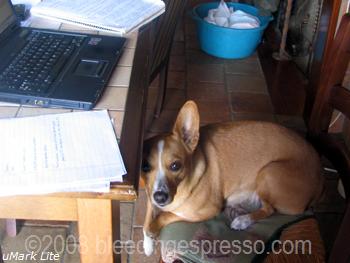
All natural, and works for us!
Happy Love Thursday everyone!
P.S. Yes this photo sums up my life rather well–
work, pooches, and laundry in the big blue vasca.
What’s Cooking Wednesday: Calabrian Sausage & Fava Beans
 You had to know it was only a matter of time before fava beans made an appearance on What’s Cooking Wednesday.
Fava beans (also known as broad beans and “fava” in Italian, “fave” is plural) are peasant food at its finest, and if there’s one thing we do well in Calabria, it’s peasant.
I wrote about favas before they start coming into season right around St. Joseph’s Day in March; now we’re at the end of the fava run. Mostly we just eat them raw as a snack (more info on how you get to that point below), but when P’s mom brought a big ole bag of them over, we had an urge to cook them.
And yes, that could also be because “Fabio” comes from faba…Latin for fava! It’s in our DNA around here.
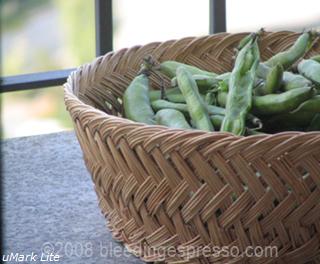
Normally P’s mom would use “carne salata” (a very salty cured meat) with this dish, but we didn’t have any so we used spicy Calabrian sausage. Pancetta or bacon could also easily be substituted.
While researching for the post, I came across this recipe from medieval times–not only is the recipe quite similar to what P’s mom would make, there are words in there more reminiscent of Sicilian/Calabrian than standard Italian. Interesting, huh?
Before we get to the recipe, let’s get something clear before you start–you have to *really* want to eat favas to go through the work involved. Susan of Food Blogga, gives a great demonstration of shelling them here, and now a quick lesson from me.
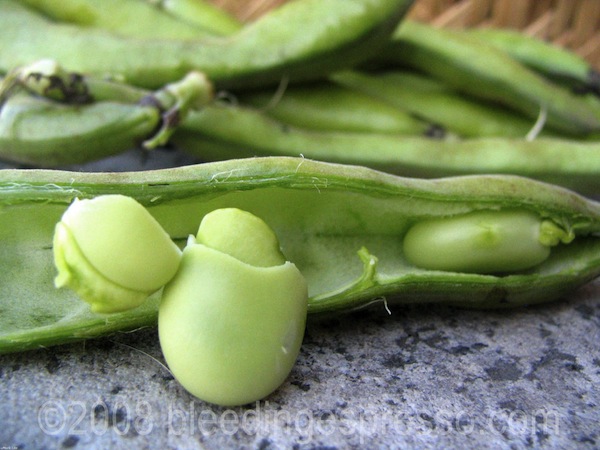
They start looking like this:
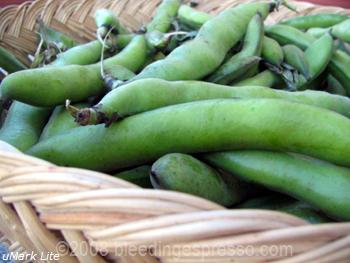
Snap off the top of the pod and pull down so the pod splits at the seam (or otherwise twist and turn the thing until you expose the beans):
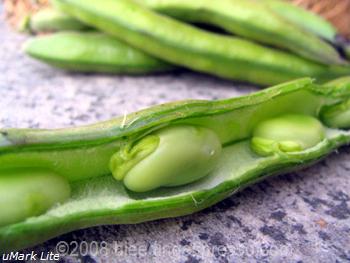
Remove the beans and throw away the pods so that you’re looking at a bunch of beans like this:
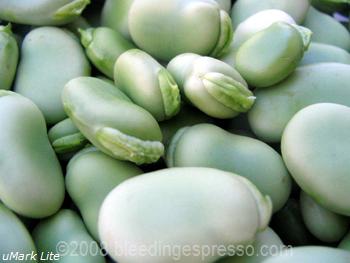
You’re not done yet! Now you have to take off the outer casing as well, otherwise you could be in for some nasty digestion issues later.
Susan recommends boiling the beans and then plunging them in ice water, but I just peeled off the little “handle” on top and then squeezed out the beans.
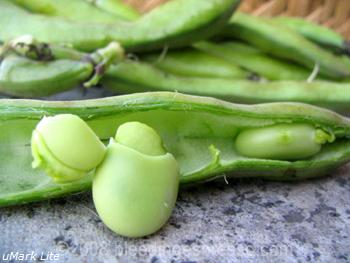
Now your favas are shelled and ready to eat raw or cook.
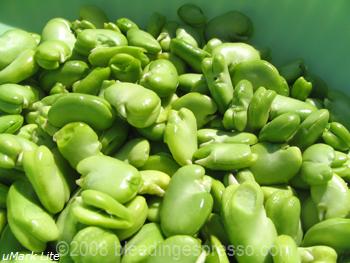
I told you. You have to want these.
If you’re in the right frame of mind, shelling favas can be an extremely relaxing experience as it was for me. Yes, my thumbs hurt a little bit afterwards, but you know what they say:
No pain, no favas.
They are worth it, I promise, especially since this recipe has only four ingredients. Easy peasy! Or, easy fava-y? And as I told P, it’s fava-loso.
OK I’ll stop now.
Calabrian sausage & fava beans
(Salsiccia calabrese con le fave)
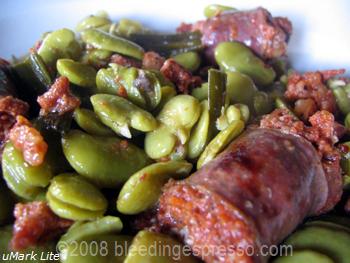
4 tablespoons olive oil
2 links of spicy sausage, cut into chunks
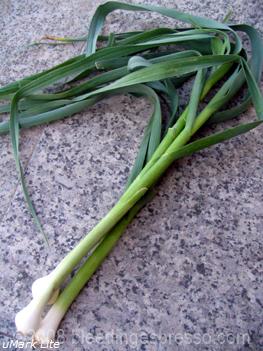
4 garlic sprouts, chopped
Pile of favas
Salt to taste
1. Heat oil in medium pan and add sausage. Let cook for about 10 minutes until the sausage releases some of its fat and flavor into the oil.
2. Add garlic sprouts and beans and cook until beans are tender but not overcooked, about 15-20 minutes, testing often.
3. Adjust for salt.
4. Serve with fresh, crusty bread, and this is a delicious, hearty meal on its own.
Notes:
1. The green attached to the end of this fresh garlic is what I mean by garlic sprouts. The first time P’s mom called these “code” (COH-deh) or garlic tails, I just had to smile. Isn’t that a great name? Don’t you love Italian?
2. I think this recipe would be great with tomatoes thrown in too, but P wasn’t feeling adventurous, so we did it without. Maybe next fava season.
Buon appetito!
Have you tried fava beans?
What’s your favorite way to enjoy them?
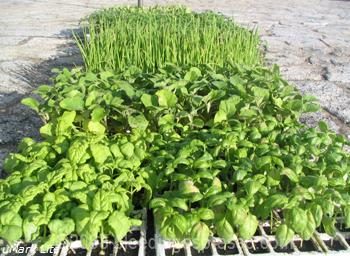
Tuesday Morning Market in Calabria: Part I
Every Tuesday morning, vendors of fruit,

vegetables,
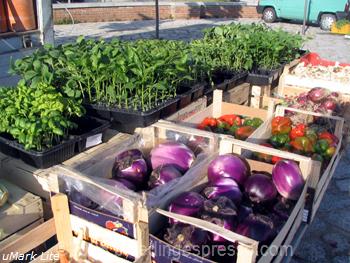
herbs,
meats and cheese,
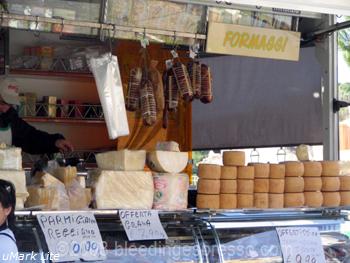
(especially local cheese)

hold a mercatino in the main square of the village.
And when I say morning, if you’re not there before 10 a.m., well, you’ll just have to wait until next week.
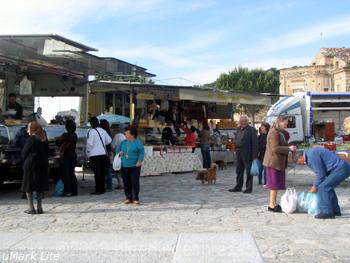
Speaking of which, be sure come back next Tuesday for Part II of Tuesday Morning Market in Calabria for a lesson from a pro in how to get a good deal and lots more photos!
What would you buy at the weekly mercatino in my village?
La Fontana della Vergogna – Fountain of Shame – in Palermo, Sicily
It’s Palermonday again! If you missed the first installment, please check out last Monday’s visit to Teatro Massimo as well.
Cherrye and I only had one full day to explore Palermo. We wanted to really get a feel for the city, so we decided to just walk around and see what we stumbled upon (with the help of some guidebook info of course).
As it turns out, Palermo is *fabulous* for walking because many of the major sites run along Corso Vittorio Emanuele, historically been the city’s most important street, and that’s the route I’m going to take you on.
We started at our hotel in the Piazza Marina area and headed away from the water and up the main street.
The gorgeous Piazza Pretoria was our first major find:
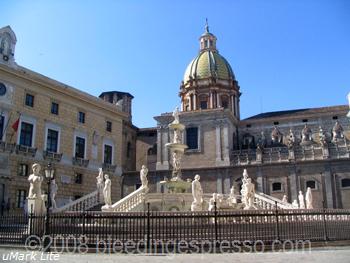
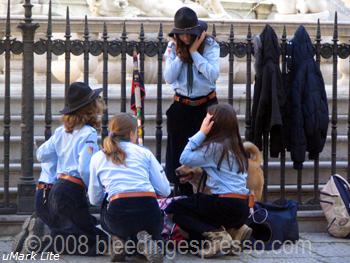
And we weren’t the only ones there.
One sweet girl from this troop actually came up to me and asked me where to find something–apparently there was a scavenger hunt going on.
But the only thing I really knew how to find was what was in the middle of Piazza Pretoria: La Fontana della Vergogna, or the Fountain of Shame, a work by Florentine sculptor Francesco Camilliani and Michelangelo Naccherino completed in 1555.
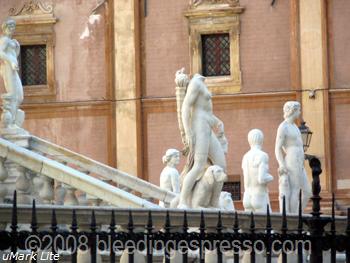
Why is it called the Fountain of Shame you ask?
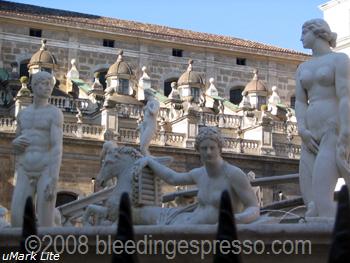
Well look at all that nekkidness!
You see, the fountain was originally intended for the private villa of the Viceroy Don Pedro de Toledo in Tuscany, where perhaps the 16 (nude) representations of gods and goddesses would’ve been more appropriate.
Let’s just say it didn’t go over so well in the middle of Palermo.
Piazza Pretoria is absolutely surrounded by churches, and as it turns out, the faithful weren’t too excited to come out of Mass and see such debauchery.
But to my 21st century eyes, the fountain and everything around it is simply amazing.
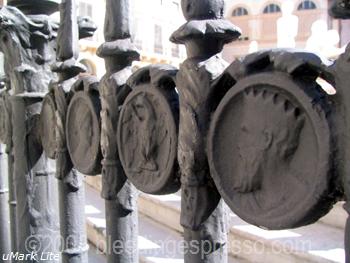
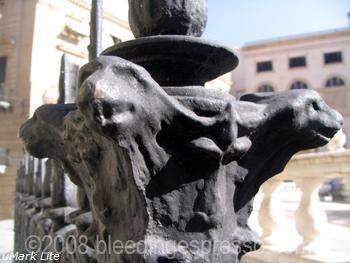
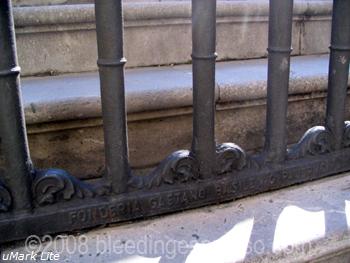
I even love the inscription telling us the name of the iron foundry responsible for protecting the fountain.
Grazie Fonderia Gaetano Basile!
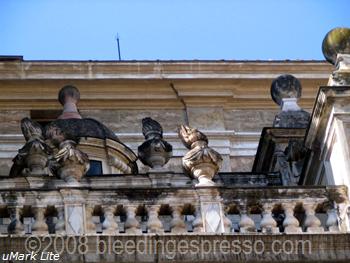
And here is some detail of the church across Via Maqueda (in the background of the first photo), Chiesa di San Giuseppe dei Teatini, designed by Giacomo Besio in 1612 with the dome added in the 18th century:
You might get the idea that Cherrye and I spent quite a bit of time in this square. We did.
It’s breathtakingly beautiful.
And since photos of the fountain at night are so lovely, I can only hope to get back to Palermo someday and see it all lit up in person.
Who’s coming with?
 Michelle Kaminsky is an American attorney-turned-freelance writer who lived in her family's ancestral village in Calabria, Italy for 15 years. This blog is now archived.
Calabria Guidebook
Recipes


