
Archive for 2008
What’s Cooking Wednesday: Calabrian Zeppole for St Joseph’s Day
 Happy St. Joseph’s Day! And to my dad, Happy Italian Father’s Day!
Perhaps you’re confused. That’s OK. You can read all about the Festa di San Giuseppe in last year’s post: Fava Beans and Cream Puffs. There you’ll also find a photo of my great-great-grandfather a.k.a. the reason I ended up in my charming village.
Auguri Papù and to all Josephs, Giuseppes, and dads out there!
Also to Giuseppinas, Josephines, and any others celebrating!
Also, if some of you happen to remember St. Joseph’s Day altars from childhood but are missing them right about now, check out this Virtual St. Joseph’s Day Altar. If you don’t have any idea what I’m talking about, read about this tradition.
Now . . . it’s time for zeppole.
Or as we say around here, zippoli.
As I noted in last year’s post, this word means many different things depending on where in Italy you are. This is a common phenomenon, and in fact, just last night I read a similar sentiment in Laura Schenone’s The Lost Ravioli Recipes of Hoboken: A Search for Food and Family:
“Prescinsêua cheese may mean one thing in the city, but to some contadini in the country it may mean something completely different.”
So, in that vein, some of you know zeppole as cream puffs, but there ain’t no cream in the Calabrian version. In fact, there are anchovies.
How’s that for una sorpresa if you’re expecting cream?
I have a very vague memory of my grandmother [perhaps] making these with anchovies when I was small, but the ones I remember best were simply coated in sugar while they were still hot.
Ah . . . zeppole memories . . .
Waiting patiently at my grandmother’s hip (seriously I was that high, or low I should say as she was under 5 feet tall) for these to cool down ever so slightly to dig in. She never got even near a platter-full before one batch was already gone. They’re that good.
Unfortunately for my recipe repertoire though, my grandmother didn’t make her own dough in her later years when kneading wasn’t possible; she always bought fresh dough from the *best* local pizzeria and bakery.
Indeed, she’d pick up the dough early Friday morning (during Lent especially), make pizzas throughout the day and then fry these babies up just as we were finishing up on the pizza. I cannot tell you how much I miss walking into that house on Friday afternoons after school.
MAMMA MIA . . . CHE PROFUMO!
So I went to a few sources for a recipe:
(1) P’s mom; (2) my friend Alida from nearby Isca sull’Ionio who I met in Philadelphia (she brought homemade biscotti to our first in-person meeting!); and (3) my dear friend Mary Amabile Palmer’s cookbook Cucina di Calabria: Treasured Recipes and Family Traditions from Southern Italy.
Between these wonderful women (grazie mille!), I am tasting exactly what I remember swiping off paper towels as a child. And now you can enjoy them too.
Zeppole con Alici o Semplice
(I Zippoli Calabrese)
Fried Dough with Anchovies or Plain

- 1 package active dry yeast or 10 g of fresh yeast
- 1 1/4 cups warm water
- 3 cups all-purpose or “00” flour
- 1/2 teaspoon salt
- Splash of white wine
- 1 small jar or can of anchovies
- vegetable oil for frying
- confectioner’s or regular sugar for dusting (if making plain version)
1. Dissolve yeast in 1/4 cup of warm water.
2. Put salt and flour in a mound on your working space, a wooden board if possible, although I use something like this like my grandmother used.
3. Make a well in the center and gradually add the dissolved yeast, remaining water, and wine pulling flour into the liquid as you go.
4. Knead for between 5 and 10 minutes until the dough is smooth, elastic, and “bella morbida” as my suocera kept saying–quite soft. If you’re used to making pizza, you may have recognized these ingredients; just make sure the dough here is softer than for pizza.
5. Put dough ball in oiled bowl, cover it with a towel, and put in a dry, warm place to rise for about 2 hours.
6. After the dough has doubled in size, take it out, and knead it for another few minutes. Then put it back in the bowl and allow it to rise again for another couple hours. This will make for fluffier zeppole, but if you don’t have time, just let it rise once. They’ll still be good.
7. In the meantime, if you’re using anchovies, prepare them by removing them from their container and draining oil. Cut them in two pieces so that they will fit into a pocket of dough that will end up being about the size of the palm of your hand once folded over.
8. Heat oil over medium heat.
9. Pull off small chunks of dough about golf-ball size, flatten, and stretch into a rectangle. Place anchovy or two inside and fold over, sealing edges well. If you’re making the plain version, simply stretch to dough to the size of the palm of your hand.
10. Fry in hot oil for 3 to 4 minutes, turning zeppole so they are lightly brown all sides.
11. Remove from oil with slotted spoon and place on paper towels to drain.
12. If you are making them without anchovies, dust them with sugar while they’re still hot–and if you’re like me and actually like the anchovy-filled ones with sugar as well (ssh–they think I’m very weird here for this), go right ahead!
Note you can also fill these with lots of other things. Raisins, for example, are delicious inside and then I recommend dusting with confectioner’s sugar.
Buon appetito!
The Ruins of Tindari, Sicily
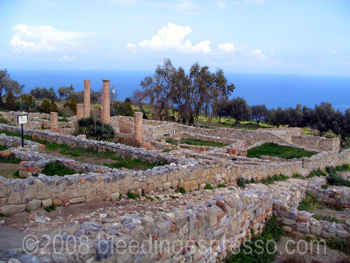
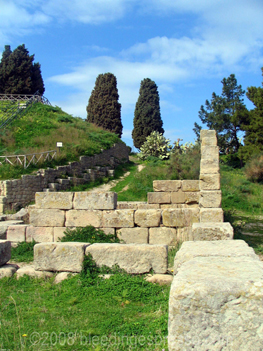 We’ve visited the Sanctuary of the Black Madonna in Tindari, and now it’s time to tour the ruins.
Tindari, ancient Tyndaris, is about 60 km from Messina and sits above the Tyrrhenian Sea with views of the Gulf of Patti and the Cape of Milazzo, a fabulous strategic position to control the waters between the Aeolian Islands and Messina back when there where pirates and whatnot.
Tyndaris was originally settled in 1500 B.C. but Dionysius I of Syracuse turned the settlement into a full-fledged Greek city in 396 B.C.
Tindari then came under control of the Romans in 254 B.C., after which most of the Greek infrastructure was modified or simply built over to accommodate the prospering city.
Other major events in the city’s history include an earthquake in 365 A.D., a landslide at the end of the 1st century A.D., and the construction of the Sanctuary of the Black Madonna sometime before the Saracens invaded the city in the 9th century.
By the 19th century, Tindari was abandoned, leaving behind only the Sanctuary and the ruins. Ready to see what’s left?
Here is the Greek amphitheater built in the 4th century B.C. and later modified by the Romans:
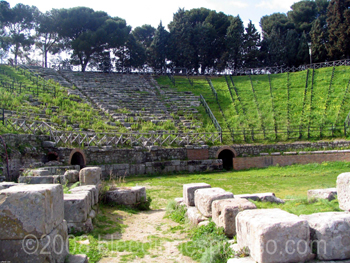
This once hosted some spectacular gladiator battles, but now it is home to the Tindari Estate (Summer) Festival. From late July through the third week of August, the old theater is full of life with poetry, music, dance, and play performances.
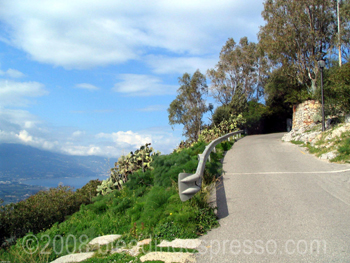
Incidentally, over the years, the theater was disassembled to make city walls, some of which are still in place; this is the walk up to the ruins with some of the old stones visible on the lower left:
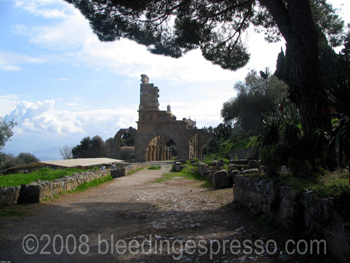
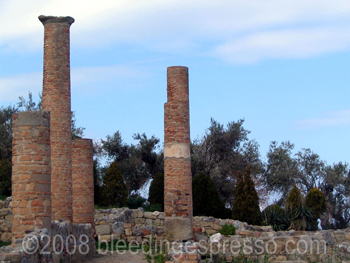
The site also contains the remains of an old basilica that, again, was erected by the Greeks in the 4th century B.C. but has been modified over the years, and even partially restored quite recently.
And then there’s everything else–remains of baths, houses, schools, and other buildings.
And the mosaics–can’t forget the mosaics.
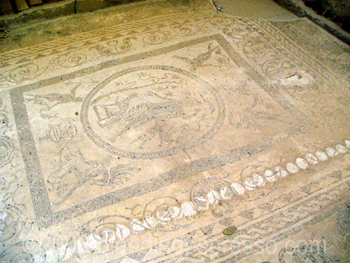
Here is the Sicilian symbol “Trinacria.”
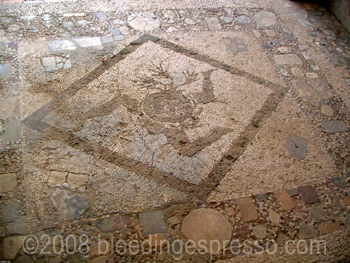
There are also animal mosaics–a fabulous bull and goat if you’re interested.
The complex also houses an Antiquarium–a museum that stores some of the treasures found at the site:

Doesn’t he remind you of my muse, Leonardo?
I could’ve spent *much* more time here, absolutely enveloped in peace and calm. The natural surroundings here are just amazing:
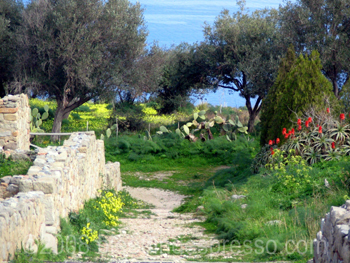
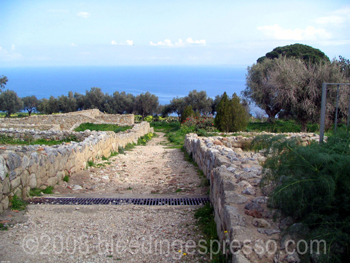
Between the ruins, the Sanctuary of the Black Madonna, and the gorgeous scenery, Tindari is simply a must-stop if you’re traveling through this part of Sicily.
Bring a picnic lunch and allowing yourself plenty of time to daydream.

Check out my Sicily 2008 Flickr collection for lots more photos of Tindari!
Celebrating St. Patrick with Vino & Co. in Palermo, Sicily
Today is the day when the Irish all over the world celebrate the patron saint of Ireland, St. Patrick.
Italia’s day is coming soon (Wednesday for San Giuseppe to be exact), but far be it from me not to join in the festivities with my Irish brothers and sisters.
After all, I may be just a wee bit Irish as I had a great-great-grandmother by the name of Maggie Kennedy.
I’m not into the green beer thing, I’m afraid, but I will offer up some vino for the occasion; how about a fabulous red from Vino & Co. in Palermo, Sicily?
I personally can’t think of a better excuse to take an empty 5-liter jug and head to a filler station like this one.
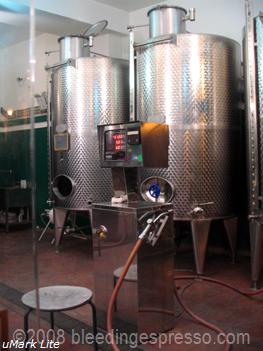
This was just a few minutes from our hotel, but unfortunately, Cherrye and I didn’t plan ahead and bring a container large enough–no regular old plastic bottles allowed.
But back to the green-themed day, I also found this page for those of you in need of some last minute party supplies that will also make you laugh as you’re browsing. The faces on some of these models are just hilarious.
And, I guess, effective because a lot of this stuff is actually sold out. Go figure.
Happy St. Patrick’s Day to those celebrating!

Familiar Eyes (Plus Limoncello Recipe) by Guest Blogger Susan Filson
 It’s time for another guest blogger! This month it’s Susan Filson of Sticky, Gooey, Creamy, Chewy, who I was lucky to stumble across during the World Nutella Day celebration.
Susan’s recipes are *fabulous* (indeed she won a judge’s prize for her Sogooditshouldbeillegal Triple Chocolate Nutella Semifreddo for WND) but her blog is so much more than simply food; after you read her amazing guest post, treat yourself to a cup of whatever you like best and a few hours immersing yourself in Susan’s beautiful words and photos.
Like her guest post below, you’ll quickly feel the love of la famiglia at Susan’s place; indeed some of my favorite posts of hers talk about her dear, departed father, her grandmother (and her gravy!), and her gorgeous daughter; like a true Italian, Susan makes you feel at home from the moment you arrive, so I do hope you’ll stop by for a visit.
——————–
When Michelle invited me to write a guest post on her wonderful blog, I was flattered. And excited! I’ve been enjoying her blog for some time, and I must admit, been living a bit vicariously through her.
You see, Michelle is living my dream.
I’ve always wondered what it would be like to pack up my life as I know it and start all over in the far off land of my ancestors. To let go of everything familiar and take a leap of faith!
Growing up in the flatlands of Florida, I’d always kind of felt a bit like a fish out of water – like I was incomplete. For as long as I could remember, I’d been yearning for some nameless, faceless thing, the mere definition of which, eluded me.
Don’t get me wrong. I’ve had a great life. I love my family and I’m pretty certain that the feeling is mutual. I’ve been lucky in love, at least after quite a lot of practice. I live in a community that many consider paradise – a very large playground for sun-starved tourists from all over the world.
Yet, if you strip away the balmy breezes, the glossy aquamarine seas and the technicolor sunsets, you are left with a place devoid of any real sense of posterity or ethnicity. A transient microcosm.
There is no permanence. No roots!

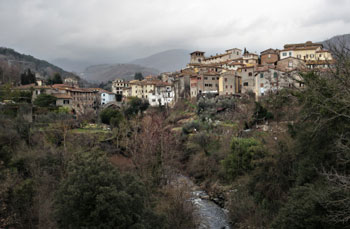
I think that, when you come right down to it, this “thing” that I’ve sought all along is all about finding my roots. My father was born in 1932 in a small town in Italy called Esperia.
Esperia is a picturesque little hamlet nestled in the hills of the Apennines, halfway between Cassino and the Tyrrhenian Sea.
Because of its location between the beach at Anzio and Monte Cassino, Esperia had a prime front row seat for a lot of WWII action. The little town was part of the Nazi occupation during the latter part of the war and was right smack in the middle of many of those last battles between the Allies and the Germans.
Dad never spoke much about it, but over the years, he would occasionally let something slip about the many atrocities he witnessed and suffered there. Even as a young child, I could tell that it affected him deeply.
When Dad immigrated to this country in 1956, he never looked back. Although his father died when he was four, he still had his mother, brother and two sisters back in Esperia. He would write to them often and of course, send money, but he absolutely refused to go back – not even for a visit.
In 1971, he sponsored his youngest sister and her family’s emigration to the US, and in 1980, he brought my grandmother over for an extended visit, but that was it.
For most of my life, I heard about aunts, uncles, cousins – all just names without faces. We would all beg and cajole him to take us on an Italian holiday; to meet our family, but he stood firm. It was over thirty years before he finally relented and agreed to go home. I don’t know what change his mind. Maybe he had finally healed enough.
I was elated to finally make the trip. By then, I had a four-year-old daughter of my own, and I desperately wanted her to know her culture and heritage.
I began to plan.
There were ten of us: my husband, daughter and I, my parents and my brother and sister-in-law. We would be gone for a month, half the time traveling on our own and half the time together in the home town.
During the first half of our trip, we went to Stresa, Bellagio, Venice, Florence and Rome. Each city wove its own magic around us. I couldn’t honestly tell you which place I liked best. They were all so different . . . and so wonderful. I could write volumes about all of the amazing experiences we had (and the phenomenal food!) everywhere we went, but I’ll save that for another time.
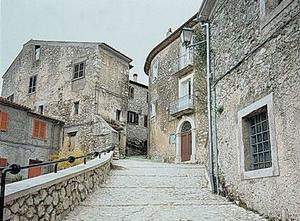
When our train finally rolled into Esperia, my anticipation had reached epic proportions! Apparently the townspeople were just as curious about us. It was a mob scene! It seemed that my father had become somewhat of a legend in their own minds and everyone from miles around had come to catch a glimpse of the native son who “made good” in America.
By the way, one thing I learned over there is that the Italian trains don’t actually come to a complete stop at every little station. When they go through a really small town, they merely slowwww down to a crawl. If you need to get off, you have to toss your bag out ahead of you and make a well-calculated jump onto the platform.
Anyway, there we were, being rushed like celebrities, when my gaze caught hold of a pair of familiar eyes. What the . . . they were . . . my eyes!
On the other side of those eyes stood a lovely and stylish young woman with long, dark, wavy hair. My hair!
I was mesmerized. It was almost like looking in a mirror, except that she had better shoes! The woman was my cousin Renata. I could tell by the look on her face that she was a little thrown too.
We greeted each other, Italian-style, with a kiss on both cheeks. My Italian was weak. Her English was worse. Somehow, we managed to become fast friends.
Over the course of the next two weeks, I saw more familiar eyes, familiar noses, mouths and ears. I just can’t quite describe how it felt to find these people – my people – living on the other side of the world all this time, and yet, I never knew them. These people who not only had similar physical features, but also looks, gestures and mannerisms. I saw not only myself in them, but my father, brother and even my little daughter as well.
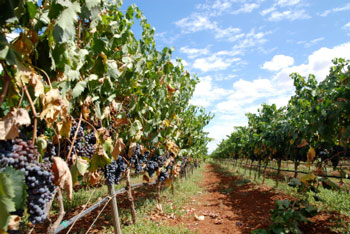
We spent halcyon days enjoying each other’s company and the natural beauty around us. I wished I could absorb it right into my pores!
There were vineyards and olive groves and fig trees with gorgeous figs the size of your fists, dripping with sticky sweetness. We ate spectacular meals together, featuring olive oil made with the olives from our groves. The homemade wine from our own grapes flowed freely. It was bliss.
I was complete.
One of the treats we enjoyed every day as we sat outside under that big fig tree was ice cold Limoncello. Limoncello is an Italian citrus-based lemon liqueur that is very popular all over the country, especially in the warmer months.
Limoncello is made by the infusion of lemon skins in pure alcohol, to which a sugar syrup is added. Authentic Limoncello is made from Sorrento lemons, which come from the Amalfi Coast, but you can use any lemons you have access to.
Here is the recipe I like to use:
Limoncello
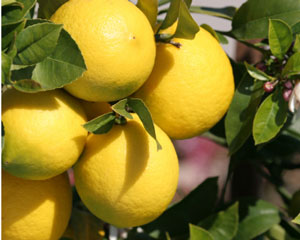
15 lemons
2 bottles (750 ml) 100-proof vodka *
4 cups sugar
5 cups water
* Use 100-proof vodka, which has less flavor than a lower proof one. Also the high alcohol level will ensure that the Limoncello will not turn to ice in the freezer.
Wash the lemons with a vegetable brush and hot water to remove any waxy reside. Pat the lemons dry.
Carefully peel the lemons with vegetable peeler so there is no white pith on the peel. Use only the outer part of the rind. The pith, the white part underneath the rind, is too bitter.
Step One:
In a large glass jar, add one bottle of vodka. Add the lemon peel. Cover the jar and let sit at room temperature for at least 10 ten days and up to 40 days in a cool dark place. The longer it rests, the better the taste will be. Gently shake it around a little every couple of days. As the Limoncello sits, the vodka slowly takes on the flavor and color of the lemon zest.
Step Two:
In a large saucepan, combine the sugar and water. Cook into a thick syrup, about 5 to 7 minutes. Let the syrup cool and it to the Limoncello mixture. Add the additional bottle of vodka. Allow to rest for another 10 to 40 days.
Step Three:
After the rest period, strain and bottle: discarding the lemon zest. Keep in the freezer until ready to serve.
Salute e ciao!
—————
Please feel free to leave comments for Susan here or over at her place!
love thursday: gifts and bees
* Hurry and sign up! The Ultimate Blog Party ends tomorrow!*
*Also: Get over to i-Mommy’s place for a fun game giveaway!*
This Love Thursday I’m celebrating gifts and bees.
Burt’s Bees, that is, and a lovely gift of their products from a dear blog friend, Geggie of So . . . What Else, What Else, What Else?
You see, a little while ago, I helped Geggie out with a small blogging issue, and she said she’d send me a thank you gift. And boy did she ever.

Hand soap, hand sanitizer, body wash, shampoo, lip balms, lotions, cremes, and even an adorable bee-covered shower cap–and two travel cases to boot!
I am now an official Burt’s Bees addict after only a few days of the all-natural stuff; as I told Geggie, I just can’t stop sniffing my hands after washing them with the Citrus & Ginger Root hand soap. So lovely!
Anyway, for this Love Thursday I am not only expressing my love of Burt’s Bees products (by the way, woohoo Durham, NC, my home for 4 years!), but also thanking Geggie, encouraging you to go over and visit her, and letting you know that our generous Geggie, through the Ultimate Blog Party, is also giving away $100 worth of products from Burt’s Bees Naturally Ageless skin care line (#91 on the prize page)–you just need to sign Mr. Linky at the Ultimate Blog Party to enter.
And that’s why I’m celebrating gifts and bees today.
Happy Love Thursday everyone!
 Michelle Kaminsky is an American attorney-turned-freelance writer who lived in her family's ancestral village in Calabria, Italy for 15 years. This blog is now archived.
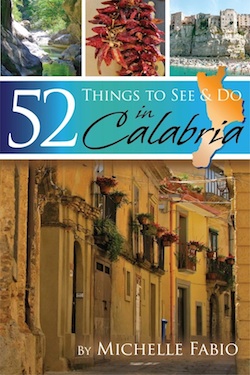
Calabria Guidebook
Recipes


