
Archive for 2009
Freelance Writing Week: 5 Tips for How to Find and Develop Your Freelance Writing Niche
Welcome to Day 3 of Freelance Writing Week! So far we’ve covered:
 Now it’s time to talk about how to find and develop your freelance writing niche.
But you may be asking yourself whether you really need a niche.
Look at this way: You’re an editor looking for someone to write an technical article on iPhone applications. One applicant has a long list of writing credits about technology and the other has clips all about Hollywood gossip and fashion.
Sure it’s entirely possible the gossip/fashion writer knows a lot about iPhone applications, but which writer would you go with?
That’s why you need a niche.
You want to be *the* person an editor thinks of when an assignment in your niche comes up, and you also want your readers to trust what you’re writing because, hey, you’re an expert!
Now you don’t need to focus so narrowly that you put yourself out of the running for many gigs, and you certainly don’t need to stick with only one niche. Look at me, for example. I’m an attorney who lives in Italy. Right there that gives me two big possible niches:
1. Law/law school: I write for LegalZoom and am the About.com Guide to Law School.
2. Italy: I write for Italy Magazine, easyJet, and Italian Notebook.
I could also write about expat life if I so choose, although that’s something I’ve really only touched on here at Bleeding Espresso. Hmm….
So that brings us to the first of:
5 Tips for How to Find and Develop Your Freelance Writing Niche
 1. Make a list of words that define you.
Sounds kind of cryptic, but all I really mean are things you are or like to do such as “mom,” “former cheerleader,” “engineer,” “cyclist,” “antique dealer,” etc. The old adage is “write what you know,” and that’s never more true than in narrowing down your freelance writing niches.
There are writers’ markets for just about every niche you can imagine, so be as comprehensive as you can when listing your areas of expertise.
2. Make a list of things you’re interested in learning more about.
OK, we’re already straying from “write what you know,” but I think this is worth exploring. Just because you’re not an environmental scientist doesn’t mean you can’t write intelligently on the environment, right? You can learn more *and* get paid to do it as well.
See Tip #5 for more on how to become an expert on something you are only currently learning about.
3. Make a list of the publications, websites, and blogs you like to read.
What do they talk about? Could you talk about it too? Chances are a lot of these topics will overlap with those in the first two lists you’ve made–that’s a good thing because it means you’ve been researching your niches all this time and you didn’t even realize it.
Also, be sure to keep this list as it’ll come in handy when it’s time for you to explore potential writing markets.
4. Find publications, websites, and blogs that focus on the topics you’ve listed so far and read them regularly.
The more informed you are about your niche, the better. Not only will you be up to date on the latest developments and information, you’ll also get a feel for the way articles and posts are written in your niche.
For example, a beauty care tip blog most likely isn’t written in the same way a political blog would be. Allow the different styles of writing to seep into your subconscious so it will be easier for you to write similar pieces later.
By now you’re probably thinking, fine! Niche! Got it! Now when do we get to *write*? Right now.
 5. Start a blog.
Or, if the subject matter flows, start using your existing blog to start testing the waters of your niche. This is an especially useful tip if you don’t have any writing credits in a particular niche or any writing credits at all. Brand spanking newbies, I’m talking to you!
For now, don’t worry about readership (although that’s a nice bonus). What you’re really looking for is a platform in which to publish your writing to start getting you recognized as an expert in your niche; at the very least, you’ll have somewhere to point potential employers when they want to see samples of your writing. I know many say they want “published” samples, but hey, published on your blog is better than nothing at all, isn’t it?
Now this tip also works for more established freelance writers as well. If you’re ready for a new niche but are having trouble breaking in, write about it on your blog.
For example, I’ve recently started the Going Green series here at Bleeding Espresso. I don’t think I’ve published anything particularly “green” anywhere else, but now if I want to apply for, say, an environmental blogger position somewhere, at least I’d have something to back that up.
And in case you’re wondering, yes, I *have* gotten job offers purely based on my blog (including one from Publishers Weekly that I couldn’t do because they won’t send books abroad…boo!), so never underestimate the power of a blog.
And hey, at the very least, through your blog, you’ll be working on your writing skills–and that’s never a bad thing.
OK, I think we’re finally ready to go job hunting, don’t you? Come back tomorrow for How to Find Freelance Writing Jobs!
If you haven’t already, be sure to subscribe through an RSS feed so you don’t miss a single Freelance Writing Week post.
Also free free to bookmark, Stumble, and share these posts with friends via email, your blog, and Twitter. The more people we have reading them, the more ideas and suggestions we can come up with in the comments. We freelance writers have to stick together!
What do you think your niche(s) are or might be?
Freelance Writing Week: Freelance Writing Resources
You’ve read yesterday’s Freelance Writing Week post, Is Freelance Writing For You? and you’ve answered a resounding “Yes!”
So now what?
Well before you start looking for jobs, I highly recommend doing a bit more research about how freelance writing works. You’re off to a great start by following Freelance Writing Week here, but let me point you to some of my favorite freelance writing resources in print and on the web:
My Favorite Freelance Writing Resources
Freelance Writing Books
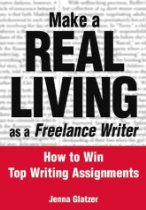
- Make a Real Living as a Freelance Writer by Jenna Glatzer. Hands down my favorite freelance writing book. Glatzer breaks down each and every part of freelance writing in simple and easy to follow chapters; her writing is clear, entertaining, and best of all, inspiring. I find myself going back to this book periodically whenever I need to get re-motivated to continue freelance writing–and it always delivers.
- The Street Smart Writer: Self Defense Against Sharks and Scams in the Writing World by Jenna Glatzer and Daniel Steven. Another great one by Glatzer with straight-forward advice, this time on the business end of writing. Excellent tips on how to protect yourself and your work.
- 2010 Writer’s Market by Robert Lee Brewer. Markets, book publishers, agents, and lots of advice from successful writers. The 2010 version will be published in June, but if you can’t wait, the 2009 version is still available.
- On Writing by Stephen King. This one isn’t necessarily about freelance writing, per se, but it’s one of the best books on writing in general out there. Period.
Also be sure to check out the “Writing” category in my Amazon store for more great writing books.
Freelance Writing Websites
- About.com Freelance Writing: pages upon pages of awesome advice on every aspect of freelance writing by Allena Tapia.
- About Freelance Writing: Anne Wayman‘s blog in which she shares what she has learned as a copywriter, ghostwriter, blogger, e-book author, and more. Great job lists too.
- AbsoluteWrite.com: started by the aforementioned Jenna Glatzer; be sure to check out the forums in particular.
- Freelance Writing Jobs: Deb Ng‘s amazing collection of articles and advice on all different types of freelance writing; great job lists as well.
- WOW! Women on Writing: “an e-zine promoting the communication between women writers, authors, editors, agents, publishers, and readers.” Fun place too!
- WritersWeekly.com: Angela Hoy‘s site with lots of great articles, but especially helpful are the forums, namely “Whispers and Warnings,” which tells you which clients to avoid.
There are really lots of writing sites I love, but these are the absolute best, IMHO. I also have favorite writing books, which you can see in the writing section of my Amazon store.
Now I’m not saying you should read all of these straight-through before you dive into freelance writing, but a quick look around them will certainly help you get a feel for the business. All of these are great to keep coming back to again and again whenever you need a particular piece of info, advice, etc., so be sure to bookmark!
Now be sure to come back tomorrow when we’ll talk about How to Find Your Freelance Writing Niche!
If you haven’t already, be sure to subscribe through an RSS feed so you don’t miss a single post of Freelance Writing Week!
Also free free to bookmark, Stumble, and share these posts with friends via email, your blog, and Twitter. The more people we have reading them, the more ideas and suggestions we can come up with in the comments. We freelance writers have to stick together!
Please share your favorite writing resources in the comments!
Freelance Writing Week: Is Freelance Writing For You?
Welcome to Freelance Writing Week at Bleeding Espresso!
 If you’re interested in freelance writing, even as a part-time gig, this is the place for you.
All this week I’m going to share what I’ve learned about freelance writing over the past six years. I’m basing the posts on questions I remember having when I was starting out and also those asked in my Questions post a little while back. If you’ve thought of more questions on freelance writing, please share them in the comments!
OK, so as I see it, the first step in pursuing a freelance writing career is figuring out whether freelance writing is really for you.
Just like not everyone was cut out to be a doctor or lawyer, not everyone is meant to be a freelance writer. I personally love the freedom of researching and writing from home on assignments that interest me, but not everyone enjoys such work, a lack of structure, and a solitary working environment.
Here are:
Five Characteristics Every Freelance Writer Should Have
(Or Be Willing to Work On):
1. Good writing and grammar skills. You don’t need to know everything right now, but it certainly helps to know the basics. If you’re not sure whether your writing is effective and more or less grammatically correct, ask someone whose writing you like to read and critique it.
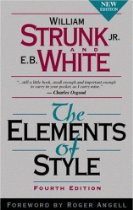 Also, I always keep two books handy: a good dictionary and The Elements of Style by William Strunk, Jr. and E.B. White.
2. Self-motivated. No one will know if you show up for work except you (and your bank account), so you really have to be able to push yourself to work when you’d rather be flipping through magazines or, ahem, out walking the dogs (or baby goat).
My best advice is to keep a regular work schedule just as you would if you had an office job, and if you want extra time off here and there, work ahead to earn it.
Some people also suggest you dress for work as you normally would as well, but I personally work much better in comfy track suits and also spend zero time getting ready for work in the morning, which leaves me more time to write, take walks, and read magazines. But if you feel and, most importantly, work better in a suit, have at it!
3. Determined and not easily discouraged. Rejection is a part of the freelance writing business for *everyone.* Don’t take it personally.
You’ll apply for far more jobs than you’ll secure, and you’ll send out far more query letters than assignments received. That’s normal. Just keep pushing ahead and building a name for yourself and eventually the work will come to you. Really!
I know, I didn’t believe that either when I started out–until I received some job offers based on writing I’d done elsewhere. Your reputation does precede you, so be sure to always put your best effort out there.
4. Reliable and responsible. Show your clients that you deliver quality work on-time, and you’ll quickly build a good reputation among editors.
Yes, sometimes life happens and you’ll need an extension; most clients will understand that–so long as it only happens once in a while. Simply contact your client and let them know ahead of time, and they’ll appreciate your professional attitude.
 5. Organized. As a self-employed person, you have to keep track of everything including assignments, due dates, research, invoices, tax information, and more, so if you’re naturally scatterbrained and not willing to work on being organized, freelance writing may not be the best career choice for you.
I keep an editorial calendar for each month to keep assignments straight and often work in blocks of time, e.g., research for a half hour on one assignment, invoicing for ten minutes, email for fifteen minutes, write another assignment for a half hour, etc. It not only keeps me organized, it also allows me to reward myself for good behavior throughout the day and keeps me motivated.
Be sure to come back tomorrow for Great Freelance Writing Resources to Get You Started!
If you haven’t already, be sure to subscribe through an RSS feed so you don’t miss a single Freelance Writing Week post.
Also free free to bookmark, Stumble, and share these posts with friends via email, your blog, and Twitter. The more people we have reading them, the more ideas and suggestions we can come up with in the comments. We freelance writers have to stick together!
What do you think are the most important qualities freelance writers should have?
Are Crocs Dead in the Water?
 I’m neither a Crocs lover nor hater, but when I saw this headline on MSNBC.com and literally LOL’ed (because of the title, not the subject matter), I just had to share it:
Is the ugly shoe craze about to end?
Crocs auditor questions whether plastic shoe maker can survive
The article discusses how Crocs Inc. lost $185.1 million last year with revenues down almost 15 percent. Two years ago, Crocs had 5,300 employees but at the end of last year, that number was down to 3,700; in particular, manufacturing facilities in Canada and Brazil were closed.
Sounds like Crocs may become another victim in this down economy where people simply have less disposable income to dispose on, say, plastic shoes.
Disclaimer: I actually do own two pairs of fake Crocs bought for 5 euros each at a Chinese store here in Calabria, and I must say they are super comfortable and were a great transition shoe from summer flip-flops to winter boots.
Now I want to know what you think:
Are you going to help keep Crocs in business or what?
Buon weekend!
Love Thursday: Direct from a Southern Italian Beach
Today’s love-filled photos come directly from the a southern Italian beach town, the home of Charlie, who writes the blog Figs and Lemons and sells amazing soap products at Saponissimo.
Our dear Charlie snapped these gorgeous photos, and sent them to me with this lovely message:
I found this stone on the beach and thought of you!!!
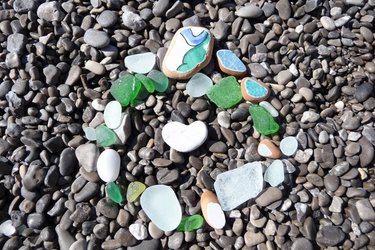

Whee! Love *is* all around!
Anyone else dreaming of a vacation on an Italian beach now?
Happy Love Thursday everyone!
And Happy Italian Father’s Day Dad!
 Michelle Kaminsky is an American attorney-turned-freelance writer who lived in her family's ancestral village in Calabria, Italy for 15 years. This blog is now archived.
Calabria Guidebook
Recipes


