
Archive for 2009
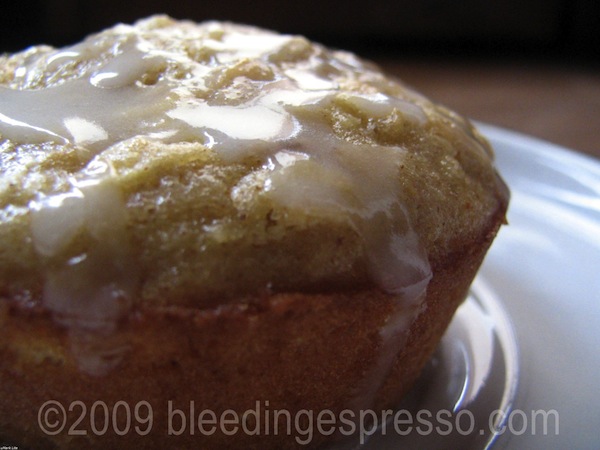
What’s Cooking Wednesday: Glazed Apple Oatmeal Cinnamon Muffins
 One of the American magazines my mom so generally sends me from time to time is All You. Have you heard of it?
I *love* this magazine. The writing is casual and comfortable, and it includes many ideas that I’m actually likely to use–not just things that although I find interesting would never attempt.
One of those fabulous ideas was an easy recipe for Apple-Cinnamon Cupcakes in the December 26, 2008 issue, and this week’s What’s Cooking Wednesday recipe is my adaptation.
Aside from making delicious muffins, this recipe doesn’t make very much–so it’s great for those of us who will have to eat most if not all of the muffins ourselves.
I added oatmeal to make them a bit more muffiny as opposed to cupcakey and also to add more nutritional value, although as they were, these were actually respectable as far as sweets go (nutritional information is listed in article on page 114). These came out extremely moist and quite dense–just the way I love baked apple cakes, er, muffins.
Plus I figure with the oatmeal, these are now totally OK for breakfast, right?
Glazed Apple Oatmeal Cinnamon Muffins
(makes 5-6 muffins)

For muffins:
- 3/4 cup flour
- 1/2 cup sugar
- 3/4 teaspoon baking powder
- 3/4 teaspoon cinnamon
- Pinch of salt
- 1 egg
- 1/2 cup milk
- 1/4 cup vegetable oil
- 1/2 teaspoon vanilla extract
- 1 large Granny Smith or other tart apple
- Juice of half a small lemon
- 1/2 cup oatmeal
For icing:
- 1/3 cup confectioner’s sugar
- 1 tablespoon lemon juice
1. Preheat oven to 375°F.
2. In a large bowl, mix together dry ingredients for muffins.
3. In a small bowl, whisk together egg, milk, oil, and vanilla, and stir into dry ingredients until just combined.
4. Peel and grate apple into fine mesh sieve over the sink, being careful to stop before hitting the core. Squeeze in lemon juice and mix to distribute among apple.
5. Stir apple and oatmeal into muffin mixture.
6. Grease muffin pan and fill muffin cups 2/3 full. Bake until golden and toothpick inserted in center comes out clean (about 20 minutes).
7. Let muffins cool for five minutes then remove and place on wire rack.
8. Meanwhile, in a small bowl, whisk together confectioner’s sugar and lemon juice, and then drizzle over muffins.

Buon appetito!
P.S. Remember today is Pesce d’Aprile in Italy!
For more fun, check out April Fool’s Backfires!
A Day in the Life of Pasqualina
It’s been a while since I’ve talked about our kid Pasqualina, but rest assured she’s still around, bringing us kid love in new ways each and every day.
I’m happy to report she is doing fabulously–she’s fully weaned and is eating a combination of feed designed for weaning time, barley, and, of course, fresh grasses. And she even drinks water now. So cute!
I know, yeah yeah yeah. You want photos. Enjoy!
Pasqualina out to pasture:

Peek-a-boo:

Eccola! (Here she is!)

Getting sleeeeepy (YES! Goats yawn! Who knew?):

And Pasqualina taking a little snooze before we finish our walk:
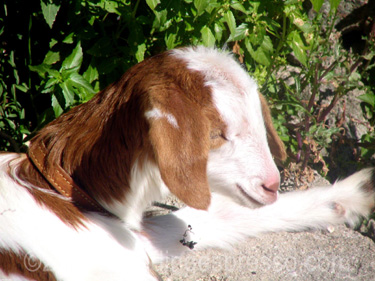
So does she look like she’s growing?
Guest Blogger and Book Giveaway: Sybil Baker, Author of The Life Plan
 Fresh off Freelance Writing Week, we’re going to keep the writing theme going just one more day with a guest post from Sybil Baker, author of The Life Plan.
Sybil is the first author to appear here through blog tours with WOW: Women On Writing, and hopefully there will be many more to come.
This book tour caught my eye in particular as Sybil is an ex-expatriate who spent 12 years teaching in South Korea; she says her experiences as an expat greatly shape her writing, and I was looking forward to seeing that come through in her book.
And indeed it does.
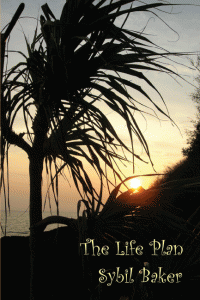 Her novel, The Life Plan, is about Kat Miller’s carefully planned life falling apart and her efforts to salvage it, which include going to Thailand with Dan, her unemployed husband of five years. Dan has recently been spending a little too much time at yoga class with a beautiful classmate, so when he suddenly signs up for a massage course in Asia, Kat just had to gowith him. With scenes in Washington D.C., Bangkok, and Chiang Mai, the book traces Kat’s search to have it all, whatever that ultimately means.
When I joined the blog tour, Sybil kindly sent me the electronic version of her book to have a look-see, and I may or may not be guilty of minimizing “work” computer windows to catch a peek at what Kat and Dan are up to throughout my workday. I was hooked from page one, and I think this is why e-books are dangerous for me. It’s *way* too easy to click over to the book while I’m supposed to be working!
Sybil has also kindly offered a signed print copy of The Life Plan to one lucky Bleeding Espresso reader; to be eligible for the book drawing:
Leave a comment on this post at or before 11:59 p.m. (Italy time) on Sunday, April 5.
Now here’s Sybil:
The Expatriate Writer in the Post Millennium
 When I moved to South Korea in 1995, the internet was just getting started, email was a few years a way, and beepers—not cell phones—were the “must have” item by my students. Once a month I would write a long letter on notebook paper and then photocopy it before mailing the copies to family and friends. My family called once after we arrived, but when my father got the phone bill, he decided he could live with letters.
Those first few years in South Korea, my life was not much different from expatriate writers twenty years ago. I was cut off from my own country, immersed in a very different culture, and forced to communicate using a language I barely knew. I didn’t have a computer, and instead wrote in my notebook. I didn’t know any other aspiring writers, which was a nice change from the States, where it seemed at least two other people at every party I went to wanted to be a writer. I could work on my writing in a strange quiet, within the demands of living in a different country but also without the “noise” of distractions in the States.
Another expatriate writer, Robert Eversz, who lived in Prague during that time said the same thing when I interviewed for an essay on American expatriate literature for The Writers’ Chronicle. His Nina Zero novels take place in LA, which he visited once or twice a year. But Eversz told me that if he lived in LA he wouldn’t be able to write about it because he’d had sensory and information overload. For those first seven years in Korea I wrote about the States—the South that I had left and the characters that lived in that world.
Then in about 2002, I finally wanted to write about Korea and the other countries I visited. By then I had a computer and my notebook was more for planning than anything else. I was living in Seoul, which was becoming more international by the day and less isolating. I could watch Sex and the City, Friends and other popular American TV shows, and the internet connected me to music, movies, and the news that I’d been away from. Suddenly, the advantages of being an expatriate writer were becoming liabilities. I had no one around to read my work and give me feedback. Even with the internet, it was hard to keep up with new work and writers in the States, to figure out where to send my work out. And sending work out from Korea was complicated, time-consuming, and expensive. My self-imposed exile as a writer was no longer freeing but isolating. To resolve this problem, in 2003 I enrolled in Vermont College’s low residency MFA program. I was able to enjoy living abroad but also become connected with writers in the States, to have my work looked at seriously, to catch up on the books I missed.
When I graduated with my MFA in 2005, Seoul was one of the most wired countries in the world, Koreans watched TV shows on their cell phones, and I could chat with my family for free and see them on video using Skype or MSN messenger. Literary journals were starting to appear online, and I’d met a few other writers in Seoul. I now live in the States again, but life for expatriate writers is much different. Blogs allow writers to keep up with the publishing industry, to read about new work and trends. Many journals now take electronic submissions. Online journals are increasing in number and quantity. Online writing communities are sprouting up everywhere.
It’s much easier for an expatriate writer to feel connected to other writers in the States and around the world. In many ways that’s a good thing, although if you fantasize about living as an American expatriate removed from the United States writing scene, you should probably unplug your computer, turn off your cell phone, and take out pen and paper because otherwise, almost wherever you live, you won’t be able to duplicate the expat writer’s life of Hemingway or James Baldwin or Paul Bowles. These days, even my writer friend living in Kabul has internet.
Thanks so much Sybil!
Now I ask all of you: Do/did you have a “life plan”?
Remember to leave a comment to be eligible to win a copy of The Life Plan!
Freelance Writing Week: How to Find Freelance Writing Jobs: Job Ads and Cold Calls
Welcome to the final day of Freelance Writing Week! So far we’ve covered:
- Is Freelance Writing For You?
- Freelance Writing Resources
- 5 Tips for How to Find and Develop Your Freelance Writing Niche
- How to Find Freelance Writing Jobs: Query Letters
 Now it’s time to talk about two other ways you can find freelance writing jobs: job advertisements and cold calls.
* Job advertisements *
Another way to find freelance writing jobs is by scouring job advertisements. This is my preferred method, and it’s the way I’ve had the most success. You’re looking for jobs in your niche(s), and also those in your experience level and desired pay range.
Job ads may be looking for someone to write a specific piece or to become a regular writer; whether you or the editors will come up with story ideas varies by publication.
When responding to ads, you’ll need something like a cover letter—although it may not really “cover” anything as many employers don’t ask for resumes. Regarding resumes, I say don’t send one unless it’s requested; in fact, avoid sending attachments at all unless requested.
In your response, summarize the highlights of your resume in a three or four paragraph e-mail. My e-mails in response to job ads generally go like this:
1st paragraph: Tell them where I saw the ad and one sentence as to why I’m perfect for the job.
2nd and possibly 3rd paragraph: Specific qualifications for job (education, previous writing credits, organization memberships, other work experience).
Last paragraph: Thank them for their time and consideration, etc.
I recommend keeping this e-mail short and sweet—not so short that you don’t explain why they should hire you, but not so long that the reader gets bored halfway through either. People hiring writers generally want someone who can say a lot in a short space, and the place to start proving you can do that is in your introductory e-mail.
My personal tip: if you have previous writing credits you think would help land the job, link to them even if they didn’t ask for them; I firmly believe people are naturally click-curious when they see links. On that note, be sure to include links in your e-mail signature, even if it’s only to your personal blog.
Some of my favorite online job sites:
- About Freelance Writing
- Freelance Writing Jobs
- Morning Coffee Newsletter from Freelance Writing
- ProBlogger Job Board
I personally have never used paid services like Elance or Guru, but I have freelance friends who have and have enjoyed success with them–just be willing to dig for good clients, I’m told.
* Cold calls *
 This is what I call letters (or, more likely e-mails) to publications offering to write for them. This is slightly different from query letters as you’re pitching yourself in general as opposed to offering particular ideas, but they’ll actually read pretty similarly.
For example, let’s say that I come across a site selling property in Calabria that severely lacks information on the region. They aren’t advertising for writers, and I don’t know if they’d even hire any, but I think, “Hey, I wonder if they could use someone like me?”
So I whip off an e-mail explaining I’m a full-time freelance writer who has lived in Calabria for nearly six years and built a successful website largely based on my experiences here. I include links to a few of my best posts most tailored to their site, perhaps offer photographs, cross my fingers, and wait.
You probably won’t see *huge* success with this method, but you never know, so why not give it a try?
This is yet another reason why I think aspiring freelance writers can benefit by having a blog—even if you don’t have writing credits per se, at least you have something out there somewhere.
My writing career picked up significantly right around the time I started gaining blog readers; it could be merely a coincidence, a function of my confidence level rising, or maybe employers saw me as a more serious writer. Whatever it was, it worked, so I highly recommend it.
So now that I’ve led you to job sources, it’s time to talk money, but we’re out of time for Freelance Writing Week. We’ll take a break from freelance writing tips next week, and the following week is Easter, which means special holiday posts. So right now it looks like Freelance Writing Week II will be April 13-17. Don’t worry—I’ll remind you!
What is your preferred method of finding freelance writing work?
Thanks so much for reading all week!
Buon weekend!
Freelance Writing Week: How to Find Freelance Writing Jobs: Query Letters
Welcome to Day 4 of Freelance Writing Week! So far we’ve covered:
- Is Freelance Writing For You?
- Freelance Writing Resources
- 5 Tips for How to Find and Develop Your Freelance Writing Niche
 Finally we’re at the point where you’ve all wanted to be since Day One. It’s time to go job hunting!
As I prepared this post, I realized it became too long for just one day, so I’m splitting it up into two posts, which means we’re simply going to have to Freelance Writing Week II—all about money.
I already have five post ideas about freelance writing pay to fill up the week, but if you have specific questions, please include them in the comments so I can address them as well.
Now, back to:
How to Find Freelance Writing Jobs
First of all, please note that a lot of your time as a freelance writer will be spent finding work, at least when you’re starting out. This is just something you *have* to make time for, plain and simple. Until you get your name out there and established, the work isn’t going to find you.
There are essentially three ways that you can find work as a freelance writer:
1. Query letters
2. Job advertisements
3. Cold calls
Today we’re talking queries.
Also, note that for our purposes, we’ll be discussing finding work writing articles and/or blog posts. If you’re pitching a novel or nonfiction book, the process is very different; perhaps we’ll get to that someday, but for now, let’s get started with:
* Query Letters *
 What are query letters?
Queries are letters that you send to publications to pitch ideas for articles and/or blog posts.
How do you write query letters?
Confession: I don’t really do query letters (more on this in a bit).
But since that doesn’t help you at all, I will tell you that generally a query letter should have six parts, according to Jenna Glatzer’s Make a Real Living as a Freelance Writer:
1. Salutation. That is, “Dear Ms Editor’s Last Name:” Try to avoid the general “Dear Editor” if possible, and also be sure to use a colon as that is proper formal letter punctuation.
2. Hook. Lead with a punch, something snappy and interesting that will catch the editor’s eye and make her curious to read more.
3. Synopsis. Concise summary of what you plan to write about in the article.
4. Offering. What you can give the editor, e.g., an 800-word article plus photos.
5. Qualifications. Whatever writing and/or life experiences you’ve had that make you qualified and the best person to write this article. Note: if you’re not published yet, don’t call attention to it/
6. Call to action. Something like “Thanks for your consideration, and I look forward to your response.”
Can you share sample query letters?
Again, since I don’t really do them, I don’t have any personal examples to share, but I will send you to Appendix A of Jenna Glatzer’s Make a Real Living as a Freelance Writer where she generously includes letters that landed her assignments. By the way, are you convinced yet that you should find a copy of this book?
Also check out:
- Sample Query Letter at About.com Freelance Writing
- Sample Query Letter at About Freelance Writing
- Sample Query Letter by Moira Allen
 Are query letters really important?
Query letters are generally *the* way to break into print publications.
Some of you have asked about the differences between writing for online and print publications, and while one big difference used to be that print publications pay more, times they are a-changing (look how many print publications are folding or going online these days!), so even that isn’t necessarily true anymore.
The two biggest differences, I’d say, are:
(1) turnaround is much quicker online (tighter deadlines but faster pay and publication); and
(2) formalities (online publications are generally less fussy with formalities; some print pubs *still* don’t accept e-mail queries).
Do you do query letters?
As I’ve stated above, I really don’t do query letters; just about all of my work has either come from answering job advertisements, by the work finding me, or through continued relationships with editors where I write “query” e-mails like “How about topic xx? I’d include a, b, c, etc.”
Why don’t I bother with queries? Writing query letters takes quite a bit of time and research at the front end, and I just haven’t had much luck with the few I’ve done. For me the process was too time-consuming for very little (no) reward, but if the right idea came to mind, I’d certainly query it up.
Final Note on Pitching Articles
For the record, generally you should avoid preparing an article first and then trying to pitch it; you might very well be wasting valuable time working on something that will never get published (unless you want to use it on your blog or as a guest post somewhere, of course).
Now be sure to come back tomorrow when we’ll talk about finding freelance writing jobs by answering job advertisements and making cold calls.
If you haven’t already, be sure to subscribe through an RSS feed so you don’t miss a single Freelance Writing Week post.
Also free free to bookmark, Stumble, and share these posts with friends via email, your blog, and Twitter. The more people we have reading them, the more ideas and suggestions we can come up with in the comments. We freelance writers have to stick together!
Have you ever written a query letter? What’s your technique?
 Michelle Kaminsky is an American attorney-turned-freelance writer who lived in her family's ancestral village in Calabria, Italy for 15 years. This blog is now archived.
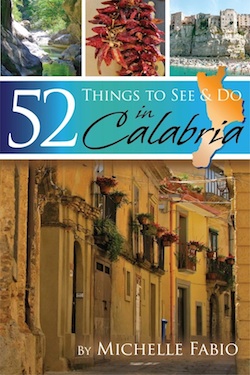
Calabria Guidebook
Recipes


