
Archive for the ‘palermondays’ Category
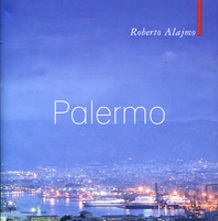
Palermo by Roberto Alajmo
 If you’ve been to Palermo in Sicily, you probably either loved or hated it. My love for the city is no secret. Palermo is not a place that throws open her arms to you; she makes you work for it, makes you discover her charm one ridiculously busy street at a time — and I tend to like that in cities. See also: Philadelphia.
I’ve written a series of posts about some of my favorite popular stops in Palermo including the Duomo, Fountain of Shame, Antica Focacceria San Francesco, and the Capuchin Catacombs, so when I got an offer to review Roberto Alajmo’s new book Palermo from Haus Publishing, I jumped at the chance. The fact that it fits in perfectly with the Gita Italiana 2010 is like icing on the cannoli. Or something like that.
Roberto Alajmo is a native of Palermo; this book is translated into English by Guido Waldman. When I received it, the first thought in my mind was whether this was going to be a love letter to the gritty Sicilian città probably known best for the Mafia and its pastries — and I’d say yes. Yes it is, but it’s a palermitano love letter, if you will.
Now let me explain.
Alajmo speaks directly to a first-time visitor to his city from the first sentence: “You have to get yourself a window-seat and arrive on a clear sunny day.” This sets the tone of the entire book as he educates the reader about the city’s sights, but not just tourist attractions. Much of the book is a tongue-in-cheek look at the city and its natives with caustic, wry observations about illegal structures, Palermitano mentality about corruption, rubbish, politics, and so much more.
Buy Palermo by Roberto Alajmo on Amazon
I found myself smirking through most of Palermo (and underlining an overwhelming portion of the book) because Alajmo’s analysis is so keen, his criticism subtle and yet full of daggers. He leaves you with many thought-provoking ideas such as the real reason why the South has so many unfinished buildings: “an unconscious sense that total completion carries with it an inbuilt sorrow.” It’s just a brilliantly written book.
So where’s the love?
Remember, Alajmo is a native of the city. He knows it. He appreciates its beauty, but he really delves into its problems — *big* problems in many instances — and the latter is what nearly all of this book is about. But in order to truly love someone (or in this case, something), don’t you have to recognize the faults and decide to love anyway?
So, yes, I would characterize Alajmo’s Palermo as a love letter to his city — a whopping, entertaining dose of tough love, but would a Palermitano have it any other way? I just loved it. Five very full espresso cups out of five.
Aside from content, by the way, this is simply a snazzy little book. It’s hardcover and measures 15.6 x 11.6 cm (about 6 x 5 inches); perfect for stuffing in your bag on a trip and a great gift item as well.
Have you been to Palermo? Would you like to go?
*

Subscribe to my Book Reviews feed — book reviews ONLY, which aren’t published to the main feed — by visiting Feedburner.
Capuchin Catacombs in Palermo, Sicily
Well, Mom is on her way home to the US and the last Palermonday is upon us. A sad day all around, but let’s try to liven things up around here with . . .
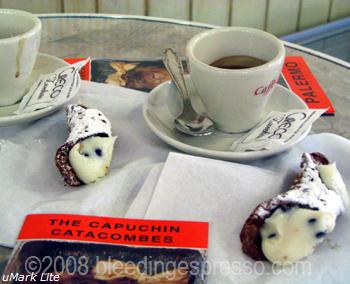
The Capuchin Catacombs of Palermo!
(cannoli not included)
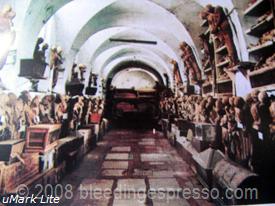 I saved the Capuchin Catacombs (Catacombe dei Cappuccini) for last because they were my favorite spot on our quick jaunt through Sicily. Since I’ve always been fascinated by and drawn to cemeteries (so peaceful and comforting), I knew I’d love the catacombs. And I did.
For those who don’t know, catacombs are underground burial crypts and the Capuchins’ version in Palermo is outstanding. The Capuchins, by the way, are an order of Franciscan friars (Order of Friars Minor Capuchin) who wear brown hooded robes. For a little word origin fun, “hood” in Italian is “cappuccio” and the diminutive (“little hood”) is “cappuccino.”
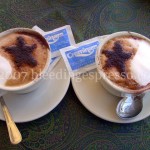 And yes, that is where my favorite drink gets its name; some believe that Marco d’Aviano, a Capuchin friar, invented the drink in the 17th century, but others say the frothy milk and coffee mixture simply resembles the brown, pointed hooded robe.
Whatever the Capuchins’ contribution to beverage history, they sure left behind something spectacular in Piazza Cappuccini between Via Pindemonte and Corso Calatafimi in Palermo.
Even on a Sunday in February when we visited, there was quite a crowd waiting to get in when the catacombs reopened at 3 pm after unch. A sweet, white-bearded monk took our coins, and we followed the crowd down some steps and through a corridor, cooler air hitting our faces with every step.
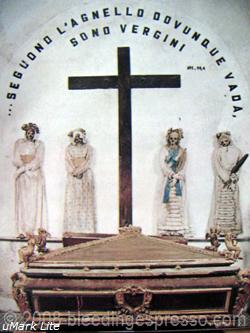 The first glance inside was simply amazing.
There are about 8,000 bodies down there, lining the walls, lying on shelves, hanging upright, some posed in chairs, etc. There are sections for men, women (children included), professionals, priests and even virgins, pictured at left; you just need to follow the arrows to hit every part of the underground maze, although Cherrye and I went through backwards to avoid the flow of (living) people.
How did all these bodies get down here? Well, toward the end of the 16th century, burial space for monks was scarce, so in 1599, the first monk was buried underground and the remains of a few other monks were moved there. The spot started out exclusively for monks, but the Order began receiving special requests from benefactors to be buried there as well.
Permission had to be granted by the High Prelates and the General Superiors of the Order until 1739, and thereafter by the Superiors of the Convent; it certainly must have been quite an honor to be included among such Palermitani.
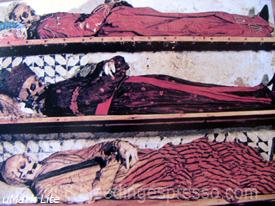 Many of the clothes placed on the corpses are still in fairly good condition and walking through the catacombs can be kind of an eerie historical fashion show–religious robes, military uniforms, housewives’ attire, children’s best from the 17th century through the beginning of the 20th.
There is just so much history in this relatively small space; I only wished there were more information on each individual corpse, much like I wish more tombstones and markers in cemeteries told fuller stories. But how much can you really fit on a marker, I guess?
So many of the bodies were so lifelike; I could just imagine them laughing, talking, joking, arguing, you know, living.
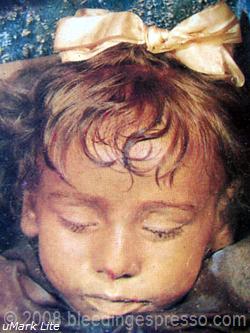
The best preserved is little, gorgeous Rosalia Lombardo, at left, who died in 1920 and was one of the last laid to rest in the catacombs.
Dr. Solafia, a doctor from Palermo, embalmed her, but to this day his method remains a secret; whatever he used, the results are spectacular. Rosalia looks like she is sleeping, taking an afternoon nap after a long morning of running around under the Sicilian sun.
Other preservation methods included arsenic, lime or vinegar.
I don’t know that I’d ever want tourists rushing past my dead body trying to sneak photos (for the record, you’re not supposed to take any and I didn’t; the photos in this post are all photos of the brochure), but I am *so* very honored we got to spend some time underground with these old souls.
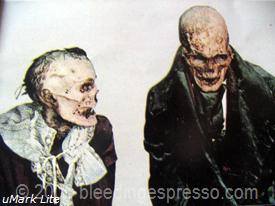
In fact, Cherrye and I definitely spent much more time in there than others who rushed in beside us.
I’m not sure there was even anyone left down there when we finally made our way out to pick up some brochures and say good-bye to the elderly monk as he sat behind his small basket of coins saying daily prayers under his breath.
I hope you enjoyed our stay in Sicily! If you missed any in the series, please check out the posts in the Palermondays and Sicily categories.
I Beati Paoli: Secret Society in Palermo, Sicily
I thought today might be the last Palermonday, but then I remembered that in addition to the Capuchin Catacombs (come back next Monday for those!) I also wanted to tell you about i Beati Paoli, a secret society that may or may not have existed in Palermo.
[I think it did, but then I do love secret societies and whatnot.]
I hadn’t heard anything about this group until Cherrye and I zeroed in on a restaurant in Piazza Marina that shares its name with this mysterious sect that was immortalized in Luigi Natoli’s book I Beati Paoli.
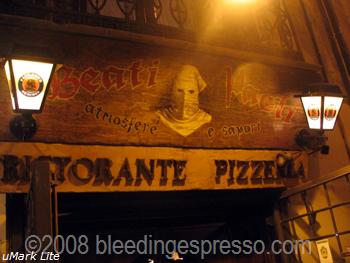
The pizza was absolutely fabulous, and it’s obviously a popular local spot as the place was packed by 8 pm–and they had only started letting in patrons about 10 minutes before. Inside, the atmosphere is also amazing; it is constructed like a cave, complete with black textured walls, lanterns lighting the way and little alcoves at every turn.
Sorry there are no food or inside photos but Cherrye and I were *starving* at that point and the cameras didn’t even make it onto the table.
Back to the group, the existence of the Beati Paoli is still in dispute, but it is commonly believed that Natoli’s book was at least part historical account with some fiction thrown in. The book takes place between 1698 and 1719 during which Sicily passed from being under Spanish rule to Piedmontese to Austrian.
Throughout this difficult time for Sicilians, the secret society is said to have fought against both the Church and the State in favor of the common man–think “rob from the rich to give to the poor” kind of thing.
There was also an element of delivering justice for the people when the throne was so far away and not doing much for them; in that sense it is also believed that i Beati Paoli may have had its origins in the“Braccio della Giustizia,” or Arm of Justice, actually sanctioned by the State; the group carried out vendettas on behalf of perceived crimes committed against both individuals and the community.
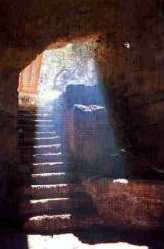 It is said that their principal meeting place was a cave in the Capo quarter near the Chiesa di Santa Maria di Gesù, also called Santa Maruzza; the church is still there but the cave entrances have been blocked off. The photo on the left is labeled “The Tribunal of the Beati Paoli” and comes from the official website of the Duomo of Palermo, which you’ve seen before on Bleeding Espresso here.
Even the group’s name is a mystery but may come from the legend that by day, its members dressed as monks of San Francesco di Paola (Saint Francis of Paola in Calabria) and sat in church pretending to pray the rosary. By night, however, the men wore black hoods (like in the photo above, except black, I suppose) and carried out their business, hiding and meeting in the hidden passageways and abandoned catacombs that still lie under the streets of Palermo.
I Beati Paoli is considered by some a precursor to the current Mafia, the roots of which are in agrarian Sicily. Although the two groups haven’t been directly linked, similar mentalities and principles, including the famed “omertà” or code of silence, show some definite overlap.
Indeed, at least one Mafia pentito (turncoat), Antonio Calderone, is quoted as saying he was told to “follow the example of the Beati Paoli” when he was initiated into the Mafia.
You probably won’t come to any concrete conclusions about the group when you’re in Palermo, but whether or not this group ever existed, the restaurant is definitely worth a stop:
Al Covo dei Beati Paoli
Piazza Marina, 50
www.alcovodeibeatipaoli.com
And as for the rest, I’m looking forward to checking out Natoli’s book.
Read more about I Beati Paoli in Roberto Savona’s excellent article here.
Gardens of Palermo: Villa Garibaldi & Villa Bonanno
Welcome back to Palermonday! This week we’re moving on the gardens of Palermo.
Palermo once had so many public gardens and parks, it was known as the “Garden City.” Cherrye and I only got to see two of them as discussed below, but you can read about the other gardens here and here.
Villa Garibaldi was very close to where we stayed near the end of Corso Vittorio Emanuele and the harbor. It was designed by architect Giovan Battista Filippo Basile between 1861 and 1864 in Piazza Marina, which had been used for Aragonese weddings, victory celebrations, and, unfortunately, public executions.
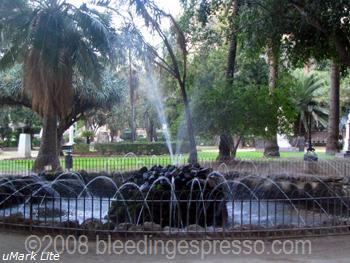
Nearby is Palazzo Chiaramonte (the seat of Palermo University), Palazzo Galletti, Palazzo Villarosa, the Chiesa di Santa Maria dei Miracoli, and Palazzo Fatta. There is also a free theater (Teatro Libero) in the square.
The gardens surrounding Villa Garibaldi are definitely intriguing, partially because the area always seemed kind of dark even in sunlight. There were always plenty of people, though, even a photo shoot for some kind of family celebration and lots of dogwalkers (and dogs, of course).
Some of the most interesting features inside the park are the exotic plants, in particular the Ficus magnoliodes–creepy as all get out and one of the largest in Italy.
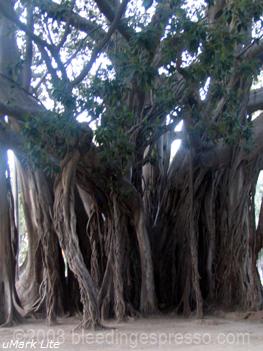
Also in Villa Garabaldi is a memorial for Joe Petrosino, the NY police officer who was killed in Piazza Marina while in Palermo fighting organized crime; we saw the memorial on our way to the hotel the first day, but I forgot to go back and take a photo. This one will have to do until I get back there.
The other gardens we visited briefly were at Villa Bonanno in the middle of the city, not too far from the Porta Nuova. Villa Bonanno is behind Palazzo dei Normanni and the gardens’ main attraction is an enormous statue of Philip V of the House of Bourbon.
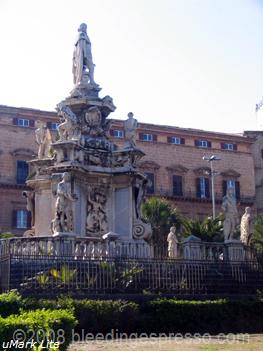
Honestly, Cherrye and I *could have* seen more of Villa Bonanno, but we were tuckered out by that point and used the fabulous scenery, e.g.,
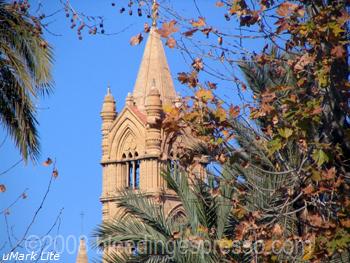
as a backdrop for our afternoon riposo before we took on the famed Capuchin Catacombs . . . which I’ll tell you all about next Palermonday!
La Vucciria Market in Palermo, Sicily
I intended to only write one post combining the markets and gardens of Palermo. When I started it, though, I quickly realized that I can’t. There’s simply too much good stuff to try to cram it all together.
So today won’t be the last Palermonday after all! Today we’ll hit the markets, and next Monday, the gardens, OK? And if you *really* want, perhaps we’ll even explore the Catacombs as well.
So tell me, would you like to see dead people?
Palermo’s markets are famous, and just from what we saw, I have to say–with good reason.
Unfortunately for Cherrye and me, our time in Palermo was limited, so we only had a quick pass through La Vucciria market the morning before we left. The other markets are Capo, Ballarò, and Borgo Vecchio, and then there are tons of little markets, or mercatini, on various days throughout the city.
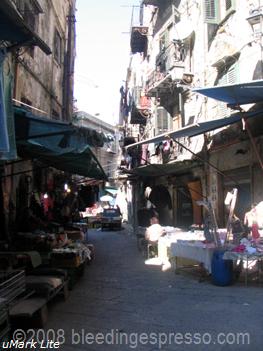
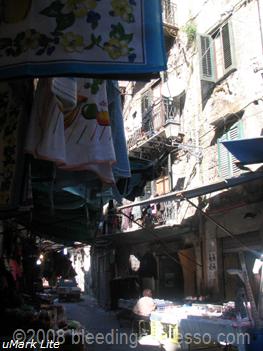
La Vucciria is split up into food items and then everything else. Here’s a glimpse of part of “everything else”; sorry for the lighting. Didn’t catch the angles of the sunlight well I’m afraid, but you can still get a feel for the streets of the city, right?
There was a lot of nice knock-off stuff that was better quality than at our markets here, and yet I came home with souvenirs from an Indian shop of all places. What can I say? We don’t have any Indians in my village.
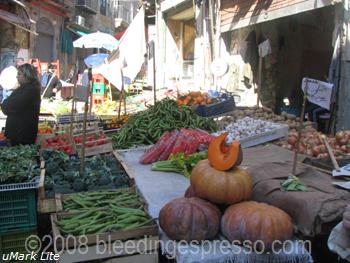
The food part was full of lovely sights and smells (except the fish, which doesn’t smell so good). The colors sure were pretty though.
We loaded up on spices but realized later that we should have grabbed some fruit for the train ride home. Lesson learned.
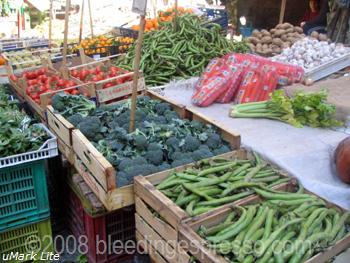
I would go back to Palermo just for the markets, I tell you.
Come back next week for the gardens!
P.S. I should warn my faithful readers that from now until at least early July, I will be cutting back on posting to three times a week. My mom is arriving shortly, and I want to have as much time with her as possible. Woohoo for mom visits!
 Michelle Kaminsky is an American attorney-turned-freelance writer who lived in her family's ancestral village in Calabria, Italy for 15 years. This blog is now archived.
Calabria Guidebook
Recipes


