
Are You Ready for the Gita Italiana 2010?
You are cordially invited to Bleeding Espresso’s Gita Italiana 2010!

For those who don’t know, many Italians go on vacation during the month of August, and they often end up in various places around the Bel Paese. In celebration of Ferragosto, Bleeding Espresso’s gita (trip) will run from August 16th to the 31st (except Mondays when we’ll have Italian-themed book giveaways), and is especially for those of you who can’t get away for a tour of Italy. Some of my favorite people have kindly contributed posts about their respective areas and will be featured here, so be sure to come back every day for a bit of a virtual holiday to close out the summer.
What: Gita Italiana 2010
Where: Bleeding Espresso
When: August 16-31, 2010
Along the way we’ll have stops in the Aeolian Islands, Sardinia, Venice, Assisi, Piemonte, and many more places, so I hope to see you there (here)!
How to Store Fresh Cut Basil
As we’re at the height of basil season here, I thought I’d share with you my method for how to keep basil fresh after it has been cut from the plant.
I’ve tried all kinds of ways over the years, and this is what I have found works best:
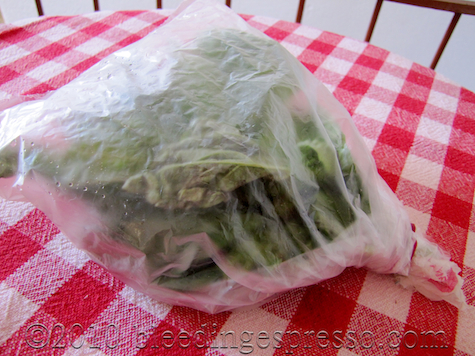
1. Wrap the stems in a damp paper towel.
2. Put a plastic bag over the unwashed leaves and secure with a rubber band at the base.
3. Place the basil in the refrigerator.
4. Pluck off leaves as you need them, washing just before use.
With this method, I have kept basil fresh for up to two weeks in the refrigerator, but you do want to keep an eye on it if you’re not using it immediately. Be sure to re-wet the paper towel when it’s going dry and also remove any leaves that are turning black and/or slimy; they will get moldy if left in there too long.
If you still aren’t using your basil quickly enough before it goes off, wash and pat dry the basil then tear off the leaves and pop them in a freezer bag. The leaves won’t be great for something like a Caprese Salad once they’re thawed, but they’ll still add great basil taste to soups and dishes like our Borlotti Beans alla Calabrese — and they do retain excellent flavor for about four to six months.
What are your favorite food storage tips?
The Eye on Italy Podcast
 If you follow me on Twitter or Facebook, you have probably already heard about the Eye on Italy podcast (but please make sure to read through the post for updated info!). For those of you who haven’t, here’s your official introduction:
Eye on Italy is “[a] podcast for anyone who’s loved Italy or wants to love it.” Each week, Jessica Spiegel (WhyGo Italy), Sara Rosso (Ms Adventures in Italy), and I talk about current events and other interesting topics that relate to the Bel Paese.
We have been privileged to host some rather awesome guests so far, including Gelato King David Lebovitz; B&B owner and creative soul Diana Baur; and art historian, sommelier, and food expert Katie Parla. We’ve tackled all kinds of issues from the freedom of the press in Italy with Livia Iacolare, community coordinator and assistant producer of Italy’s Current TV, to uncovering the Holy Foreskin with author David Farley.
There are already 14 podcasts available for your listening pleasure, but there’s no need to feel behind! Now that we’re taking a little August break like the rest of Italy, you have plenty of time to catch up on what you’ve been missing so far. You can subscribe on our page or directly at iTunes.
And for those of you who have been following, first thank you! Second (and this goes for everyone) keep an eye (hah!) on the Eye on Italy website for posts throughout August as we’ll be sharing links to some of the news stories and blog posts that have caught our attention . . . starting today with the spotlight on Art & Culture.
Thanks again to all who have been listening, and as always, if you have feedback, comments, or even guest suggestions, please pass them along either through the website or at the following locations:
- Eye on Italy on Facebook
- @EyeonItaly on Twitter
Happy listening (and reading)!
Calabria Traveling Market: Buying Pecorino, Capocollo, ‘Nduja, and Pancetta from the Back of a Car
In Calabria, some days you go to the market. On other days you’re innocently typing away on your computer when you hear the cry of “Formaggio formaggio formaggio paesanoooo!” outside.
On those days, the market has come to you. So you grab your wallet and camera (no need for keys — you can just leave those in the lock in the front door), and head outside to see your choices.
Here was the selection yesterday morning:
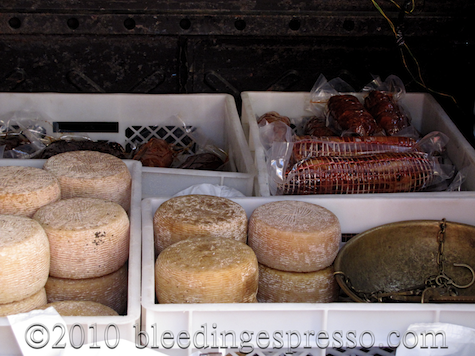
This is all homemade and handmade locally by the seller and his wife.
Here he is weighing my capocollo and pancetta:
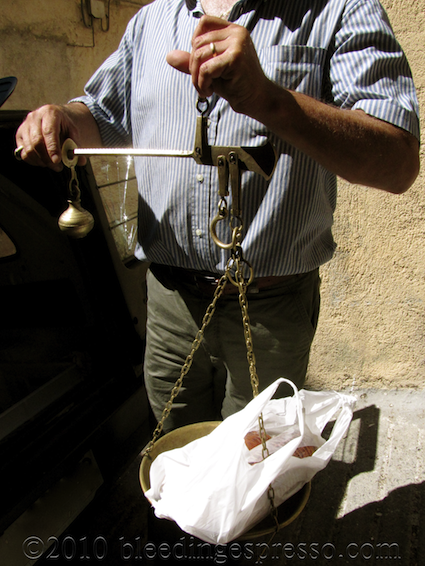
Yes, I decided to splurge and get pecorino, capocollo, and pancetta. Paolo and his friends have been working hard in our campagna (which means they need food up there every day) and most of his family is also around this month, so it’s good to have reserves in the house for drop-ins.

Homemade “paesano” salumi and cheese doesn’t come cheap, but it’s worth every centesimo. Still, the guy could sense my reluctance to part with my euros (may have been due to my price-haggling), so he threw in a big chunk of ‘nduja for free. You can see it a bit in the upper left of this photo:

What’s that? You’re not familiar with ‘nduja (ahn-DOO-ya)? Guess I’ll have to write a blog post about it, but for now, suffice it to say that it’s a Calabrian treasure — an uber-spicy, spreadable sausage that works well on everything from bruschetta to pasta.
And if you want a refresher course on the differences between pancetta, capocollo, our beloved suppressata, and more, check out Vince Scordo’s Guide to Cured Italian Meats: Salumi.
How would you enjoy the pecorino and salumi I picked up at the traveling market?
Panino Caprese: Tomato, Mozzarella, and Basil Sandwich
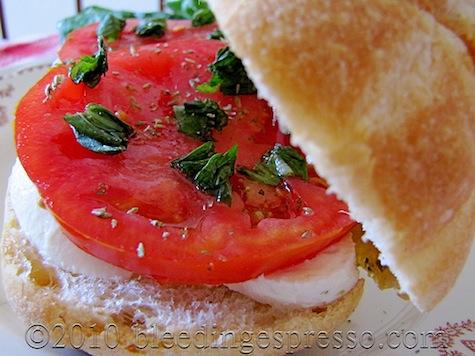
One of our summer staples around here is the Caprese Salad, but sometimes you just want something you can hold in your hand . . . enter the panino caprese.
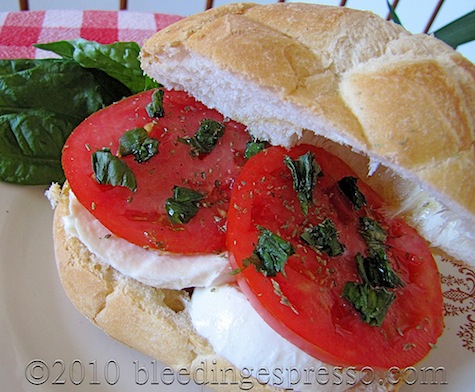
As with many Italian dishes, the quality of ingredients in this week’s What’s Cooking Wednesday is extremely important, so you should use the best tomatoes (homegrown off the vine), mozzarella (di bufala) and olive oil (extra virgin) you can find. Basil, oregano, and salt round out the ingredients.
I like to put some olive oil on each inside of the bun to start, but you can assemble this any way you like. I do sliced mozzarella first, then sliced tomatoes, then basil, oregano, and salt — with another drizzle of olive oil over the tomatoes to finish it off.
Remember, “panino” in Italy just means a sandwich — it can be on any kind of bread or roll and certainly doesn’t need to be pressed in a grill. That said, you are more than welcome to heat up your panino caprese as that’s tasty as well.
And if you want to whip up some focaccia seasoned with olive oil and oregano (even thyme, yum!) for this sandwich, you won’t be disappointed; indeed, the first time I had one of these, it was at Dean & Deluca in New York City. Love at first bite doesn’t begin to describe it.
Buon appetito!
 Michelle Kaminsky is an American attorney-turned-freelance writer who lived in her family's ancestral village in Calabria, Italy for 15 years. This blog is now archived.
Calabria Guidebook
Recipes


