
Archive for 2009
What’s Cooking Wednesday: Linguine with Shrimp and Mussels
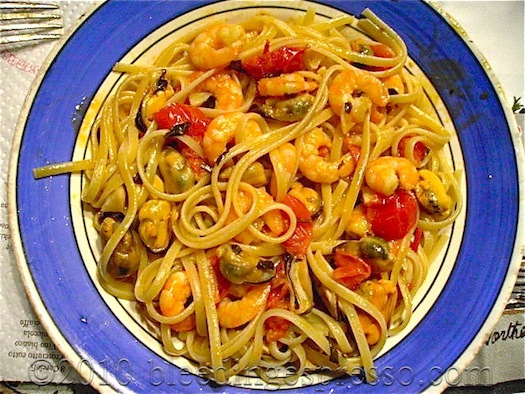
 In going through old photos, I came across one of this dish, variations of which we make quite often in our house. Apparently I never posted it (the photo is from March 2007) so now it’s finally time to share the recipe for What’s Cooking Wednesday.
The seafood we used was frozen, so you can use this basic recipe with any combination of frozen seafood you like.
This is yet another really quick meal; don’t you just love when you start the water for the pasta before you even start preparing the sauce?
Linguine with Shrimp and Mussels
- 2 tablespoons olive oil
- 2 small cloves garlic
- 5-6 cherry tomatoes
- 1 package of frozen shrimp and mussels (or seafood of your choice)
- 1 small glass of white wine (or water)
- Salt
- Bunch of parsley, chopped
- Linguine for two people
1. Put the water for the pasta on to boil, and prepare pasta when water is ready.
2. In a saucepan, heat oil and then add garlic, letting it cook for about a minute or so. Don’t brown.
3. Cut tomatoes in half and add to pan, sprinkling a little salt over them; let them cook for two to three mintues.
4. Add frozen seafood and half the parsley, and let cook for another 2-3 minutes.
5. Add wine (or water).
6. When the liquid is reduced by about half, adjust for salt.
7. Toss well with linguine and serve with a sprinkling of fresh parsley.
Buon appetito!
False Friends/Falsi Amici in Italian
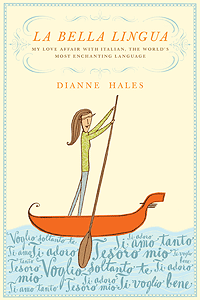 I was recently introduced to a fabulous new site about the Italian language called La Bella Lingua by Dianne Hales.
Dianne has a book by the same name coming out in May, and you will see her here at Bleeding Espresso closer to that time, but for now, Dianne has inspired me to share one of my favorite/least favorite parts of the Italian language:
False Friends/Falsi Amici
What are false friends in Italian?
Also called “false cognates,” these are Italian words that sound a lot like English words but *so* do not correspond in meaning.
If you’re just starting to learn Italian, this is a great list to simply commit to memory. It is by no means exhaustive, but these are some that have always stuck in my mind:
Italian False Friends/Falsi Amici in Italiano
Attualmente: currently NOT actually (in realtà)
Camera: room NOT camera (la macchina fotografica)
Cocomero: watermelon NOT cucumber (cetriolo)
Comprensivo: understanding NOT comprehensive (completo)
Confetti: sugared almond NOT confetti (coriandoli)
Confrontare: to compare NOT to confront
Crudo: raw NOT crude (volgare)
Educato: polite NOT educated (istruito or colto)
Educazione: good manners NOT education (istruzione)
Eventuale: any NOT eventual (finale)
Fabbrica: factory NOT fabric (tessuto)
Fastidio: annoying NOT fastidious (pignolo)
Fattoria: farm NOT factory (fabbrica)
Firma: signature NOT firm, as in company (azienda) or firm, as in a mattress (rigido)
Gentile: nice NOT gentle (dolce or leggero)
Intendere: to understand NOT to intend
Libreria: bookstore NOT library (biblioteca)
Magazzino: warehouse NOT magazine (rivista)
Morbido: soft NOT morbid (morboso)
Noioso: boring NOT noisy (rumoroso)
Parente: relative NOT parent (genitore, madre, padre)
Patente: license NOT patent (richiesta di brevetto)
Peperoni: peppers NOT pepperoni, the spicy sausage (salame piccante)
Preservativo: condom NOT preservative (conservante)
Pretendere: to expect NOT to pretend (fare finta)
Rumore: sound NOT rumor (voce)
Sensibile: sensitive NOT sensible (ragionevole)
Simpatico: nice NOT sympathetic (comprensivo)
Stravagante: eccentric NOT extravagant (sprecone)
Have you made any false friend mistakes?
Do you have more to add to the list? Please share!
Calabria Pride: Noi Ci Mettiamo Il Cuore
I just couldn’t resist sharing this *gorgeous* video promoting the Region of Calabria featuring one of our favorite sons, Gennaro Gatuso:
Gah! I *love* this video!
Don’t you just love the distinctly Calabrese feel to Gennaro’s words…simu o no Calabrisi? Are we Calabrians or not?!
For non-Italian speakers, the last line before the video montage is “Calabria has everything,” and then the closing line, which so perfectly describes my bella Calabria:
We put our hearts into it.
Viva la Calabria!
So, when are *you* coming to visit us here in the toe of the boot?
Guest Post: Author of Passeggiata, GG Husak
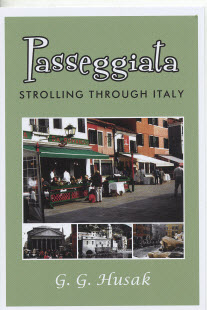 Today I have the pleasure of introducing you to G.G. Husak, author of Passeggiata: Strolling through Italy. G.G. and her husband Al make a yearly pilgrimage to Italy in March, enjoying the Bel Paese from the inside, and this book is the result of their trips.
G.G. writes that Italy has become comfortable and familiar for them “even though we know ours is a fringe position and that, as visitors, we have the luxury of a romantic and imaginative perspective. Still, we are pleased that we can stand at a counter in a café in a small town and drink cappuccino with the local folks, pretending that, in our jeans and black jackets, we blend in. We feel as if we belong, at least for the moment.”
The book is a collection of tales from their stroll, or passeggiata, through various Italian cities and towns, and the following is
G.G.’s take on Italian coffee:
Returning to Italy means a return to the best espresso and cappuccino in the world. One of our simple pleasures is watching the owner of a small café prepare the espresso or cappuccino as we lean over the bar. We smell the coffee beans, feel the steam, and hear the froth of milk.
Instead of a complex language describing the size, additions, and ratios of our drink ingredients, in Italy, we simply ask for a caffé or cappuccino, not wet or dry, not small or large.
We know that if we sit at a table in a cafe and have our coffee served to us, it may cost several dollars, but if we stand at the counter, drinking the same coffee without table service, it will be 50 cents.
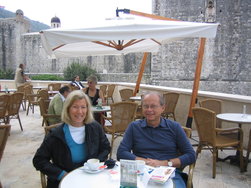 We know that ordering “coffee” or “caffè” will bring us a cup of espresso, rather than American style coffee. If we want a lighter drink, coffee with milk, we order a cappuccino or latte.
We know that Italians drink espresso, rather than cappuccino or latte, later in the day, adding milk only in the mornings. Waitpeople have gotten used to visitors like us enjoying both in the afternoons. In a café we know to leave a small coin beside the cup as a tip, even if we are served standing.
We are accustomed to seeing loose sugar in a bowl on the bar with a couple of communal spoons, no little bags of sanitized sugar and no sugar substitutes. There is also no mess, no torn wrappers, no empty powdered cream containers, no paper to-go cups and no wooden or plastic stir sticks. You get a cup, a saucer and a spoon.
Occasionally an office or shop worker from down the block will come in and get a small tray of coffees, presumably for coworkers, and leave with a round tray and several ceramic espresso cups. Later they will bring back the empties.
Recently in Rome, I was shocked to see my first ever take-out coffee shop, with a sign advertising cups “to-go.” I guessed that they were targeting the tourists. But thinking of the waste of paper and plastic that we have unfortunately come to see as normal in many coffee shops at home, I can’t imagine that Italy would ever go down that road.
What do you think?
Do Starbucks and the like have a chance in Italy?
Love Thursday: Hearting Chicken
Faithful reader and new blogger Ann of Only in Maine recently sent me the following email entitled “I heart Bleeding Espresso”:
I could not resist sending you these two shots because they so made me think of your Love Thursdays – and really, what says love better than raw meat? Or actually in this case chicken? Some people send you cappuccino, I send chicken……
I couldn’t *not* post them to share with everyone, so here you go:
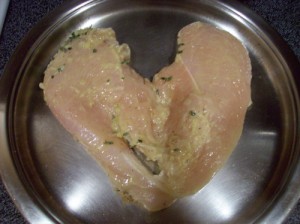
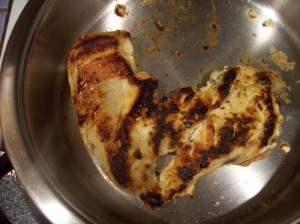
I *so* heart chicken too, Ann. Thanks for thinking of me!
Happy Love Thursday everyone!
What’s your favorite chicken recipe?
 Michelle Kaminsky is an American attorney-turned-freelance writer who lived in her family's ancestral village in Calabria, Italy for 15 years. This blog is now archived.
Calabria Guidebook
Recipes


