
How to Brew Coffee in a Stovetop Moka Pot
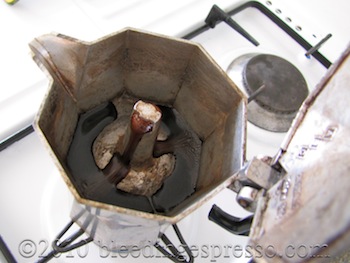
Coffee brewing in a stovetop moka pot
Happy National Espresso Day! While the “National” refers to the US (apparently Italy celebrates espresso in April), I say we make it International Espresso Day — and I’m going to help you celebrate by finally doing the post I know some of you have been waiting to see at Bleeding Espresso:
How to Brew Coffee in a Stovetop Moka Pot
First things first. The word “espresso” refers to the way coffee is brewed not to the coffee itself. Espresso is brewed by water that is forced up threw finely ground coffee because of steam pressure; in America especially, “coffee” is generally made in a percolator or via the drip method. The latter actually ends up having a higher concentration of caffeine, while the former tends to be thicker and richer in flavor.
Put another way, espresso is always coffee, but coffee is not always espresso. That said, it is important that if you want to make espresso in a moka pot, you get finely ground (often called “espresso grind”) coffee as other types are too coarse.
Some people might argue that coffee made in a stovetop moka isn’t *really* espresso since it doesn’t tend to create the gorgeous layer of golden brown “crema” on top, but really since it is indeed brewed via pressure coming up from the bottom, it is.
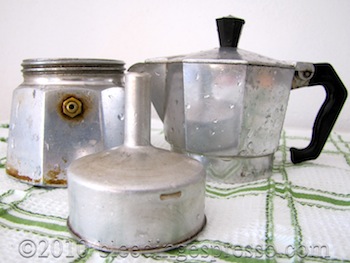
- Parts of a stovetop moka pot
It’s not going to taste exactly like what you get in a bar (remember in Italy, the place where you get coffee is called the “bar”), but quite simply, for many of us in Italy and elsewhere, making this type of coffee at home is just the most cost effective choice — we also find it quite delicious as well.
Where did the moka pot come from?
The moka pot was created by Bialetti and rose to popularity in Italy in the 1930s; the basic design has been copied ever since, and there are also different moka pot looks, so feel free to experiment. Moka pots also come in different cup sizes (ahem), so it’s not uncommon to see several different sizes of moka pots in an Italian house for use with different numbers of guests.
Now, finally, the easy peasy directions for how to brew coffee in a stovetop moka pot:
1. Fill the bottom with fresh, cold water up to the middle of the safety valve; as you can see in this photo, my moka has a line that marks that level in various places around the bottom, which makes it even easier to tell where to fill to.
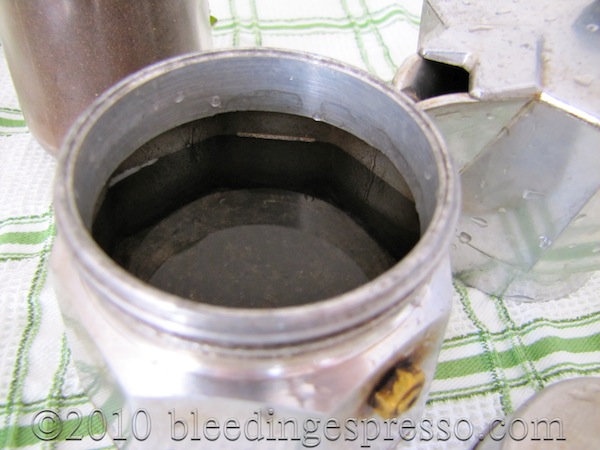
Bottom of moka pot filled with water.
2. Put the basket in the bottom, and spoon in the coffee. This part you can experiment with, depending on how strong you like your coffee. As you can see, we like ours pretty strong, but you can fill yours considerably less — the most important thing to remember is not to pack it down.
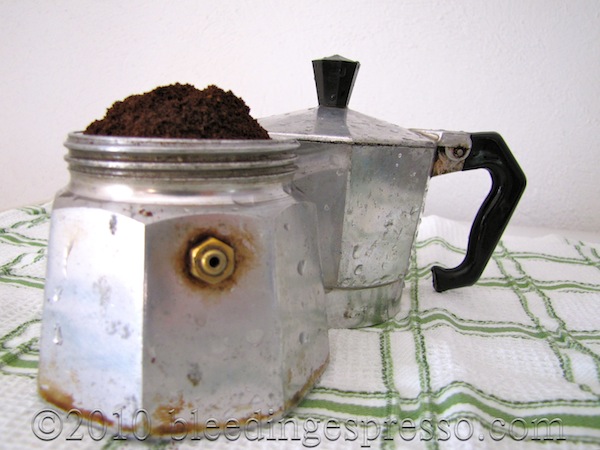
Basket really full of coffee.
3. Screw the top onto the bottom creating a super-tight seal. I use a towel for extra traction to really get that last turn tight. Then put the pot on the stove on low heat.
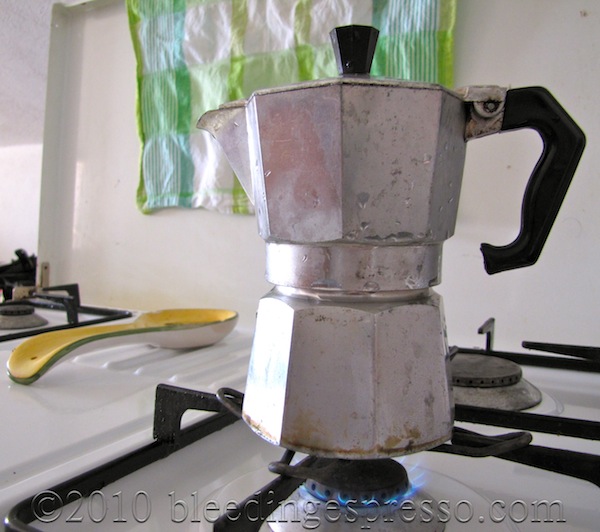
Moka pot on low heat.
4. The top part of the moka will begin to fill with coffee. When you start to hear the sputter and gurgle of the coffee, remove it from the heat. P.S. Don’t lift the lid as I did for the sake of photos. There is very hot coffee spurting out of there, and it doesn’t care what’s in its way.
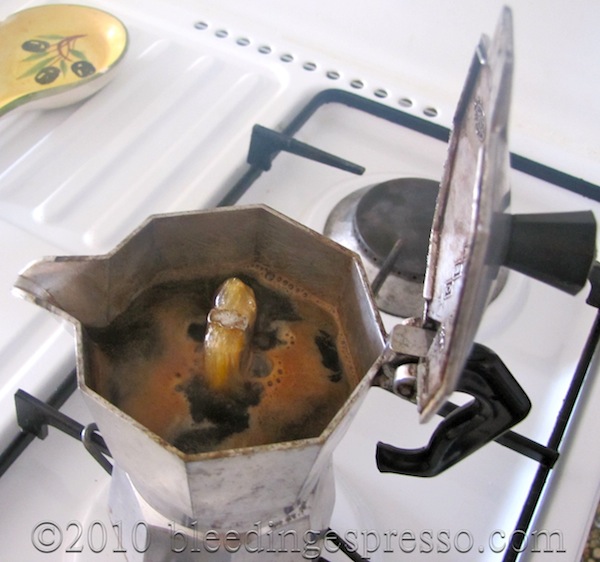
Coffee just about ready.
5. Serve hot, with or without sugar, with or without steamed milk, just however you like it.

Steaming cup of espresso made in a stovetop moka pot.
When cleaning the moka, I have been told to never use any kind of detergent on it at all, so I don’t (just hot water and my hands). I have seen recommendations online to use a mild detergent, but I’m going to stick with what the locals here tell me. I do, however, take a scouring pad to my moka pot now and again to keep it looking mildly shiny, but as you can see from the photos, mine isn’t exactly new.
Ah, and that’s another thing about using a moka pot — throw out at least the first batch of coffee made by it, possibly even two or three batches. The flavor is just going to keep getting better the more you use it, so if your pot starts experiencing problems (the coffee is leaking out the sides at the seal or the top part isn’t filling up with coffee), I’d say to change the rubber ring that creates the seal. The replacement ring costs 15 cents (here at least), and it’s well worth a try before you start over with a new moka pot IMHO.
How do you drink your espresso?
Escarole, Bean, and Pancetta Soup – Zuppa di Scarola, Fagioli e Pancetta
Last week Vince at Scordo posted a recipe for Escarole and Bean Soup. It looked tasty to me, and just as I was tucking it away in my memory, wouldn’t you know my mother-in-law gave us a bunch of escarole the next day?
I more or less stuck to Vince’s basic recipe but added some pancetta — and then P wanted some soup pasta with it so we threw that in as well (although that’s not in the photo below).
This recipe is super easy and delicious, especially if you use canned beans. As Vince mentions, your own soaked beans inevitably taste better and are less expensive, though, so give them a try sometime as well.
Overall, I have to say, if you’re looking for a hearty, warm-your-soul kind of meal, this is a wonderful choice.
Escarole, Bean, and Pancetta Soup — Zuppa di Scarola, Fagioli e Pancetta
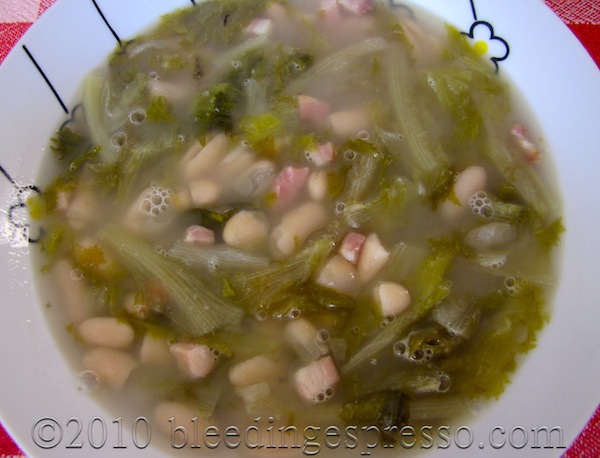
Just grab a spoon and a hunk of bread!
- 3 tablespoons of olive oil
- 2 cloves of garlic, each cut in half
- 1 peperoncino, cut into a few pieces
- 40 g of pancetta, cubed
- Bunch of escarole, washed and coarsely chopped
- 2 cans of cannellini beans
- 1 liter of water
- Salt to taste
1. Heat olive oil on medium heat in a large soup pot and sautée garlic, peperoncino, and pancetta for a few minutes.
2. Add escarole and sautée until wilted, being sure to coat thoroughly with the oil mixture. Add a bit of salt as well.
3. Add water, beans, and a bit more salt. Cover, turn down heat to low, and let simmer until the escarole is done to your liking — at least 10 to 15 minutes.
4. Serve hot with fresh chunky bread; although it’s not very Italian of me, a slab of butter on the bread and then dipped in the soup just makes everything right with the world.
Buon appetito!
Love Thursday: An Adorable Little Nuccihra of Love
P and I don’t have grand birthday or Christmas celebrations; neither of us are fans of giving gifts only because it’s expected, although “just because” or “I was thinking of you” tokens are always welcome around here.
And we do tend to exchange little, thoughtful things year round — often simple gestures like one of us taking over cooking duties or running to the store when the other is exhausted. There are some physical gifts, but they tend to be of very little monetary value. In our house, it truly is the thought that counts — it always warms my heart to know that when P was “in giro” (out and about), he saw something and thought of me.
Over the years, he’s brought home tiny rosebuds, almond blossoms, old lire coins, a big bluish green lizard (!), porcini mushrooms, and even some saffron flowers.
And most recently this little nuccihra (noo-CHEE-ruh) arrived:
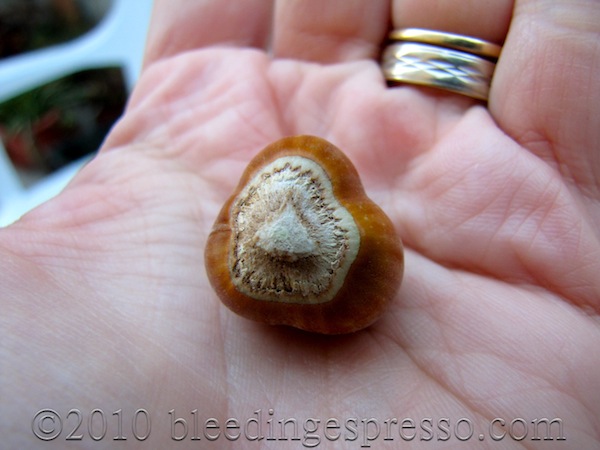
An adorable little nuccihra of love
It’s a type of hazelnut (nocciola) here in the mountains of Calabria —“nuccihra” is Badolatese (local dialect) for little hazelnut . . . an adorable little nuccihra of love if you ask me.
Happy Love Thursday!
The Colors of Fall in Calabria
We do get some leaves changing color here, but fall in Calabria actually is quite colorful besides those warm autumnal hues I grew up with in the mountains of Pennsylvania:
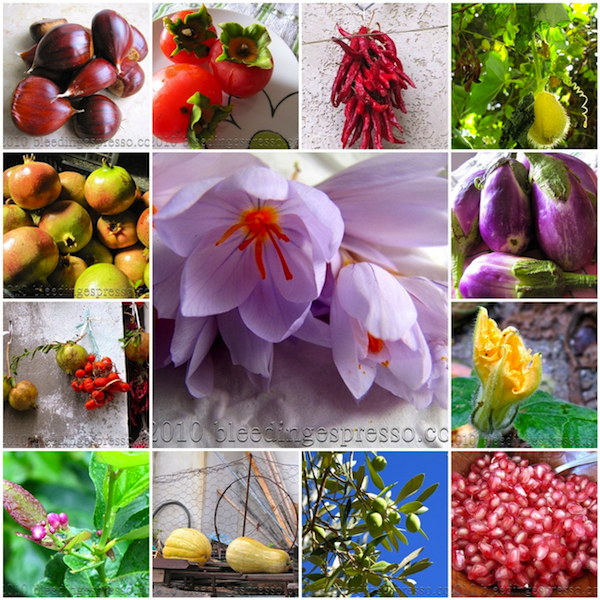
Fall in Calabria on Flickr
1. Saffron flowers, 2. Chestnuts, 3. Persimmons, 4. Drying peperoncini, 5. Prickly zucchine, 6. Melagrane dal giardino, 7. Eggplant, 8. Hanging out, 9. Zucchine flower, 10. Lemon blossom after the rain, 11. Zucche, 12. Some of our olives in September, 13. Pomegranate seeds
Many of us expats in Italy have written about being more in touch with the seasons here than we were in our home countries, mostly because our routines are so much more ruled by what the weather is like outside. Over the past month or so, for instance, many of us have been busy gathering wood, picking olives, preserving the summer’s bounty for enjoyment all winter, and thinking about all the soups, stews, and dishes “al forno” we’ll be making for the next few months. The first “signs o’ fall” if you will.
And yes, for me, there have been other changes in the routine, like feeding the goats and locking the hens in the henhouse just a little bit earlier in the evenings and also picking back up some habits that had fallen by the wayside over a busy summer — wonderful daily commitments like yoga and working on a dusty old manuscript, and also weekend projects like finding little ways to make the house that much cozier.
We’ll be spending quite a bit of time in here in the coming months, after all.
Yes, fall here always inspires me to dig back into the good, warm, comfortable, and cozy . . . which comes first, the cooler weather or the nesting mentality? I don’t know, but I’m not complaining.
What says “fall” to you?
What’s Cooking Wednesday: Sausage and Peppers
To be perfectly honest, I didn’t love sausage when I lived in the States; here in Calabria is a whole other story, though, and one of my favorite ways to prepare salsiccia is with peppers and onions in tomato sauce.
P had never had sausage prepared this way before I came along, but it’s been one of my family’s favorites from back when my grandmother made it — and it has quickly become one of P’s favorites as well.
And you want to talk about easy? There are only five steps!
A couple notes before we dig in:
I prefer using sweet sausage, red onion, and red and yellow peppers:
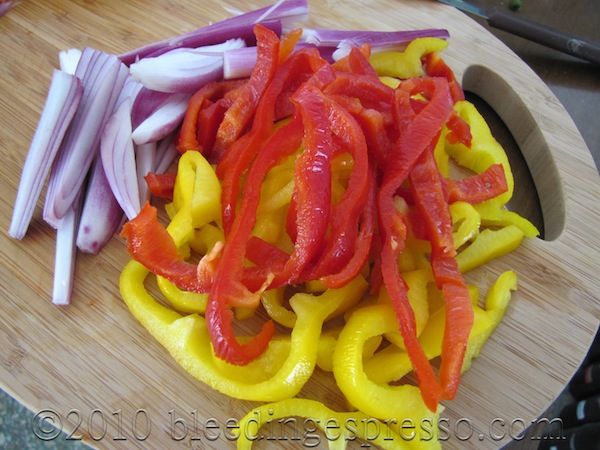
Peppers and onions ready for sauteeing
You are, of course, welcome to play with various combinations that may include spicy sausage and green peppers. Here our sweet (“dolce”) sausage tends to have a little kick with peperoncino, so don’t be afraid to add a little hot pepper even if you’re using sweet sausage; mostly it will just heighten flavors if you don’t use too much.
Also, I like to make extra sausage and sauce so we can have it with pasta the next day — the first day we usually do the sausage and peppers on hard rolls (sausage and pepper hoagies for those of you who know what a hoagie is). This is why I use two cans of tomato sauce; if you only want to use this for one meal, one can is probably plenty. This is definitely one of those sauces, though, that tastes even better the next day, so I highly encourage making enough for leftovers.
Sausage and Peppers
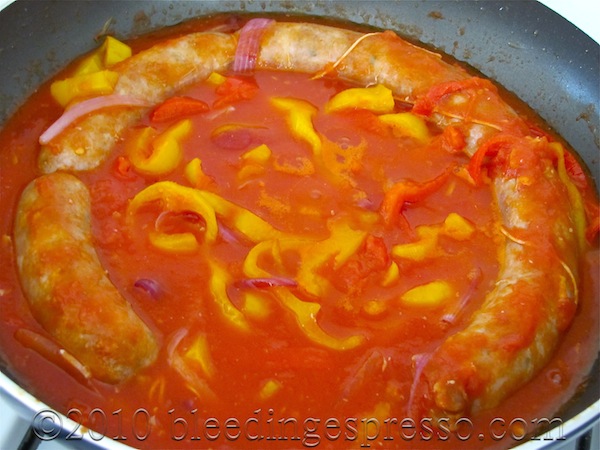
Sausage and peppers ready to simmer
- Sausage links
- 1 tablespoon olive oil
- 2 large or 3 medium peppers, julienned
- 1 large onion, julienned
- 1 large clove of garlic cut in half
- 2 cans of tomatoes/tomato sauce
- Salt to taste
1. In a large nonstick pan on medium to high heat, brown sausage (about 10-15 minutes).
2. Remove sausage from pan and set aside. Turn down the heat a bit and add the olive oil, peppers, onion, and garlic. Saute until peppers and onions soften, at least five minutes.
3. Return sausage to pan and add tomato sauce, using about a quarter cup of water to rinse out the can (add that water to the pan as well). Add salt as desired.
4. Cover and let simmer, stirring occasionally, until tomato sauce tastes ready to you. This will take at least 15-20 minutes, but could take longer depending on your tastes. If you like a thicker sauce, be sure to take the lid off the pan at some point, which I do after about 15 minutes.
5. Serve sausage on hard rolls with plenty of sauce, peppers, and onions *or* serve with pasta (we prefer penne with this).
Buon appetito!
 Michelle Kaminsky is an American attorney-turned-freelance writer who lived in her family's ancestral village in Calabria, Italy for 15 years. This blog is now archived.
Calabria Guidebook
Recipes


