
Archive for July, 2010
Panino Con La Mortadella Fritta
Sounds fancy, eh? OK, then let’s stick with that instead of calling this week’s What’s Cooking Wednesday what it really is: a fried bologna sandwich. With senape!
Have you ever had un panino con la mortadella fritta? Even if you don’t normally like bologna, I highly recommend finding the best sliced mortadella you can, tearing it up into smaller pieces, frying it in a pan (no oil, just a hot pan), and then slapping it on a fresh Italian roll. Oh, and add mustard.

My grandmother used to make these whenever we wanted a substantial snack but didn’t know what else to eat. P had never had one of these babies before I came along — and yes, he turned up his nose at first. But then the smell of frying mortadella got to him. He rarely has a “raw” mortadella panino now.
And even though you have to turn the stove on, frying doesn’t take very long so this ends up being a super easy summer treat around here.
Oh, and while we’re talking sandwiches/panini, be sure to check out Sara’s (Ms Adventures in Italy) explanation of the difference between a panino in Italiano and a panino in America at Panini Happy. Great stuff!
Buon appetito!
Love Thursday: Family and Friends Edition
This week’s Love Thursday is quite special because the photos come from two friends made via Internet and my very own niece, Mia:

From L-R:
(1) My friend Beth’s daughter Sarah made a batch of peanut butter cookies and this heart came out.
(2) My friend Lucy of On my way 2 work and Other Stuff spotted this branch-formed heart.
(3) My niece Mia caught this heart-shaped puddle before it dried up.
(4) Again, Mia’s eye saw a heart in this pork cutlet.
I have *no* idea who Mia takes after!
Happy Love Thursday everyone!
Are you ready for the weekend?
I sure am.
Celebrating the Fourth of July in Italy
 Quite a few people have asked me over the years whether Italians celebrate the Fourth of July. The simple answer is no, as Italians don’t particularly care when the United States became an independent nation.
But chances are if you find an American on July 4th, you’ll at least find some kind of cookout around. Most of the Americans in Italy I know still find a way to celebrate — and many of us also wear our American flag t-shirts as well (myself included). P.S. Those stylin’ nails in the photo are *not* mine, but those of Dreamgirl Pumpkincat210 on Flickr.
Yesterday was actually a festa in the village (Madonna della Provvidenza) so we ended up even having fireworks, which we watched from our house; every year this celebration is held the first weekend of July, so I’m always guaranteed fireworks around the 4th. Funny how things work out.
Before the fireworks, though, yesterday morning, P and I went up into the campagna (the land we just bought in the country — yes it’s final now!), and had our own little feast with grilled chicken, salad, baked beans, suppressata, and pecorino. Quite appropriately a mix of American and Italian, I suppose. Ah, and fresh figs from one of trees for dessert:
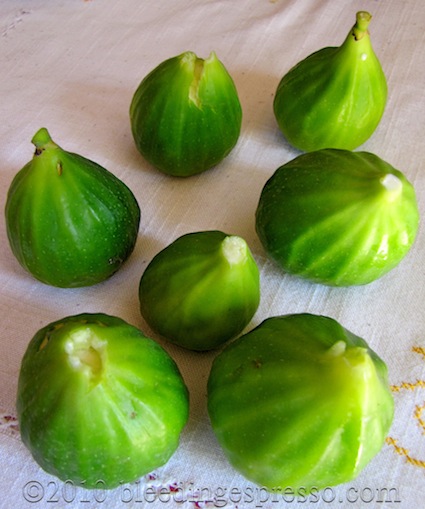
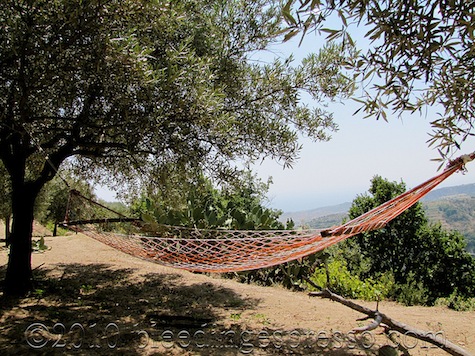
Truth be told, though, while P prepared, I spent a lot of time either reading David Farley’s An Irreverent Curiosity: In Search of the Church’s Strangest Relic in Italy’s Oddest Town on my iPod Touch (Farley will be our guest on the Eye on Italy podcast this week!) or just staring off into space while sitting here:
Last week was quite stressful for me with all the Amanda Knox-related posts, and if you haven’t noticed, I’ve now turned comments off on them. I wanted to start this week stress-free and get back to focusing on my life and the people, animals, and few objects I’ve chosen to surround myself with.
I do appreciate that there are horrible events in the world every day, but many years ago I stopped watching the news because it’s too easy for me to get emotionally involved in all the bad — there is *so* much bad — and that just isn’t good for me. I still like to think I stay well-informed by picking and choosing what to read, and I lend my support to causes I truly believe in, but I just can’t let in all that negative and still live a happy life.
Perhaps that’s selfish, but it’s the best — and only — method of self-preservation I know.
Thanks to everyone who read and commented last week; hopefully some of the newcomers will stick around, but if it’s just the “regulars” here, that’s cool too. You’re the best regulars around.
And now, gratuitous kitty photo entitled “iz reddee 4 mah closeup” just because:

Have a great week!
Amanda Knox Conviction: Motivazioni della Sentenza
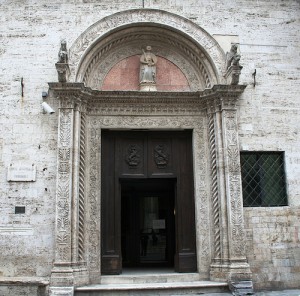 So far this week, we’ve been through the alleged anti-American bias and so-called media circus in the Amanda Knox murder case.
Quick recap: While it seems many (not all) Knox supporters have backed off the anti-Americanism claim, many still don’t believe the experiences of those of us who live in Italy regarding media coverage. I don’t know why I (and other Americans living in Italy who commented on the post of their own free will) would have any motivation to lie about how much average Italians followed this case in our experience, but there you have it.
My final words on that: Yes, this was a big news story when it broke — the murder of a young girl always is — and it got bigger because of the international angle, making it one of the top stories to come of out of Italy in many years (mostly because let’s be honest — the world normally doesn’t care what happens in Italy). But as far as what average Italians were talking about and paying attention to, this just wasn’t on the radar. I’m sorry if that ruins your image of our morning cappuccino chats, but it’s true.
One thing before we move on regarding comments, though: thank you to everyone who stayed on-topic and gave their viewpoints on the last post. Much appreciated. And to those who commented with obviously false email addresses, you’re spammers to me, so that’s where your comments went. Blatant disregard of my rules will also send your comment to the rubbish bin.
Moving on…
The So-Called Conviction Based on Nothing
I was in in the United States when the Knox and Sollecito verdicts were announced. Following the announcement, I watched as some American commentators trashed the entire Italian criminal justice system because an innocent American girl was railroaded and just convicted on no evidence and all of Italy should be ashamed of itself and harumph! *crosses arms in indignation*
It was a well-crafted and well-executed play on emotions, but unfortunately not entirely based in reality. There was and is evidence on which the court based its decision. In fact, the court has since written it out for everyone to read — in the 400+ pages of the “motivazioni della sentenza,” which we’ll get to in a bit.
Before I get into what is in the decision, let me lay down some disclaimers about this post:
 1. My goal here is mostly to provide those who haven’t been following the case or who haven’t been privy to what is contained in the sentencing report because they don’t read Italian an idea of what the Italian court believed and on what it based Knox’s conviction. From what I’ve read, particularly in the American press, the impression has been given that Knox was convicted based on her behavior and nothing more. This post is to clarify that the factfinders had more before them than just Knox’s behavior.
2. What I am including below is my personal translation of what I consider to be the major pieces of evidence on which Amanda Knox was convicted; there is obviously *much* more to the report, including various theories as to why Knox and Sollecito acted the way they did at different times. Some of those scenarios undoubtedly weighed more heavily into the decision than others (and it’s certainly personal opinion as to whether their scenarios make sense), but I’m focusing on physical evidence and eyewitness testimony, because, again, I don’t think they have been widely reported in English-speaking media.
In other words, I’m really not writing this post for those of you who live and breathe the case, as I’m sure those of you who disagree with the decision have an argument against every piece of evidence below — which by the way is entirely normal in a criminal trial.
3. I’m not addressing the evidence against Raffaele Sollecito or the case against Rudy Guede. This is not an indication that I think either or both of them was rightfully or wrongfully convicted — I’m just not covering it here. They certainly deserve their own posts, but I’m not the one to write them, at least not now.
4. This post will present what the judges wrote. Period. Whether or not you agree with the findings of the court is another matter entirely, and something many of you touched on in your comments throughout the week. You’re likely to get into that again in comments, but I’m not going to be commenting on it.
5. Whether or not I personally would have made the same findings of fact as the court did, I can’t say. In fact, I can’t know because I haven’t read the trial transcripts or have any indication of what witnesses sounded like, etc. I’m sorry I won’t take for granted what “journalists” have written about what went on in court. I just don’t trust either “side” with that information.
 6. Even taking as true every finding of fact by this court, whether or not I personally would have voted to convict Amanda Knox based on the evidence the court accepted is not in discussion — and this is closely related to the previous point.
Without having access to trial records and transcripts, I simply don’t feel like I can make an adequate judgment about what I would have done in their shoes. I could, with transcripts and previous motions and all that fun stuff, take a position on what I’d find on appeal — but I don’t have them, so I won’t.
Once upon a time, I used to be an appellate law clerk who reviewed trial court decisions in order to offer my thoughts to the judge under whom I worked, and trust me, the trial court’s opinion was *never* enough to go by. Related to this point, remember in your reading of my very brief summary of the motivazioni, what the report is: it is the trial court defending its decision. It doesn’t necessarily mean the judges are right, and although the court has balanced the evidence, the way it presents is findings is partial to the way the judges believed things happened — entirely normal.
7. The motivazioni della sentenza isn’t officially translated into English yet, but keep an eye out on my Facebook page and Twitter, and I’ll let you know if/when it’s released. In the meantime, if anyone wants a copy of the report in Italian, you can download it here (this is a tip from a reader; I have not downloaded from there and can’t find where I did get it from. If you want a copy from me, just be in touch). If I have messed up any page numbers, please let me know as well; I just haven’t had the time to triple- and quadruple-check things like I would like.
Now, the motivazioni.
The Alibi
The court didn’t believe Knox and Sollecito’s joint alibi; as most of you probably know, both changed their stories on some points, but the important parts of the alibi include the following: they watched a movie on the computer, had a late dinner (even as late as 11 p.m.), were at Sollecito’s apartment the entire evening of the murder, and slept in until about 10 a.m. the following morning.
The court found the following evidence credible:
- Sollecito’s father called him at 8:42 p.m. the evening of the murder, and at that point a water pipe under the sink was already broken while the dishes were being washed; the court concludes this means they had already eaten dinner and were washing up at that time, debunking the “late dinner” contention (p. 69).
- Sollecito’s computer was last used at 9:10 p.m. meaning that there is no further proof that the couple was in Sollecito’s apartment after that time (p. 68).
- An eyewitness testified he saw the couple outside near a basketball court at around 9:30 p.m. until sometime around 11 or 11:30 p.m., but they were gone by midnight (pp. 69-71).
- Computer data shows that Sollecito’s computer was turned on at 5:32 a.m. and music was played for about a half hour (p. 73).
- Sollecito’s cell phone was turned on at 6:02 a.m. at which time he received an SMS that his father had sent the previous evening at 11:14 p.m. (p. 73).
- An eyewitness identified a girl who matched Knox’s description as waiting outside of his “generi alimentari” store (sells everything from food to cleaning and personal hygiene products) to open at 7:45 a.m. the following morning; he didn’t remember what, if anything, this girl bought, but he did say he saw her headed in the direction of where Knox and Kercher lived (pp. 74-75).
- Sollecito’s father called and spoke to Sollecito at 9:30 a.m.; this phone call was never mentioned by Knox in her statements, which the court concluded to mean she didn’t know about the call because she wasn’t in Sollecito’s apartment at the time (p. 74).
Based on this evidence accepted by the court, they found that neither Knox nor Sollecito were truthful about their whereabouts the evening of the murder and the morning after.
The Forensics
The court turned to forensics, and accepted the following into evidence:
- Three separate samples found in the small bathroom that showed Kercher’s and Knox’s DNA mixed, all that tested positive for human blood (pp. 198, 204); these were located in a sink, around the drain of a bidet, and on a Q-tip container on the sink. Two experts maintained that the stains in the sink and bidet appeared to be diluted blood and made of a single trace based on their shape (rising and falling together) (pp. 301-02).
- Several samples taken from the small bathroom showed Kercher’s blood not mixed with anyone else’s DNA matter (pp. 198, 204); one of them was on the light switch and another on a bathmat, which the court concluded meant someone entered the bathroom with Kercher’s blood on him or her (p. 300).
- A sample that showed a genetic profile mix of Knox and Kercher in the bedroom of one of the Italian roommates (p. 200) — the room that also had a broken window.
- Also in the Italian roommate’s room, a footprint uncovered with luminol toward the entrance of the room that resulted in a genetic profile of Knox and Kercher mixed (pp. 205-06).
- A footprint in the hallway leading out of the Italian roommate’s room that had been uncovered by luminol with the genetic profile of Knox (p. 206).
- In sum: 10 samples in the house that included Knox’s DNA; five that were mixed with Kercher’s (three of which tested positive for human blood), but none in the room where Kercher’s body was found (p. 221).
- A 31 cm knife recovered at Sollecito’s apartment that was shown to have Knox’s genetic material on the handle and Kercher’s genetic material on the blade (p. 201-03), although Kercher had never been to Sollecito’s apartment (p. 313). The court explicitly refuted any contamination could have happened (pp. 282-84; pp. 308-12).
- The court found that this knife was compatible with the fatal wound to Kercher (p. 313).
As I said, the court went through many, many other things in the sentencing report (as you might imagine with over 400 pages of material), but to me, these were the most damning for Knox — and again, my going through this evidence isn’t intended to support the prosecution’s case or the convictions but only to make clear that there was physical evidence and eyewitness testimony in front of the judges.
 I simply can’t tell you from reading the report how strong the evidence was, how convincing the eyewitnesses were, etc. I can’t say if the court got the decision right, half-right, three-quarters wrong, or totally blew it. Again, to be perfectly clear, my point in sharing this information is to show people who haven’t seen this before what evidence the court had before it and on which it based its decision.
The defense challenged all the evidence and attempted to poke holes in the prosecution’s case as best it could, but at the end of the trial, the judges and jury didn’t believe their side — and in the report, the judges do explain why they didn’t buy the defense’s arguments along the way.
I’m sorry, I know that’s a really general statement, but there’s just so much in there, it’s impossible to go through it all here; I will say that in my opinion, whether I agree with its analysis or not, the court did an excellent job of covering its bases, so to speak, and didn’t give off any of the vehemence or anger one might have expected judging from claims that the Italian criminal justice system just had it out for this girl. The opinion, IMHO, was rather sober indeed.
And so, to bring this week to a close, the court in the Amanda Knox trial (Part I) formed a decision, and it *was* based on evidence — despite Mignini’s wild imagination and seriously crazy theories, a lot of which were implicitly if not explicitly discounted in the motivazioni. And as I wrote before, if you have problems with what the judges believed, that’s entirely another issue, and it will be dealt with on appeal.
*
Some final thoughts: We all know that miscarriages of justice happen all over the world, so if one happened here — regarding any of those convicted — I imagine we all hope it gets fixed on appeal. I always root for justice, and I keep hoping we just may find out the full truth of what happened that night in Perugia directly from whoever was involved.
The only thing I know for certain regarding this case is that my heart breaks for the Kercher family and friends. I can’t begin to imagine what they have gone through and will continue to go through with each passing birthday, holiday, and every single ordinary day in which they don’t get to see their daughter, sister, or friend laugh, smile, and simply be.
May Meredith rest in peace, and may her family and friends find comfort in their memories.
—————
As many previous commenters have mentioned, if you’re interested in another American perspective on the case that differs greatly from Candace Dempsey’s Murder in Italy, check out Angel Face: The True Story of Student Killer Amanda Knox by Barbara Latza Nadeau, a journalist based in Rome. I haven’t read this book, so I can’t give my personal review, but I think you can already get a feel for the tone based on the word “killer” in the title. UPDATED: I did read and do a short review of this book on the Bleeding Espresso Facebook page.
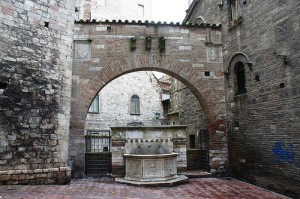
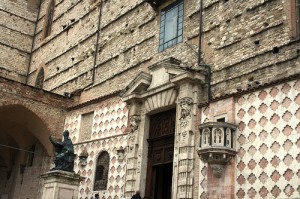
[PHOTO CREDITS via Creative Commons licenses: Perugia Corte d’Appello by B.Roveran on Flickr; Perugia by B.Roveran on Flickr; Perugia by B.Roveran on Flickr; Perugia by B.Roveran on Flickr]
 Michelle Kaminsky is an American attorney-turned-freelance writer who lived in her family's ancestral village in Calabria, Italy for 15 years. This blog is now archived.
Calabria Guidebook
Recipes


