
Archive for the ‘food’ Category
What’s Cooking Wednesday: Spaghetti Aglio Olio e Peperoncino
OK, I’m kind of wimping out here as this week’s What’s Cooking Wednesday is probably the simplest pasta dish ever invented.
But that doesn’t mean it’s not good.
And it also doesn’t mean I haven’t seen it on Italian restaurant menus pretending like it’s all fancy and frou frou when really, every Italian has probably eaten this thousands of times when there was nothing else in Mother Hubbard’s cupboard (or, you know, when they were drunk and/or hungover).
I’m just sayin’.
Spaghetti aglio olio e peperoncino
(Spaghetti with garlic, olive oil, and hot pepper)
*serves 2
 Put on the water to boil.
Peel 3 cloves of garlic, crush slightly. Set aside.
Chop up one hot pepper (or don’t if you’ll use hot pepper flakes instead), and set aside.
Once the water is boiling, add salt and pasta; remove when al dente and let sit in strainer.
Now heat a generous amount of oil, about 5 tablespoons, on medium heat, and then add the garlic, hot pepper (to your taste), and a bit of salt. Just let the garlic get a little brown, but be careful so it doesn’t burn.
Remove the garlic, add the pasta to the pan, and toss well together, leaving it all over the heat for about a minute as you mix.
And that’s it.
So seriously, please don’t ever spend money on this in a restaurant. I don’t ask much of you around here, so per piacere?
Other additions to this dish to make it more special include parsley, grated cheese, and even bread crumbs, but this is your basic Spaghetti aglio olio peperoncino, and it’s truly delicious as is.
Buon appetito!
P.S. Weather watch for Pasqua photos: it’s *extremely* windy and rainy right now, but I’m hoping that means it’ll clear up for the weekend–can’t stay like this forever, right?
Pasqua / Easter in Calabria
Many people who haven’t visited Italy often think that Christmas is the big holiday here–Catholicism equals Jesus equals Christmas, right? Well, Jesus’ birth is most definitely celebrated (amazing presepi are everywhere), but in fact, Easter, the day Jesus rose from the dead after being crucified, is hands down the most important holiday in Italy.
I’m not religious (although I was brought up Catholic), but it’s easy to get caught up in the emotions of the Pasqua (Easter) season, particularly in this village.
The festivities begin on Palm Sunday with the blessing of the palms; see Cherrye for more about this tradition. Since I don’t participate, my neighbor makes sure I’m not a complete heathen and always brings me some; this time she also brought me a Calabrian cake traditional for Easter called “cuzzupa.” They are kind of crumbly with a slight lemony flavor, not too sweet and perfect with espresso.
If you’ve been around Italian neighborhoods, perhaps you’ve seen such cuzzupe twisted and shaped into baskets and cradling hard-boiled eggs, but here where I am, they simply make small, glazed cakes usually with rainbow sprinkles.
And, yes, they are delicious. I’ll post a recipe later this week.

Then from Monday through Friday, every morning there is a small procession through the village with a drummer and a small group of male church members dressed in the robes of their brotherhood; each of the village’s 13 churches has a corresponding brotherhood, or organization that keeps its name and activities going. The groups change each morning, and the songs are in a mix of Italian, Calabrese, and Latin–which means I understand precisely nothing.
But you don’t need to understand the words. It’s enough to hear the wails of mourning that their Savior is about to be murdered, martyred. They stop in front of several churches to sing, and are accompanied by a steady, slow drumbeat as they walk through the village.

All of this leads up to grand procession of Sabato Santo (Holy Saturday), which lasts for approximately nine hours, starting at one in the afternoon and ending when the last mass is said in the main church sometime around 10 p.m. People come from all over the area to take part in this special tradition as this village is one of the few around here that still does it.
Participants dress in costumes representing the major and minor players of Christ’s crucifixion, including Christ himself, who is given his cross at one of the lowest points in the hilly village and carries it on his shoulders for the rest of the procession. There are soldiers, penitent sinners, the other two who were crucified with Jesus, the Madonna, and so many more–and then there are the regular folk who are welcome to walk along the path, which touches most of the villages churches, including one on the site of a former monastery.
Then on Sunday is the “Cumprunta,” which is the meeting between the risen Christ and the Madonna on a small incline leading up to one of the churches. Onlookers line the street for a glimpse of the reunion as between them younger boys from the congregations run up and down the hill, accompanied by frantic drumbeats as back and forth, back and forth, they wave their churches’ flags–which are at least five times the size of them.
The statues of the Madonna (dressed in black) and Jesus are on separate platforms carried by groups of men from oppositely situated churches. As the statues get closer and closer, the men run faster and faster so that the statues meet, and at that exact moment, the Madonna’s black clothes are stripped to reveal a beautiful white, celebratory dress–her son has risen.
It is beautiful and moving and wonderful and *sigh.*
I think it’s my favorite moment of every year.
Afterwards there is spontaneous dancing in the street as the drumbeats continue, and the strongest men balance the wooden poles of the enormous flags in their mouths, holding the strings of the flags with their outstretched arms to keep everything in check. And so they dance, looking up at these flags now as high as the houses for as long as they can stand until passing it to the next willing taker.
The other day in the piazza, I saw a little boy practicing with a push broomstick in his mouth, preparing for his future day in the sun. Oh, why hadn’t I brought my camera?!
I give you these tidbits now, but if all goes well with the weather, there will be more information (i.e., photos) to follow later this week. So let’s pray for good weather, shall we?
Picking Truffles in Calabria: Another Homeless Smurf
On Saturday afternoon, P and his friends went hunting tartufi (truffles) in the mountains that surround us. Other than a ton of rainbows, the sprouting of delicious mushrooms is another great side effect to all the rain we’ve been getting. While normal funghi hunting, e.g., for porcini, occurs in the fall and winter, our black truffles are just getting good around this time.
Ah, yes, I should point out that we only have black truffles down here as the white, expensive, sacred ones are further north in more famous white truffle country.
So how did we do? Well, no luck on the tartufi this time, but P did find a rather unique ‘shroom that he brought home for me. Have I mentioned he’s always bringing me something?

This is actually a porcino, well out of season, and just cute as a button (about that small as well). So if you want to start up a collection or something, it would seem that we’ve just created another homeless Smurf*.
And you thought Gargamel was nasty.
*In Italian, the Smurfs are called “I Puffi.”
 From Wikipedia: Italian: puffi (singular: puffo), the name has been reinvented from scratch because in Italian language the “schtroumpf” or (in Italian spelling strumpf) reminds speakers of the Italian word “stronzo,” literally meaning ‘piece of excrement.’ Note that the dialect word ‘strunz‘ is even closer to ‘strumpf.’ The fantasy name “puffi” is derived from the word “buffi” (singular: buffo, as in opera buffo) a word meaning at same time “funny” and “strange.”
what’s cooking wednesday: rosemary rabbit and roasted potatoes
Let me start by saying I know rabbit probably isn’t a common dish for many of you, but we eat it all the time as P’s parents raise the little guys for food. You could easily do this recipe with chicken, though, so please don’t be put off by the bun’.
This week’s What’s Cooking Wednesday will mark a first around here as I decided to post an entire meal–mostly because once I put a plate together last night, it looked so darn good, I couldn’t resist.
So, here we have rabbit with rosemary, roasted potatoes, garlic bread, and salad with red onion. Let’s take it from the top with all the ingredients you’ll need for everything.
 1 rabbit cut into pieces
6 medium potatoes (serves 2-3 people)
salad greens
6 cloves garlic
olive oil
rosemary
white wine vinegar
salt
black pepper
peperoncino
1 red onion for salad (optional)
Oven-Roasted Potatoes
First preheat the oven to about 400°F (205°C). Peel and cut the potatoes into wedges, and put them in a baking dish. Drizzle with olive oil and season them with black pepper, peperoncino, a few sprigs of rosemary, and a generous amount of salt. Don’t be afraid of the seasonings here; it takes a lot to overseason potatoes (except with the peperoncino, depending on how hot you like them).
Put them in the oven, and just let them do their thing. Every now and again, give them a shake and turn them around a bit. They should take about an hour and fifteen minutes to roast, and if you want them crispy on the outside but soft in the middle (how I like them but P doesn’t), it’ll take a little longer. The other option to shorten cooking time is to raise the heat from the get-go.
Let the potatoes sit for a few minutes before you eat as they are extremely, extremely hot out of the oven. Bet you knew that.
Rabbit with Rosemary
If the rabbit (or chicken) isn’t cut into pieces, that needs to be done first. P’s in charge of all things bunny around here, so he does this, and I have no tips to offer. Although a lot of people marinate the rabbit, we don’t, and I really like it better this way because you taste more of the rabbit and less of the seasonings, but to each her own.
Put a generous amount of olive oil (5 tablespoons) in a frying pan and sauté 4 garlic cloves on medium heat until lightly golden brown and then remove.* Add rabbit pieces, seasoning with black pepper, peperoncino, salt, and rosemary sprigs. Once one side of the bunny is browning, flip, and let the other side brown as well.
Turn down the heat to low, add about a half cup of white wine vinegar, and let rabbit simmer for another fifteen to twenty minutes or so, or until the inside is no longer pink. If your rabbit is sucking in all the liquid too quickly, add some hot water, but only if absolutely necessary.
*For a special treat, add some pancetta/bacon to the garlic at the beginning; this adds a great smoky taste.
Note that the entire rabbit portion of the meal will probably take about forty-five minutes, so you can try to time it with the potatoes accordingly.
Garlic Bread
About five minutes before you will eat, you should put the bread in the oven. You can use a fancy broiler if you have, but I just used the heat from the potatoes and set the oven on its lowest setting for the bread.
Use thin slices of preferably Italian bread, and smear on a little butter or drizzle a little olive oil, depending on your taste. Peel a couple of garlic cloves and cut in half; use the halves to rub onto the bread.
Put in the oven, and remove when toasted to your liking–a light golden brown is usually good.
Salad with Red Onion
OK, you probably don’t need instructions here, but for the sake of a complete meal, I’ll describe what I did.
Wash the salad greens and tear into bite size chunks. Cut a red onion into chunks and mix with greens. For the dressing, drizzle olive oil and white wine vinegar on top and then add salt and a pinch of sugar. Toss salad and serve.
And there you have an entire meal, ready in about an hour and a half from start to finish.
Buon appetito!
—————
[tags]rabbit recipes, rosemary, roasted potatoes, potatoes, salad, red onions, garlic bread, cooking, what’s cooking wednesday, recipes[/tags]
What’s Cooking Wednesday: Louise’s Banana Cake (Moistest Banana Cake Ever)
Since March has again turned colder and since I just happened to have some overripe bananas laying around, I decided to do some baking yesterday.
Wait, are you suggesting that I purposely didn’t eat those bananas the past few days just so I could make Louise’s Banana Cake?
Oh, dear blog readers, you know me too well.
So, as mentioned, this week’s What’s Cooking Wednesday is Louise’s Banana Cake. Perhaps you remember that my mom’s name is Mary, and my grandmother was Paulina/Pauline; if so, maybe you’re wondering who this Louise character is.
Louise was my grandmother’s neighbor and “good buddy,” as she always said, whose family surely has no idea that her legacy lives on in my family in the form of an old, tattered recipe.

Louise's Banana Cake Original Recipe
Yes, it’s that good. In fact, it’s my second favorite cake of all time, after only the chocolate one I shared with you last month.
When writing this post, I remembered that I actually have some old family photos in an album here, and lo and behold, there is one of my grandmother (left) and Louise lounging about in what was at the time our half of the backyard; my family now has the whole thing (without the dividing fence) because after the whole row of houses burned down in 1971–stopping at our house–Louise’s family chose not to rebuild on the same spot; my grandparents bought the entire lot and built the house that I and my brother grew up in and where my father now lives. Check out that car in the background y’all!

My grandmother and Louise of Banana Cake fame in our backyard
Ahem, right. The recipe.
It’s for an ordinary 13 x 9 pan, but this time I made muffins and a loaf (looks like bread but tastes like cake!).
My mom does a fabulous thing with this cake for special occasions–makes a whipped cream icing (recipe also below) and then does a layer cake, putting the whipped cream and fresh banana slices in the middle and then whipped cream, banana slices, and maraschino cherries on top with a sprinkling of walnut shavings. Yum!
For those of you in Italy, you can safely make the following substitutions: (1) 225 grams of butter instead of shortening; and (2) one teaspoon of “lievito vaniglinato per dolci” in place of the baking powder and vanilla extract.
Louise’s Banana Cake

Banana cupcake waiting for its espresso
1 c mashed bananas (2 medium, overripe)
1 1/2 c sugar
1 c vegetable shortening
3 eggs
3 c flour
1 tsp salt
1 tsp baking powder
1 1/2 tsp baking soda
1/2 c sour milk (add 2 tbsp of lemon juice or vinegar to sour it)
1 1/2 tsp vanilla
1 c chopped nuts (optional)
1. Mash bananas and set aside.
2. Mix together sugar and shortening, and then add eggs and beat until pale yellow.
3. Mix together the dry ingredients, and then add them to the sugar/shortening mixture, alternating with sour milk and vanilla. Batter will be thick.
4. Add bananas and the nuts if you’re using them, and beat until blended.
5. Pour or spoon into your baking vessel of choice and bake at 325°F (162°C). If baking a 13 x9 cake, it should take about 45 minutes, but check progress after a half hour or so. Muffins and loaf pans will take less time, so remove when the tops springs back from the touch and/or when a toothpick inserted in the center comes out clean.
Whipped Cream Icing
1 pint heavy whipping cream
1/4 c sugar
1 tsp vanilla
Whip (on high speed) until stiff peaks form.

Banana cupcake: Nom nom nom
Buon appetito!
 Michelle Kaminsky is an American attorney-turned-freelance writer who lived in her family's ancestral village in Calabria, Italy for 15 years. This blog is now archived.
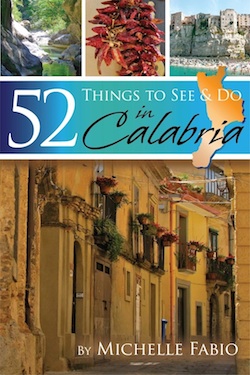
Calabria Guidebook
Recipes


