
Practicing Mindfulness & Saying No to Multitasking
We don’t have running water in the orto (where the goats, chickens, and several fruit trees live), but we do have a hose that runs from our cantina over there.
When we first put the animals in the orchard, I hated Water Day, i.e., those mornings every few days when I’d turn on the hose from the basement, walk to the orchard, and then clean and refill all the various water containers, including a couple dozen empty bottles that would help me do the cleaning, watering, and refilling in between Water Days.
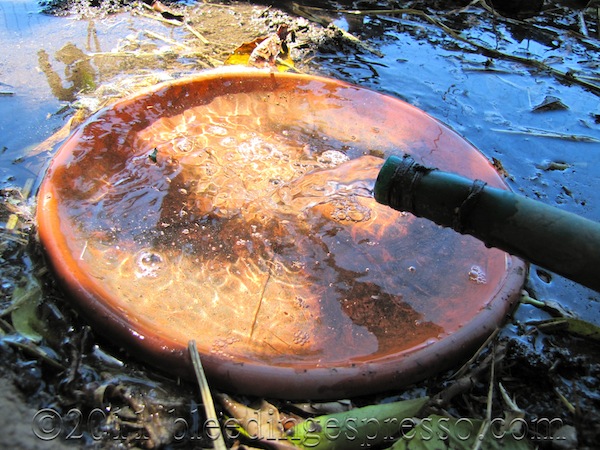
Water Day!
What a freaking chore, I’d think, on those mornings.
I’d will the water to flow faster since I can’t actually turn up the pressure; the hose is put together in sections and will blow apart halfway to the orchard if the pressure is too high. Yes, I know this from experience. Ahem.
So I’d spend that half hour making the day’s to-do list, mentally composing all the e-mail responses I could be typing if only it weren’t Water Day. I’d flip the hose violently around from spot to spot, often drenching myself in the process. FYI trying to do anything faster with a hose in your hand is not recommended.
Then I read The Miracle of Mindfulness by Thich Nhat Hanh.
I know many of you also appreciate this Buddhist monk’s writings, but for those of you who haven’t yet had the pleasure, please get a copy of something, anything he’s written immediately; I do recommend starting with his thoughts on mindfulness:
Each act is a rite, a ceremony. Raising your cup of tea to your mouth is a rite. Does the word “rite” seem too solemn? I use that word in order to jolt you into the realization of the life-and-death matter of awareness.
One of the examples Nhat Hanh uses is washing dishes. I don’t know about you, but washing dishes falls somewhere in the realm of root canal on my Pleasure Scale. So when Nhat Hanh kept stressing how important it is to really pay attention while washing dishes, I didn’t know if I could *ever* get the hang of this mindfulness thing. Then came this line:
“I clean this teapot with the kind of attention I would have were I giving the baby Buddha or Jesus a bath.”
And something clicked for me.
I’m not religious, but the idea that each and every thing we do should be done as if it were of the utmost importance has stayed with me. The concept that we should concentrate, focus, and be mindful of each swipe of the sponge around the teapot — or of each drop of water that falls into the bottle — made so much sense.
Once I stopped focusing on the time I was “wasting,” I began to appreciate and even cherish my time spent filling water bottles.
Now I look forward to Water Day to have those extra morning moments, drinking in the sounds of birds chirping and the goats munching on their hay and the sight of the chickens scrambling for a taste of fresh water. In small groups, the birds chase the little streams that form when I move the hose from spot to spot, and they especially enjoy sipping from a little dish where I rest the hose in between filling water containers. The dish sits at the base of our huge lemon tree — assuring no water is wasted on Water Day.
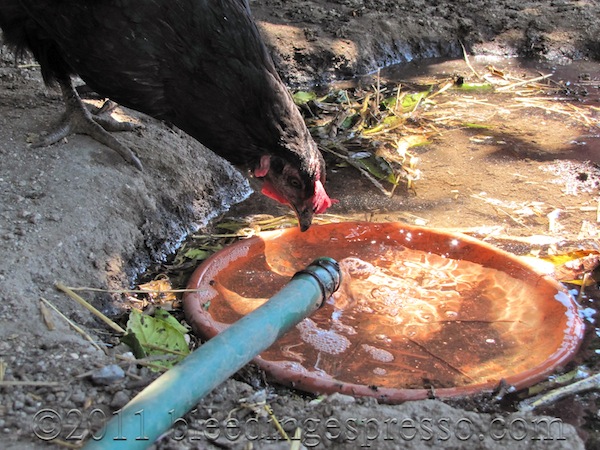
Hen enjoying the fresh water
So yes, Water Day has become special for me as I provide nourishment to creatures who in turn give us nourishment — and I’m even entertained in the process. To me, this is what being mindful is all about. Really paying attention to everything you do, while you’re doing it, and stopping your mind from wandering off to other places that have nothing to do with the task at hand.
It’s been amazing for me to realize just how much more I get accomplished simply by focusing on each task, on its own.
In other words, multitasking is the enemy.
Multitasking prevents, nay prohibits, the essential concentration and focus that allows me to complete tasks effectively, efficiently, and with fewer mistakes. Have you ever carelessly cut your hand while washing dishes because you unthinkingly thrust your hand into the soapy water and met a knife blade on the way? That’s less likely to happen if you’re focused and concentrated on each plate, glass, and piece of silverware — and especially if you’re not just hurrying through the task so you can check another item off your to-do list.
Something else interesting has also happened thanks to mindfulness:
Being present in the moment has led to innovation.
Once I gave Water Day the importance and appreciation it deserved, my mind was open to figuring about how to become more efficient. When I accepted that just because I wasn’t doing five things simultaneously didn’t mean I wasn’t getting anything done, I could focus on what was before me and improve upon my technique, making that time even more productive and valuable.
The new method? It starts with non-Water Days as I use up the water in the bottles. I put the empties back in the crate upside down to be able to tell the full bottles from the empty ones at a glance; this avoids frustratingly choosing empty bottle after empty bottle when I just need to fill the goats’ bucket. The sight of all the upside down bottles also makes it abundantly clear that it’s time for another Water Day.
When Water Day arrives, I flip all the bottles right side up in the crate and remove all the lids at once so I can just stand over them with the hose and refill them, directing the hose to one, then the next, and so forth. Sounds simple, but I used to gather some empties, squat to the level of the hose, remove a lid, fill a bottle while holding it, cap it, putting it aside, and repeat to fill every bottle, one by one, and then walking them to their crate home a few at a time, back and forth. Believe me, my back thanks me for the new technique.
Then when all the bottles are filled, lids are replaced two at a time (one with each hand) while the goats’ water bucket is being filled by the hose at my side. Orderly, productive, and best of all, calm — no rush whatsoever. Mindful efficiency.
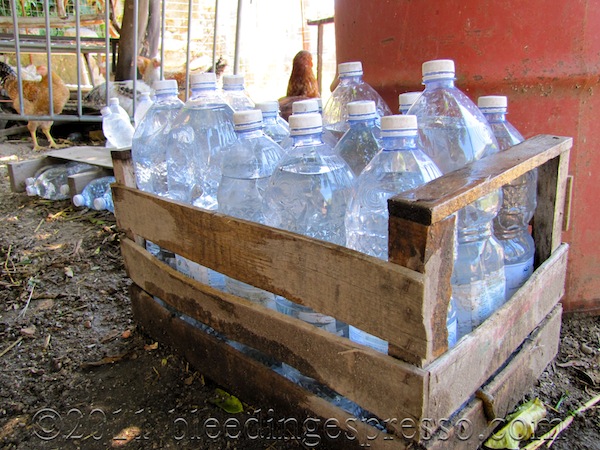
Another Water Day just about done.
So do all these wonderful realizations and routines mean I’m successful at being mindful all the time? Hardly, but that’s why they call it practice.
The more you put a new theory, a new belief into practice, the deeper it becomes ingrained in you. And indeed, I’ve noticed that on my way to mindfulness, it’s becoming mindless. I no longer *always* have to force myself to focus on the task at hand; it’s slowly becoming second nature for my mind to stay firmly planted on whatever I’m doing and not to wander too far off. I’m more relaxed, I don’t feel nearly as overwhelmed as I once did, and I’m accomplishing so much more by paying close attention to what I’m doing.
Maybe you’re thinking, but I don’t have the *time* to be mindful! I have X kids/work X hours a week/a gazillion errands to run/etc. I don’t pretend to know your exact challenges, but I assure you I absolutely thought the same thing — that I’d be “wasting” time if I “only” did one thing at once. So on that, I refer you back to Nhat Hanh:
Mindfulness frees us of forgetfulness and dispersion and makes it possible to live fully each minute of life. Mindfulness enables us to live.
I urge you to at least give mindfulness a try for a day, a week, a month. It might be challenging at first depending on how many things you’re *usually* doing at once, but as I said, it gets easier and more natural. And, hey, if you don’t like the results, you can always go back to multitasking your heart out. But if you do find that mindfulness works for you, please share the idea with others. I can’t help but believe that the more mindful individuals there are in the world, the better off we’ll all be.
Do you practice mindfulness?
Do you have a chores/obligation that could benefit from increased focus and a change in perspective about its importance?
54 Beans of Wisdom to “Practicing Mindfulness & Saying No to Multitasking”
-
[...] isn’t the right word. Maybe it’s “zen” or “balanced” or “mindf... gigigriffis.com/faith/get-back-to-zen
-
[...] easy, or even always possible. That’s why it’s called the practice of mindfulness, as Mich... acertainsimplicity.com/2011/06/the-sacredness-of-the-everyday
-
[...] always easy, or even always possible. That’s why it’s called the practice of mindfulness, as Mich... dianabaur.com/2012/05/the-sacredness-of-the-everyday
Recipes


You had me at TNH. I adore that man! I can safely say his teachings changed (perhaps even saved) my life. I’d love to someday join him on one of his walking meditations. Plum Village is on my list of places I’d love to visit!!
We should totally go to Plum Village together…imagine?!!!!! xx
I remember reading this and when I slowed to pause, and give each act I did importance, it made life, and my role in it, that much more beautiful. Thanks for writing and sharing this!
Thank you for taking the time to comment, Lauren 🙂
Thich Nhat Hahn is wonderful, a true inspiration. And in the same mindful breath, are you familiar with the work and books of Jon Kabat-Zinn? If not, look out for them, or find his site on the web. Brilliant, briliant stuff.
Thanks for the rec, Nicky; will definitely check it out!
Wonderful…just wonderful blog….. watering…hand watering yes.
I am a professional horticulturalist, garden designer & consultant, for many years I have been recommending that my clients hand water once a week even after they have automatic irrigation systems so that they may stay aware of their garden.
I can’t imagine having all the watering automated…how sad! This reminds me of something I’d like to write about the high price of convenience….
I love this….
Grazie carissima xx
Don’t you think that there is something about physical tasks that really frees the mind? Too often I use the time spent doing physical tasks thinking about other things, and sometimes those other things aren’t cheerful (reliving unpleasant conversations, anticipating upcoming confrontations) and it makes the task more unpleasant than it needs to be. I’ll have to look into that book asap!
Definitely something about physical tasks, Joanne! I am the WORST at reliving unpleasant conversations/exchanges and imagining confrontation during those times…I *really* have to fight it sometimes, but man is it worth it 🙂
I could certainly use more mindfulness and less multi-tasking in my life. As much as I love cooking, I often let myself get stressed or distracted, and I have a burn on each arm to prove it (accidentally touched a hot pan twice in two days)…
Love this post!
Imagine if everyone driving were actually mindful of what they were doing, how fewer accidents there could be…be careful, Elizabeth! 🙂
Oh, Michelle! I so very much agree with your take on the thankless task of washing dishes and I’d like to add bed-making in with that deal! What hurts though is that once I start washing the dishes, I find myself concentrating on that task and even somewhat enjoying it if for nothing else but the accomplishment of getting something done. I’m an excellent procrastinator, am also frequently totally disorganized too and need to work on your suggestions here for clearing the mind and doing one. thing. at. a. time! Something as simple and necessary as taking our little dog for a walk -which I actually do enjoy doing but some days, the joints and limbs are being obstinate with me, aching, acting up and I put it off longer than I should. I actually need this exercise time as much, if not more (for the exercise part, like the dog, not exactly for the other reasons he needs the walk for his intestinal relief, ya know) and if I’d just think about this and DO IT then and there, it’s an exercise that also relaxes my mind a LOT in the process too. I can mull things over easier while walking and enjoying the woods around me that aren’t really anything overly spectacular but yet, I find them to be lovely to look at anyway. Good words from you today and for that I really do thank you. Now, to get my screwed up mind and system to begin to be more cooperative to the changes needed. I think it’s time that Sammy and I did just that this morning -go for a walk and rest my brain to allow it to re-organize itself a bit in that process. Peace!
Oh good one — I don’t enjoy making the bed either hahaha…hope you got in some nice walkies 🙂
Thank you for reminding me! It’s a great post. I have several of Thich Nhat Hanh’s books and was in serious need of his wisdom some years ago. I don’t know what happened, probably a move overseas, or some other upheaval, and I got out of the habit of reading and meditating and fell back into my old dizzing around patterns.
Having just made another move (US to Moldova) I am finding myself rather scattered and unsettled, so I’ll dig out the books and get back into the mindfulness mode. I know it works.
Again, thanks for reminding me!
Best of luck settling in — scattered and unsettled are not enjoyable feelings for me either, so hopefully you can work through them as quickly and productively as possible 🙂
Hmmmmm, Michelle you are truly great at thought provoking….
You don’t have enough blog space here for me to write all I am thinking…..oooooops, was that the enemy?
In all seriousness I did come to this way of thinking and acting in 1974 but have had a couple of periods (10 – 12 years here and there) that I have not done well with it.
My last blog item (http://tinyurl.com/3p3cwx3) seems to speak to this subject. Interesting that your FB post was directly in front of mine for posting on my FB timeline.
This Mindfulness concept takes discipline, devotion and tenacity. Victor Borge provided the answer for most of us; “how do you get to Carnegie Hall?”, of course we all know the answer.
Through tai chi, qigong, deep meditation, prayer and mentoring those that seek it, a simple life of balance in this present moment is achieved.
No matter what our occupation, Mindfulness is the answer to being the best there is, in the present moment…..
Time to put the “orange crate” away….oh, Plum Village is present always in our “mindfulness” moments
Love and Light
richard aka “who”
Looking forward to reading your post, Richard, thank you, and thanks also for your comment here. Plum Village…aaaaah…..
This is a very tough one for me! I have always been a multi-tasker, even before Internet! But I clearly see the wisdom to it. Will have to read some of this man’s work.
I hear you; I had been doing several things at once long before the Internet as well — it’s not an easy transition, necessarily, but I do think it’s worth the effort 🙂
Another wonderfully simple, yet profound post about making mundane and repetitive tasks meaningful. As the Christian says in the same way, whatever chore or service you undertake, do it as though you are doing it for Jesus. As Charmain said already watering the garden by hand encourages mindful awareness of what is happening in the garden.
It’s quite comforting to realize the small role you’re playing in the cycle of life as well — I agree 🙂
love, love, love this michelle. anything i can do to ‘get outta my head’ is what saves me. it is why yoga/running are so healing for me. the challenge is bringing that clarity of mind to the everyday chores. thx for sharing. 🙂
I hear you on the yoga — not so much the running haha! Getting out of our heads can be a *very* good thing indeed.
What a great post, and something I need to work on, definitely. I sometimes end up feeling overwhelmed with all I have to do, even when there are things I enjoy …bathing the baby, gardening…I fight to rush through these items, and for what? This post really hit home with me – thank you for sharing.
YES! That is where I found myself too, Courtney, rushing through things I actually enjoy and never really getting the pleasure from them because I had so many other things I had to do as well. Best of luck on your journey 🙂
Thanks for this important reminder, Michelle. I used to find it hard to avoid multitasking at work and would feel guilty and unaccomplished if I didn’t. Until one day, our director said something very wise and a bit surprising: Go slow to go fast. I was reminded of this important piece of advice after reading your blog 🙂
“Go slow to go fast.” I love that! Thanks for sharing Aisha 🙂
Although I cannot see myself meditating over doing the dishes, the mindset you describe comes to me in two different activities. One, painting. When I am really involved in a painting, time stops. I am an extremely schedule driven person; but in the middle of a painting, I might forget to eat.
Another thing I respond to this way, is when i am weeding in the garden. I loosen up some soil, then I sift through it by hand and pull out grass roots. It is a wonderfully relaxing passatempo and when i get done, I really feel good. I went to look up your holy man but he has SO MANY BOOKS I am not sure which one to get.
I definitely recommend The Miracle of Mindfulness (link in post) first and then you can go from there 🙂
This is a great post. And I will look into reading something, anything, by Thich Nhat Hanh.
What amused me though, was your depiction of how you now fill the water bottles, compared to how you used to fill the water bottles. To me, the “now” way just seems like common sense, albeit a little messier, but more efficient in the long run. Funny thing is, that I often do things like that, and have often done things that way. Interestingly though, I’ve also been called “lazy” because I didn’t do them one by one, uncapping, filling and re-capping each bottle individually. And that always sort of chapped my hide (as Ed would say), being labled “lazy” because I chose to do something ONE time rather than one AT a time.
I don’t know that I practice mindfulness, per se, but I think I do pay attention to what I’m doing. I guess I’ve never called it mindfulness, but to me, it’s not having to do it more than once. To me, getting something done right the first time is more efficient. And I’ve always looked for what others might say is the “easy” way, but what I deem the “efficient” way. Interesting.
And my mother has often said that some of the tasks that people usually hate (washing dishes, sweeping the back porch, ironing…) can be used exactly how you have started to see water day – as a way to pay attention to the task at hand, or even use that time to relax and take in what’s around you.
Great post.
Thanks for commenting, Salena. I think part of the reason I hadn’t done the “now” way with the water previously was just b/c the other way was how I’d always seen it done here…and it’s a weird thing about living in a different culture that after a while, you stop fighting “their” ways and just copy (thereby avoiding a scene of them telling you how WRONG you are for doing it your way), assuming their way is better/right…but it isn’t always. Another example I can give of this is when we give the chickens our expired dry pasta; they’ll only eat it if it’s “hydrated,” so people here have always told me to boil it and prepare it just like normal pasta for them…only I realized that if you just let the dry pasta sit in room temperature water for a while, the pasta absorbs the water just the same, the chickens will eat it, and I don’t waste the gas needed to boil the water. Silly things like that, but when you’re “learning” a particular lifestyle, you often trust the “experts” — and as it turns out, that’s not always the most efficient. So it’s a combination of my paying more attention to what I’m doing *and* becoming more comfortable in this lifestyle that I think helps me come up with new (to me) methods of doing things. I’ve always looked for the most efficient way too, but I can’t stress enough how living in a different culture has made me second-guess my ability to do that…or at least it used to 😉
Your post gives new meaning to “chop wood, carry water.” I love what you wrote about, like everyone else who commented here, but I also love that you put yourself out there as an example to us all. Thank you bella. I am also left smiling after reading all the comments because once again, it shows that we are really all alike, seeking the same thing.
Peace, love and mindfullness to you!
Thanks Jeni! I love reading through the comments as well; it’s comforting to know we’re not alone on this journey 🙂
Thank you for this beautiful reminder.
I read “The Miracle of Mindfulness” about 6 months ago and felt so much more alive as I allowed myself to experience each thing I did – I ate more slowly, and felt each step as my foot connected to the ground while running – I was more peaceful when driving…but I slipped back into the American way of doing as much as possible, often in a state of mental numbness. I have continued to focus on my breath when I wake in the night and count one breath in, one breath out, 2 breaths in, 2 breaths out, etc. until I am asleep, and my middle-of-the-night stress level has stayed low. But lately when I go for a run I listen to Eye-on-Italy podcasts so instead of being in the moment I am far, far away eating pasta, drinking wine, or puzzling about Berlusconi!
I love the combination of mindfulness and water. I have always found it therapeutic to water the garden and we have several places in our yard where we can hear running water – I am glad that you have found such gentle peace in your water day.
Laura
Thanks so much for sharing your experience, Laura; I can’t blame you for the podcast multitasking though haha…but yes, water and mindfulness do seem to go particularly well together, I agree 🙂
Thanks, Michelle, for a great post. Your personal experience with mindfulness will help the rest of us think of similar actions where we can practice with more awareness to the task at hand.
I’ve read Thich Nhat Hanh’s “Peace is Every Step” and found it to be a life changing book. I haven’t read “Miracle of Mindfulness” yet but will look forward to it.
One question: Do you think it’s easier to live simply and be mindful while you are in Italy than when you were in the U.S? I do think spending time in Italy has taught me much about living life in the present tense. It used to feel easier to me to be in the moment while we were traveling there, but I’m learning to bring the same focus to my more hectic life here at home.
Great question, GG; as I wrote to Gina below, it’s probably worth a post…thanks so much for commenting!
What? You’re a mind reader, too? This blog was very timeful – a drenching hose on my parched-dry mind… Thanks again. TNH’s books – 60 seconds to my kindle, down-loading as we speak. Perhaps I will stop multi-tasking someday…. easier to accomplish in Italia than in the U.S. – why is that? should I care? Will return soon. Peace is within the boot. Brava bella. Grazie Tantissimo.
Several people have mentioned/asked about being able to find more calm/mindfulness in Italy…I think I may have to write about it…enjoy the books!
And I was so proud of my multi tasking skills!?! I actually slowed down my reading while I went through this post. I even read everything quickly and probably don’t get the whole message.Thanks this was appropriate. Now I’m off to clean my bathroom….just the bathroom and concentrate on the task at hand!
I’m definitely guilty of reading too fast sometimes — hope the bathroom is sparkling, and your mind clear 🙂
I did a day of meditation with TNH a few years back during his winter retreat in Southern California. He talked about eating mindfully, and then demonstrated by eating an orange slowly – taking the time to truly experience every juicy mouthful. One of the many things that was inspiring that day. Thanks for the post!
What an awesome experience that must have been; in the book he also talks about eating a tangerine (I believe) section by section. I think the Italians have understood this mindful concept of eating for quite a while haha 🙂
Another great post, Michelle, thank you. I’ll be reading The Miracle of Mindfulness as soon as I can get my hands on it.
Enjoy Beth; absolutely one of my favorites!
Great post! Any hope of putting in a water line up there in the near future?
Gil, this isn’t the “campagna,” where actually yes we’re installing pipes this summer woohoo! This is just a little plot of land a short walk from our house (short enough to run a hose there) 😉 We won’t put pipes in for that; not worth the money as the few houses between ours and the plot are empty (and falling down)….
I adore Thich Nhat Hanh. Where did we ever get the idea that multi-tasking was efficient? Or even a good idea? Ironically, I was more aware of the need for mindfulness in the US and practiced it much more proactively. Nowadays the only time I slow down is when I’m forced to stand a stir a risotto. Thanks so much for the reminder. It’s time I pulled his books off the shelf again…
I’ve definitely found that there are times when I need to pull down the books again as well; no doubt about it that mindfulness is more challenging in some times more than others. Thanks for commenting!
while we’re on the subject, I have discovered that pre-soaking beans and rice saves energy too! and if you treat them like sprouts (ignoring the bad press sprouts are getting this month) you get sprouted rice, beans, ceci, etc which has a higher protein level than the non-sprouted ones.
Thanks for the tip, Mimi!
I’ve come to the part of year where mindfulness gives way to fretfulness and focused concentration gives way to frenetic firing on all pistons. I get so tired. Every year I say to myself that I am going to find a way to do it – to maintain my mindfulness into the B&B season. And every year, after about eight weeks of being booked, I feel parched and burned.
Which tells me something. Not that I need to stop inn keeping, but maybe I need to rethink how we do it.
I do know that I am the happiest when I can write, when I can be in my studio, when I can cook and when I can walk Max with Micha in the vineyard. Those four things form the cornerstone of all in life that is of value to me.
Your post makes me wistful today. It’s just the tiredness kicking in. We have some time off coming up, a very good thing indeed.
Hugs to you, my friend. Thank you for reminding me what my own priorities are.
I hope you can find some good down time, Diana — it’s *so* necessary in general, but also just essential for the creation of even more lovely pottery 🙂 xx
Cherish the moment 🙂
Indeed!
I have a terrace garden in New York City with herbs, vines, plants, flowers, shrubs and trees that total about 65. I do not have a hose outside, nor am I able to use a portable hose that leads from my sink to my terrace, and, I’m constantly asked by folks from all walks of life, if I have a “watering system” (and they are referring to water vats outside that go on and off at set times). “I am my watering system,” I tell them, and, indeed I am. Twice a day (yes twice because New York City summers are hot and having things that grow in containers mean that they are subject to drying out). Therefore, I am traipsing in and out of my kitchen onto my terrace garden with a watering can — making numerous trips to make sure all sixty-five get their share of water — and like you, with your watering chore, Michelle in the past is a time I have been known to spend time constructing those “mental emails” as you call them as well as blog posts and blog comments although I am writing this one on my Mac Book Pro without a watering can in my hand. It took me quite some time to stop counting how many things still needed watering once I’d begun the daily rituals and instead to focus on the joy I received from the things I grow. I almost missed seeing a Monarch flower “drinking” from the flower on my Coppertina tree because I was preoccupied with the things I’d do when I was done watering. It is only when i was reminded of the nourishment to my soul that what I grow provides that I could go outside and water just for the pleasure of giving my plants, trees, herbs, and shrubs what they need — a drink when they are thirsty. I’m getting pretty thirsty myself with all this “water-talk” but before I sign off, two questions: 1. I’d like to re-blog “Practicing Mindfulness . . .” in my blog with proper credit to you, do I have your permission? 2. How do I include a photo by my name when I comment as others are doing near their name when they make a comment? With appreciation as always for your beautiful blogs. The LLG.
Love this, LLG; I also carry water bottles to my balcony for all the plants there — nowhere near 65, but YES twice a day during the height of summer. Thirsty little suckers 😉 Please feel free to repost this, and as for the photo in the comments, you can set that up at Gravatar.com 🙂 Thanks so much for commenting!
I appreciate the info that you gave me on Gravatar.com, Michelle, and actually stayed in the moment while I figured how to add a photo to my posting profile! I’ll let you know when I re-post your June 13th 2011 post, I am going to try and do it on the 18th (Saturday). Thanks for giving me permission to do this.
Woohoo! Your gravatar looks great 🙂
Very nice!! We all know, we must enjoy the ” Journey “…
Thank you for sharing!
Thank you for reading, CC 🙂
Hi Michelle, today I ate lunch at the computer, reading stuff online that I soon forgot and barely tasting my food. Your words remind me how much better and more relaxed I feel when I eat with mindfullness and purpose, appreciating the flavors and the nourishment and eliminating the distractions. And of course this goes for anything, not just eating.
Thanks for the reminder.
PS: your garden sounds wonderful.
I think for many of us, as long as we can remember, we were grabbing something to read or watch while eating…I blame cereal boxes!!!! 😉
Bella Mia,
You brought immediate smiles and nods of agreement as I wandered through all the truths and beautiful images on this page. I do love water, so.
I have been working on being mindful, here, too, but also open minded in an outward direction; I discovered that when I am multi-tasking, there are highways of information coming in to my mind and through my senses but nothing much getting out – too much going in one direction. So I’ve been pushing back out – letting more of what shines in me grow so that things like your ‘innovation in moments of peace and thoughtfulness’ are able to happen.
We cannot create and think and grow if we are overwhelmed and scattered by our many tasks and splintered attentions. We are stronger at our cores, centered, balanced, and able to be and give our best.
Thank you enormously for this, it was wonderful!!
I love the direction your blog has taken. Keep going.
XOXOXO
Scarlett & Viaggiatore
Yes, yes! It does make such a difference in what you’re giving out when your mind is traveling in a million directions. Not always easy for go-getter girls like us, but focus is a magical thing for everyone 🙂 Mwah!
Your post is a lovely meditation in itself.
What a beautiful comment, Elizabeth; thank you!
While it is true that I’m not a multitasker, it is also true that I am not all that mindful of the one task that I’m doing. I need to get a copy of this book and apply the principles to my natural inclination to single-task. Great thoughts here, Michelle.
Thanks Ally; you’ve already halfway there!
I love this! It’s been really hard for me (after quitting my full-time job and now working part-time at home) to turn off the American go-go-go attitude. I’ve always got something on in the background. I’m trying to do too many things. And it’s stressful.
This week I’ve been purposefully trying to limit my activities and focus. It feels so much better and more balanced. Though I’m still failing in some ways.
Lovely post!
Gigi, I’ve always studied/worked with background noise…I think that’s been my biggest achievement, to not always have *something* on 😉
I stumbled upon this idea – started taking slow alone meditation walks (I was beginning to hate my fast walks) – no thinking – just being in the moment. I had also heard somewhere not to multitask and I used to do that all the time. Maybe getting older helped me see the wisdom in one thing at a time. Anyway while visiting my sister-in-law and helping dry dishes I enjoyed those moments with her. When I got home and did my own dishes I felt a community with all the women in my family in the washing and drying and continue to feel that connection when I do that task. I look forward to it every day now – the warm water, the suds, the movements to wash, the accomplishment of renewing those implements that feed us again and again. So these are the things that feed my inner hunger. Thanks for writing about this discovery.
Oh I really hope to get there some day with dishes…still a chore for me, I’m afraid! Thanks for coming by, sillygirl 🙂
Glad you like my gravatar, Michelle, I still have not figured out how to include my “verified services” (Vimeo, You Tube, Tumblr, LinkedIn) , in emails that I send, but gravatar has approved them, so I am working on it being able to incorporate the verified services in my correspondences etc.
Meanwhile, in my last comment on Bleeding Espresso, I promised to let you know when I re-blogged “Practicing Mindfulness and saying no to multi-tasking” but I told you that I anticipated it would be June 18th 2011 as I was “scheduled” to write about garden watering. It seems I don’t have an option to re-blog your great post so I put a link to it within my June 18th 2011 post which if you have time can see it at this link:
http://thelastleafgardener.blogspot.com/2011/06/goat-berries-and-bleeding-expresso.html
BTW, I noticed your comment to “silly-girl” and I am with you on the doing dishes bit. I’ve stated that I don’t have a hose or timed-vat system for watering my garden but that I’ve made watering by hand pleasant, I do not have a dishwasher either, I am the dishwasher and like you I still find them a chore and I too “hope to get there one day” when it comes to dishwashing.
When I first moved to New York I could not find an apartment and I lived in an SRO (Single Room Occupancy) with the bath and sink down the hall. There was no cooking allowed and I recall that during those years I went to visit a friend who lived outside of Manhattan in the borough of Queens. She served a delicious lunch, and I offered to do the dishes, telling her that I was thankful to have dishes to wash, and a sink to wash them in, since I was stuck living in an SRO. As she sat on her kitchen stool watching me wash the dishes, she looked at me like I was out of my mind, and said that she would never miss doing dishes. I think of this from time to time as I bemoan my dishwashing ; and sometimes I miss the fact that I was once grateful for having dishes to clean and a sink to wash them in, but , as the song goes “those were the days, oh yes those were the days . . . ”
Thanks for that link! I really do need to get to appreciating these dishes…but I think I’d appreciate a dishwasher so much more hahaha 🙂
Thank you for your timely post. I found that my memory was getting less reliable – but I soon realized it was primarily because I was never fully experiencing my life. My mind was always only half there so, not only was I unable to be present in each moment, I had trouble remembering things. It finally made sense that I couldn’t remember what I never fully experienced. It is truly a process, but I believe it’s worth the effort.
Definitely affects memory, Rosann; I hear you! Amazing how much paying attention matters….
I feel like I’m actually pretty good at being mindful but I find that other people can get frustrated with me…the time it takes to do my prep work in the kitchen, compose a letter, take a shower, etc. I don’t think I’m excessively slow, but focusing on being fast takes my enjoyment out of the entire process and [you’re right] leads to clumsiness and forgetfulness. It would be sooooo nice if everybody slowed down a bit with me!
Yes, coordinating a calm, relaxed life with frenetic others is not easy…takes even more patience than necessary just for the mindfulness part…but it’s all good 😉
As per your response to my “6-20” comment, Michelle, I too need to appreciate doing dishes, and am no where near having the appreciation of doing them, as I did when I was at my friend’s apartment many years ago. Meanwhile, I am finding consolation in knowing I am not alone in my bemoaning as I do my dishes. (-;
BTW, did you ever hear of the children’s book, The Man Who Didn’t Wash His Dishes? Here is a link to some info about it:
http://www.amazon.com/gp/customer-media/product-gallery/0385077351/ref=cm_ciu_pdp_images_1?ie=UTF8&index=1
With that, I promise not to mention the DW word again.
Patricia Youngquist, the LLG (Last Leaf Gardener)
I haven’t heard of it, Patricia! Thanks so much for sharing 🙂 P.S. I haven’t made much progress on the dishes thing yet hahaha
Hi Michelle,
I love this post. I had the experience of being mindful before, where every little routine task feels enjoying. I felt more efficient and more alive. But then busyness, and so many other things that comes into my life, makes me back to my rush and multitasking habit. After reading your post, my heart is aching for that beautiful calm life of mindfulness. I immediately try to practice it, but find that I need more patience in order to make it more natural. Doing one thing at a time mindfully needs a lot of patience, but I’m willing to go through it, as the benefits is awesome. Thank you for the beautiful post.
Thank *you* so much for reading and sharing your experiences; patience is definitely required to be more mindful…and it’s also something most of us could use more practice with. I hope you can find some calm soon 🙂
When I try to sit and just “do nothing” and I get so antsy, I realize just how important it is to stop and detach. I also really like Pema Chodron, have you read any of her writings?
I have! Definitely enjoy her writings as well. Hope you can find some detach time…I imagine with three kids that’s next to impossible 😉
I am a big believer in NOT multi-tasking. It causes more harm than help. Cut things out of your schedule if you believe there’s no other way, because you harm yourself and others by doing things half-assed.
One of the most positive things about my recent move is that it helped me set up my life to live it mindfully.
Not only am I enjoying it more, my productivity skyrocketed, and my income’s also improved!
Yes, yes, yes, Devon; couldn’t agree more with you here…lovely to “see” you!
Amazing post… what an inspirational post which makes me feel to work upon those
things which actually turns down my mood…
Love this post!!!!
Glad you enjoyed! Mood changers, for me, are definitely most difficult to conquer…good luck!
Funny how things come to you at the right time. Multi-tasking, trying to do too much and not feeling like I’ve given all I can to each individual task has been my long time trouble and just as I’m really darn tired of it, I find this post. I usually read your blog regularly and would have seen this when you published it a few weeks ago but all that darned mult-tasking has had me busy and I glad I read it today vs. then because I was truly ready for the message(s) and I’m going to get Hanh’s writings ASAP.
Hahaha curse that multitasking! Always nice to “see” you, Kathy 🙂
be sure and read my last blog post http://www.mimitabby.com/blog/purple-mountains-majesty-serendipity I mentioned you in it!
Thanks Mimi!
I hate multi-tasking. It’s just too stressful and as you’ve pointed out there are fewer accidents when you are concentrating on the task at hand. I try to remind myself to use things like knives with a sense of reverence. You are much less likely to cut your fingers when you do so.
Indeed! Thanks for coming by Murasaki!
I’ve really enjoyed looking through your blog. I love Thich Nhat Hanh as well. I’ve applied his lessons to life, esp. laundry and dishes.
Thanks for coming by, Betsy! Laundry is something I’ve definitely become more “Zen” with over the years 🙂
Very insightful post. Multi-Tasking is less productive. In fact I wrote a similar article on my blog called Myths and Dangers of Multitasking. You can take a look
http://www.planetnaveen.com/2011/05/productivity-improvement-series-the-myths-and-dangers-of-multitasking/
Thanks for sharing, Naveen!