
Archive for 2008
La Befana: The Italian Epiphany Witch
 Today marks the end of the holidays in Italy as La Befana arrived last night. You don’t know La Befana? Read more about her here in my post from last year at this time.
As always, I’m sad to have to take down all the Christmas decorations; the house just feels a bit more empty, a bit more somber.
I suppose that’s not such a bad thing as it’s time to get down to the business of starting this new year and focus is always a good thing.
Friends, I *have* been focusing. Although it is the Italian tradition to return to work tomorrow, I’ve been quite busy the past few days–and perhaps that’s making you feel a bit neglected here.
One of the main things I’ve been working on, though, is a brand new look and home for this here blog, and I think you’re going to like what I’ve come up with.
But you’ll have to wait just a bit longer.
In the meantime I’ve had tons of positive energy from the blogosphere to keep me going, and I’ll tell you all about it soon.
Hope you’re having a lovely weekend!
La Musica Calabrese – Calabrian Folk Music
 One of my favorite parts about living here is that you never know when you’ll be caught up in an impromptu concerto. Seriously.
Now I’m sure some of you are thinking “Ah there goes another one of those stereotypes of ‘la dolce vita’ that simply doesn’t exist in real life Italy.”
Well I’m here to tell you that in small town Calabria, most males of all ages seem to play the guitar and will gladly break it out and start singing — especially the later into the evening it gets (and the more grappa that is flowing). And for those of you reading this who have visited here, chances are you can back me up on this.
In other words, we may miss out on a lot of “conveniences” down here, but at least we have la musica.
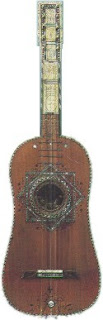
In fact the other night at New Year’s Eve dinner, one of the younger boys who is just learning to play the chitarra battente (pictured at left) asked for some advice from Mimmo, our host and lead singer/guitar player of Marasà, a local band that performs traditional Calabrese music with a bit of an updated twist.
I just love how generation after generation picks up these songs and instruments with pride, keeping the tradition going, not feeling embarrassed or shy in the least as they sing along (loudly) when the guitar shows up.
For anyone who thinks that Calabrese music and Calabrese in general is dying out, here’s a short clip of Mimmo encouraging yet another Calabrese boy on how to play the traditional way:
Although Italian musical heritage goes back centuries, including the famous chants of the Gregorian monks, Calabrian music has its own unique tradition and is rooted in songs about peasant life in the feudal system and all it entails–sung in Calabrese accompanied by Calabrian instruments.
It is music of the people, by the people, for the people, so to speak, and tells stories of both hope and hopelessness–common conflicting emotions for many Calabresi throughout the centuries.
Traditional Calabrian folk music has some common elements: high, strong vocals, a catchy, nearly hypnotic rhythm, and a bittersweet raw passion with any combination of tambourine, guitar, chitarra battente, accordion, zampogna (bagpipes), lira, mandolin, drums and more. The song rhythm you’ll hear often is the tarantella, a traditional southern Italian folk dance that was performed by female victims of spider bites to rid themselves of the venom.
There’s a great description of Calabrian music heritage here if you’re interested, but I think George Gissing sums it up pretty well in his 1901 travel memoir:
Listen to a Calabrian peasant singing as he follows his oxen along the furrow,
or as he shakes the branches of his olive tree.
That wailing voice amid the ancient silence,
that long lament solacing ill-rewarded toil,
comes from the heart of Italy herself,
and wakes the memory of mankind.
~ George Gissing
By the Ionian Sea: Notes of a Ramble in Southern Italy
For me, there’s just nothing like that distinct Calabrese cry accompanied by the chitarra battente to take me back to when my ancestors walked these same streets, living much simpler yet much harder lives, imagining what they could offer their families if only they could get to l’America.
Goodness I wish I could go back and tell them.
You can hear more of Marasà here by clicking on “il disco” and then choosing songs. My favorites are Aquila bella, Canto ad aria, and Facci di n’ammendula and if you like bagpipes, be sure to check out A Nuziata.
If you’d like to order a Marasà CD of your very own, you know where to find me.
What’s Cooking Wednesday: Bagels
 I wasn’t going to post a recipe today since I honestly haven’t been cooking very much lately–we had Christmas dinner at P’s parents and we spent New Year’s Eve at a friend’s house. Indeed, it’s the same place we spent New Year’s Eve last year, so if you’d like to see some photos from 2006, you can check them out here.
More on the recent New Year’s Eve soon, but for now–bagels!
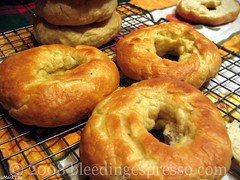
Michelle of Michellanea posted this bagel recipe a while ago for those of us in Italy dying for something, anything that we can smear some cream cheese on, and this recipe definitely delivers.
In my baking frenzy around Christmas, I finally decided to give these a go, and I will definitely be making bagels more frequently around here from now on. The recipe is easy to follow and carry out; the only time-consuming part is waiting for the dough to rise. And then waiting for them to cool off before you dig in.
The measurements are for those of us using metric, but everything is easily convertible these days online, for example at JoyofBaking.com.
Bagels
(makes 8 large bagels)
30 grams fresh yeast
2 tablespoons of oil
3 teaspoons of salt
2 teaspoons of sugar
1 teaspoon honey
500 grams of flour
Dissolve yeast in 250 ml of warm water and add oil. In large bowl, mix together salt, sugar, and flour. Make a well in the center and add in yeast mixture.
Mix together all ingredients, working in flour on the sides of the bowl in order to get an even mixture. Work dough into a ball.
Cover bowl with a damp towel for about 40 minutes and let dough rise in a warm place; it should double in size. Put a piece of wax paper on the baking sheet you’ll be using for the bagels.
Work the dough for about ten minutes. Divide into 8 little balls. Make a hole in the center of each ball and widen the opening until it begins to take the shape of a bagel.
Let the bagels sit on the warm towel for another 15 minutes while you heat the oven up to 200°C.
In the meantime, bring a large pan of water to a light boil (adding the 1 teaspoon of honey, which is a substitute for malt). Let each bagel boil lightly for about two minutes on each side and then remove and put them back on the damp towel.
If you are adding sesame or poppy seeds, at this point, sprinkle them on a plate and press each bagel down lightly over them.
After about five minutes, put the bagels on the wax paper-covered baking sheet and place in oven for about 20 or 25 minutes until they are golden brown (but not too brown – they will get a bit browner after they’ve cooled), flipping them after about 10 minutes to ensure even baking.
Buon appetito and thanks again to Michelle for the great recipe!
Buon Anno!
Wishing everyone . . .
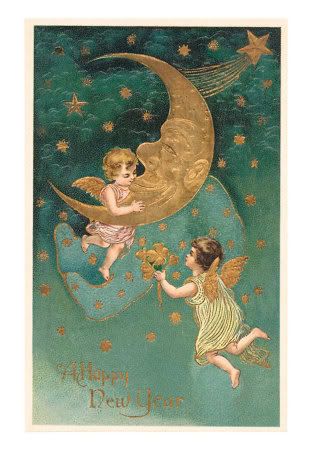
May 2008 be your best year yet!
And remember, don’t eat chicken today
or you’ll be scratching (for money) all year . . .
pork (to live high on the hog) and lentils (“coins” to bring you money)
are the way to go!
 Michelle Kaminsky is an American attorney-turned-freelance writer who lived in her family's ancestral village in Calabria, Italy for 15 years. This blog is now archived.
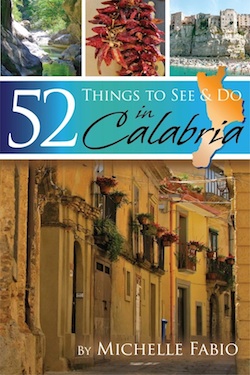
Calabria Guidebook
Recipes


