Archive for the ‘italian’ Category

La Bella Lingua/Celebrate Italian Heritage Contest
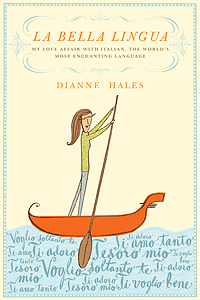
La Bella Lingua by Dianne HalesRemember when we talked about Dianne Hales’ book, La Bella Lingua? Well here is your chance to win another copy–plus four other Italian-themed books from Random House through the:

Celebrate Italian Heritage Contest

From the contest page:

October is Italian Heritage Month so Living Language and Broadway Books are pleased to provide five lucky winners with an all-about-Italian prize package, valued at $115.79.

Each prize package will include the following:

• (1) signed hardcover copy of La Bella Lingua by Dianne Hales

• (1) Living Language Complete Italian: The Basics package

• (1) Living Language Baby’s First Words in Italian package

• (1) Living Language 2000+ Essential Italian Verbs with CD-ROM

• (1) Fodor’s Italy 2010

The contest runs until November 7. The email addresses go straight to a computer in Random House’s vault and will not be used for any solicitations. The contest is limited to people with mailing addresses in the U.S and Canada.

Read more at the contest page, and hurry!

Viva l’italiano!

La Bella Lingua by Dianne Hales

La Bella Lingua by Dianne HalesPlease welcome Dianne Hales, author of the new book La Bella Lingua, which I’ve already told you about when we discussed my favorite False Friends.

Well today is La Bella Lingua‘s release date, and I have to tell you, this book is fabulous!

I got my copy two weeks ago–and flew through it in a weekend. I plan on reading it again.

For anyone who has been enchanted by the always beautiful, often frustrating Italian language and tried to grasp its basics as well as its intricacies, Dianne’s tales will not only ring true but also comfort you.

From obscure word etymologies to entertaining anecdotes, La Bella Lingua will keep you turning pages, nodding along in agreement, laughing, and even learning–I picked up quite a few new words myself.

And the writing? A sheer pleasure. Truly.

A *must* for any lover of the Italian language, this book assolutamente warrants five espresso cups out of five.

What’s that? You’d like a copy for yourself?

Well FIVE lucky Bleeding Espresso readers have a chance to do just that.

Simply leave a comment on this post at or before 11:59 p.m. (Italy time), May 19, and I’ll draw FIVE names at random as winners.

**UPDATED: For those of you in Italy who were wondering how to find a copy, you can order the book through Webster.it for €22,37 and shipping is free!

Benvenuta Dianne!

Dianne HalesNever did I—a sensible woman of sturdy Polish peasant stock—expect to become madly, gladly, giddily besotted with the world’s most luscious language. But on a mostly mute maiden voyage to Italy in 1983, Italians had talked constantly to, at, and around me. Yearning for a few words to offer in return, I decided to study their language.

My first teacher was an intense young woman from the Abruzzi who had recently moved with her new American husband to San Francisco. She insisted that I repeat an Italian sentence that translated into “I am going into the corridor to smoke a cigarette.”

“But I don’t smoke,” I objected.

“Italians smoke,” she countered.

“Signora, questa frase è importante.”

“It’s not important to me,” I persisted. “I am never, ever going into a corridor in Italy to smoke.”

She sighed. I changed the subject and asked her what she missed most about Italy. “La piazza,” she said as wistfully as if it were the name of a loved one left behind. After a few seconds, she added, “La domenica.”

“Sundays?”

“When you go to Mamma’s.” She began to sob. Shortly thereafter she packed up and returned to Italy.

My next teacher, an aspiring actress who taught Italian to local children, displayed picture books of baby ducks and puppies. When I balked at learning ninnananne (lullabies), she handed me off to her father, who taught Italian at the local community college. Tony, a trim Neapolitan who biked over the hills to my home, would break into arias, dropping onto one knee to serenade me with “E lucevan le stelle” and “Che gelida manina.”

Soon I was a goner, inebriated with Italian’s sounds, lovesick for its phrases. My next classroom was a Sausalito bungalow festooned with so many cherubs and hearts that I thought of its voluptuous owner as la mia Valentina. A Romana (and professional chef) of indeterminate age with henna hair and a full figure Italians might describe as abbondante, she served me delectable merende (snacks) and juicy tales of long-ago lovers.

AssisiCrossing the line from tourist to scholar, I decided I was ready to study in Italy. However, the first teacher I had arranged to study with developed a leg cramp while swimming off the Amalfi coast. A Sicilian prince sailing nearby swept her onto his private yacht—and then into a castello by the sea, She never again gave lessons—or, for all I know, decamped from her royal digs. I had better luck at a private school in a Renaissance villa in Assisi, where a faculty of striking young women did indeed excuse themselves to smoke cigarettes in the corridor.

The professor who headed the school complimented my grammar but grimaced at my accent. I must have looked crestfallen, for he hastened to assure me that this was “un problemino,” a teeny tiny problem. All that I had to do, he explained, was talk with more Italians. And so I did.

Returning to Italy every year, I improved my Italian in the most tried-and-true way: by tripping over my tongue and learning from my mistakes. At Camponeschi, our favorite restaurant in Rome, the waiters giggled when they overheard me describe the wonderful view from our terrace of the roofs of Rome. Instead of the masculine tetti (roofs, pronounced tet-tee), I had used the feminine slang tette (tits, pronounced tet-tay).

The madly ambitious idea of writing a book about a language other than my own grew out of a fiction-writing group I belonged to for several years. I wrote a rather prosaic novel called Becoming Italian about the adventures of a group of students, interspersed with notes on the language. Character, plot, and dialogue didn’t much interest me; writing about Italian was the most fun I’d ever had with a word-processing program.

I found the perfect collaborator in Alessandra, a Romana who migrated to the United States years ago and who taught me Italian the way Italians learn the language—through fairy tales, comic books, epic poems, classic novels, operas, folk songs, movies, newspapers, and hours and hours of chatting (chiacchierare) in Italian. I began each session with a mantra: “Sono italiana, sono italiana, sono italiana. “I am Italian, I am Italian, I am Italian.” I must see with Italian eyes, Alessandra would remind me, hear with Italian ears, speak with Italian rhythms.

“How would you say, ‘Give me a kiss?’” Alessandra asked one day.

“Dammi un bacio,” I replied, somewhat taken aback by the query.

No, no, no,” she chastised gently, explaining that the combination of “n” and “b” strikes an Italian ear as molto brutta, so I must run them together into an “m.”

Dammi umbacio!” I dutifully repeated, although this phrase seemed even less likely to enter my conversations in Italy than excusing myself to smoke in the hallway.

I was wrong. One of the many Italians who coached me in their language asked for a kiss (and, yes, he said umbacio) the first time we met. When I pulled away, he added the irresistible kicker, “But I’m 87!”

In time all of Italy became my school house, and virtually all the Italians I met enthusiastic (and patient) tutors. In contrast to the French, who praise an impeccable speaker for having une langue châtiée, which literally means a punished tongue, an Italian friend gave me the highest of compliments when he said that my Italian had progressed from being involto (rolled tight, like cannelloni) to disinvolto, as loose and easy, in his words, as a lasagna noodle.

La Bella Linguaa true opera amorosa, a labor of love—chronicles my idiosyncratic journey through (arguably, I concede) the world’s most loved and lovable language. I have cherry-picked the liveliest parts of Italian’s history and the golden eras of its literature, art, music, movies, and culture.

In its pages, you will meet the people, visit the places, read the words, behold the paintings, hear the music, taste the meals, and watch the movies that taught me the greatest of Italian secrets: how to make the soul smile.

——-

Thanks so much Dianne!

Remember to comment for a chance to win a copy of La Bella Lingua!


False Friends/Falsi Amici in Italian

La Bella Lingua by Dianne HalesI was recently introduced to a fabulous new site about the Italian language called La Bella Lingua by Dianne Hales.

Dianne has a book by the same name coming out in May, and you will see her here at Bleeding Espresso closer to that time, but for now, Dianne has inspired me to share one of my favorite/least favorite parts of the Italian language:

False Friends/Falsi Amici

What are false friends in Italian?

Also called “false cognates,” these are Italian words that sound a lot like English words but *so* do not correspond in meaning.

If you’re just starting to learn Italian, this is a great list to simply commit to memory. It is by no means exhaustive, but these are some that have always stuck in my mind:

Italian False Friends/Falsi Amici in Italiano

Attualmente: currently NOT actually (in realtà)
Camera: room NOT camera (la macchina fotografica)
Cocomero: watermelon NOT cucumber (cetriolo)
Comprensivo: understanding NOT comprehensive (completo)
Confetti: sugared almond NOT confetti (coriandoli)
Confrontare: to compare NOT to confront
Crudo: raw NOT crude (volgare)
Educato: polite NOT educated (istruito or colto)
Educazione: good manners NOT education (istruzione)
Eventuale: any NOT eventual (finale)
Fabbrica: factory NOT fabric (tessuto)
Fastidio: annoying NOT fastidious (pignolo)
Fattoria: farm NOT factory (fabbrica)
Firma: signature NOT firm, as in company (azienda) or firm, as in a mattress (rigido)
Gentile: nice NOT gentle (dolce or leggero)
Intendere: to understand NOT to intend
Libreria: bookstore NOT library (biblioteca)
Magazzino: warehouse NOT magazine (rivista)
Morbido: soft NOT morbid (morboso)
Noioso: boring NOT noisy (rumoroso)
Parente: relative NOT parent (genitore, madre, padre)
Patente: license NOT patent (richiesta di brevetto)
Peperoni: peppers NOT pepperoni, the spicy sausage (salame piccante)
Preservativo: condom NOT preservative (conservante)
Pretendere: to expect NOT to pretend (fare finta)
Rumore: sound NOT rumor (voce)
Sensibile: sensitive NOT sensible (ragionevole)
Simpatico: nice NOT sympathetic (comprensivo)
Stravagante: eccentric NOT extravagant (sprecone)

Have you made any false friend mistakes?

Do you have more to add to the list? Please share!


Top 5 Italian Words You Really Don’t Want to Mispronounce

Whether you’re coming to Italy for your first or twenty-first time, ready to meet your future in-laws, trying to impress your new Italian amore, or just in the mood to laugh *with* us as we maneuver our way through the beautiful Italian language, I have compiled for you:
The Top 5 Italian Words You Really Don’t Want to Mispronounce.

Read on...

Bleeding Espresso Mission Statement

Michelle FabioMichelle Fabio is an American attorney-turned-freelance writer living in her family's ancestral village in Calabria, Italy and savoring simplicity one sip at a time.

Bleeding Espresso Book Reviews

Subscribe to Bleeding Espresso by email:

Affiliates, Sponsors & Supporters

Italy real estate
SerenataFlowers.com
Expatriate Tax Returns
Echinacea from A.Vogel
Moo.com

Nutella E-book for Sale

The Unofficial Guide to Nutella by Sara Rosso and Michelle Fabio

Categories


Recipes


IMG_2199wtmk
IMG_1659.1
Homemade apple butter
Green beans, potatoes, and pancetta
Glazed Apple Oatmeal Cinnamon Muffins
Pasta with snails alla calabrese
Onion, Oregano, and Thyme Focaccia
Oatmeal Banana Craisin Muffins
Prosciutto wrapped watermelon with bel paese cheese
Fried eggs with red onion and cheese
Calabrian sausage and fava beans
Ricotta Pound Cake