
Archive for the ‘guest bloggers’ Category
E-Book Giveaway & Guest Post by Author Elisa Lorello
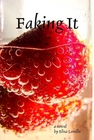 As part of the WOW blog tour, Elisa Lorello stops by Bleeding Espresso today to talk about something that has within the past few months become near and dear to my heart: e-books!
Since I treated myself to an iPod Touch two months ago, I’ve become a proud e-book convert after *swearing* I would never get used to the feel of a gadget in my hand instead of all those gorgeous pages. Of course I still love paper books, but getting used to e-books was *much* easier than I had imagined–and talk about instant gratification. I can pick out a book and have it literally in my hands in SECONDS.
Elisa is the author of Faking It and Ordinary World, and has offered up some free e-copies for lucky BE readers. Just leave a comment on this post by midnight on Sunday, February 28 (Italy time), and you’re eligible. You can get extra entries by tweeting or posting about the contest on your blog and/or Facebook (four possible entries total). Be sure to let me know about your extra entries via e-mail, Twitter, or FB.
Now, here’s Elisa!
——–
E-books Are My Friend
 E-books and e-readers have been the target of some doomsday scenarios. “Watch out, they’ll destroy the publishing industry as we know it.” “Bookstores will be no more.” And while it’s true that the e-reader (namely, the Amazon Kindle) has rattled booksellers, I’m not ready to paint it as the Big Bad Wolf just yet.
Maybe because e-publishing has been good to me. Last month, my novels Faking It and Ordinary World hit the Kindle Store Bestseller list. Faking It even cracked the Top 10! The Kindle Store was able to provide me with the mass distribution that chain brick-and-mortar stores typically refuse an independent author. That, in turn, provided me with a readership and recognition.
But that doesn’t diminish my love for the tactile book, or bookstores. Quail Ridge Books in Raleigh, NC, for example, is one of my favorite places to be and one of the first places I show off to my out-of-town visitors. Moreover, if I’m not at a coffeeshop to write, then I’ve snagged a comfy chair so I can read a book. And my home is cluttered with books on shelves, nightstands, coffeetables, you name it. It’s a comforting feeling to be surrounded by books.
So who said you had to love either one or the other? Since when did a pleasurable reading experience become an ultimatum, warranting the kind of loyalty you’d show for your favorite sports team? My bookworm friends who own e-readers say they haven’t stopped buying (or reading) tactile books. The e-reader is a tool of convenience, great for travel, for example.
I see no difference between the e-book as one more reading experience option just as audiobooks are an option. In fact, I often listen to an audiobook during my daily commute or road trips. People download audiobooks on their MP3 players as well.
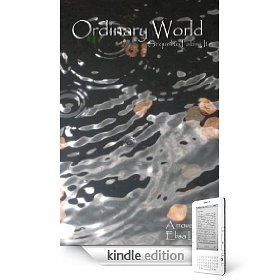 I think e-books and print books can peacefully co-exist, and I hope they do. I even think my protagonist, a writing professor and published author, would own an e-reader and be spotted in Harvard Square, a latte in tow, reading her husband’s favorite books. You could count on it.
Ordinary World is currently available in print and e-book at Lulu.com, and in e-book at Amazon Kindle Store.
About the author:
Elisa Lorello was born and raised on Long Island, New York. In 1995, she moved to southeastern Massachusetts, where she attended University of Massachusetts-Dartmouth for both her bachelor’s and master’s degrees. Her career in rhetoric and composition studies began in 2000, and since then she has been teaching first-year writing at the university level. Currently, Elisa lives and teaches in North Carolina and is co-writing her third novel. She is happily single.
To learn more about Elisa and her other writing projects, please visit her blog I’ll Have What She’s Having: The Official Blog of Elisa Lorello, or her official webpage at ElisaLorello.com. You can also follow Elisa on Twitter @elisalorello.
——–
For more information on e-books in general, check out these great articles written by Sara (of Ms Adventures in Italy fame) at her tech blog, When I Have Time.
Remember to comment for your chance to win some e-books!
Tina Tangos: On Being Authentic
Please welcome the lovely Tina of Tina Tangos for her thoughts on being authentic:
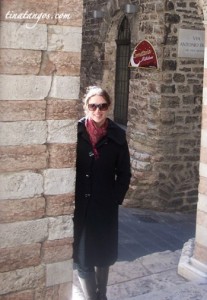 This is my fourth time being an “expat,” and my second time living in Italy. My first time living abroad, I was an au pair in Switzerland. I was 24 at the time, and I did it not only because I had always wanted to live abroad and wanted a different experience, but I also did it because I envisioned myself at dinner parties as a “grown-up” later in life, smugly saying, “When I lived in Europe…”
During my time in Switzerland, I had the chance to visit Italy several times. I fell in love with the streets, the architecture, the food. What fascinated me the most was the way people dressed and carried themselves when they walked, and the fact that their daily lives took place on this very soil. I wanted to live in Italy and I wanted to be one of those people.
Upon my return to the United States, I wore interesting scarves and pointy-toed high-heeled shoes and never left the house without my sunglasses. I would play Italian pop music on my Discman (yes, those were the pre-iPod days) and strut down the street as though I were in Rome and not Seattle.
Finally, in 2006, I got a student visa and went off to Perugia. On one hand, I flourished in a lot of ways and my Italian went through the roof. I felt free and whole. On the other hand, I was so impatient to mold the experience into how I had fantasized it would be, that I made a bit of a fool of myself, and it even affected some personal relationships.
Due to a matter of the heart, I ran away to Argentina. Living in Buenos Aires is what finally did it. It’s a tough, huge city where people have their own problems to worry about and aren’t concerned with you. I learned a lot about just doing what I needed to do, and I fell into Argentina’s daily life.
That’s when my Italian citizenship was finally processed. It’s also when my life fell apart in Argentina. My heart broke. Everything broke (even my bedroom door – it just fell off!) It’s also when a relative offered to buy me a one-way ticket to Rome. It seemed like all the signs were pointing me back to Italy. So, I went with the current, and here I am, in Perugia again.
I’ve been here almost two months, as an Italian. I realized the other day that it’s already the best and most authentic living-abroad experience I’ve had yet. And not just for the obvious reason of being able to legally stay here forever (which does help).
Why then? Because I didn’t force it to happen – it happened for me when I stopped swimming upstream. Not only that, after all that living, and after my Argentinean experience, I simply couldn’t care less about fitting in. I am who I am, and I’m proud of my experiences. My Italian has changed – I have developed a strange accent, I accidentally say Spanish words, and I forget to use “lei” instead of “tu” in appropriate situations – and people still embrace me.
It’s great to assimilate into a culture, and I highly recommend that you do – but I’ve learned that it’s also important to just be who you are, even if it isn’t the “norm” in your adopted country. The more authentic you are, the more your new home will embrace you.
Tina Ferrari is a translator, tango dancer and part-time writer based in Perugia, Italy. She writes at AffordableCallingCards.net, where you can buy affordable calling cards to Italy, as well as on her own blog, Tina Tangos. Comments are always welcome!
How to Launch a Debut Novel in the US from Abroad
Oh don’t I *wish* I was the author of this post and writing from experience? Someday!
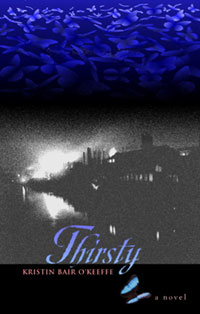
As it were, you’re about to read the outstanding advice from Kristin Bair O’Keeffe, author of Thirsty and an American who has been living in Shanghai, China since April 2006. This post is part of the WOW Blog Tour, but, to be clear, I’ve received nothing in exchange for giving Kristin some time here. I just like to show new authors who happen to be from Pennsylvania and live abroad (ahem) some extra love sometimes.
More on Kristin:
 Aside from being a debut author, Kristin is also a voracious reader, a happy mom, an engaging teacher who believes in “telling the best story you can…believing in your writing…and working your arse off,” a fierce advocate for the end of domestic violence, and a writer who spends as much time as possible in writerhead.
To find out more, visit ThirstytheNovel.com or Kristin’s blog at KristinBairOKeeffeBlog.com.
———–
How to Launch a Debut Novel in the U.S. from Abroad
When I signed a publishing contract with Swallow Press in 2008, I (like most first-time authors) was over-the-top excited. I yelped…did a jig…and wore a sh*t-eatin’ grin for weeks. At some point (between jigs) I realized, “Holy schmoly! My debut novel is going to be published in the United States while I am living in China.”
This sobered me up real quick (temporarily, at least). Anyone who has published a novel knows how hard it is to get their book into readers’ hands if they are actually living IN the United States and are able to communicate easily with bookstores, publicists, editors, and most importantly, potential readers. How the heck was I going to do it from the other side of the world?
Good question.
First, let’s look at my challenges:
GEOGRAPHY: Now, pull out that globe you used in high school geography class. That’s me in Shanghai, over there on the east coast of China. I’m waving! “Hello! Ni hao! Ni hao!”
And over there…yep, spin that globe…all the way on the other side of the world in the United States…that’s where my debut novel Thirsty was published on October 1, 2009.
 TRAVEL: To get from Shanghai to Pittsburgh, Pennsylvania (where Thirsty takes place), I have to take a 13.5-hour flight from Shanghai to Newark. Then a 3.5-hour flight from Newark to Pittsburgh. That’s 17 hours in the air, PLUS an endless number of hours spent taxi-ing on runways and eating awful food in various airports. That doesn’t even count the time spent getting to and from airports. Total travel time? With no glitches, at least 24 hours. (Tired yet?)
CHILDREN: I have a 21-month-old daughter who goes everywhere with me. She is energetic, chatty, stubborn, hilarious, prone to kicking the seat in front of her on an airplane, and at the age when all she wants to is RUN. Enough said.
TIME ZONES: Right now (as I write) it is 6:35 a.m. on Friday, November 13 in Shanghai. At this same moment, it is 7:35 p.m. on Thursday, November 12 in New York City. (Yes, it’s the day before. Weird, huh?) We are 13 hours ahead of the east coast.
INTERNET ACCESS: Because I live in a country that does not allow free access to the Internet, I am blocked from all the sites I need in order to interact with potential readers, including Facebook, Twitter, my own blog, YouTube, and many other writer-related sites. (Gggrrr…grumble.)
Hhhmmm. That’s a pretty comprehensive list of the challenges I faced. Here’s how I managed them:
STAY AWAKE! In the months leading up to the launch of Thirsty, I had to set up readings and book signings in the United States. To do this, I had to talk to events coordinators and bookstore managers from Shanghai on U.S. time. That means I was calling them at oh, say, 11:00 AM their time, which was (while Daylight Savings Time was still in place) 11:00 PM my time. Inevitably three out of four would say, “Oh, I’m interested, but can you call me at 2:00?” Yes, that meant 2:00 a.m. my time. (And I did. How did I stay alert? By hopping up and down and chomping into a lemon slice just before making each call.)
CLOSE THE GAP: Early on I decided that the only way to properly launch my debut novel was to be in the United States at the time of publication. So despite the cost, the debilitating jetlag, and the time spent, I (along with my husband and daughter) flew to the U.S. in late September.* My daughter and I stayed for about six weeks; my husband flew back to China after two weeks.
SAY YES! While in the U.S., I did as many events as possible. I attended a convention of independent booksellers. I did readings, book signings, and radio interviews. I even spent two days at my high school alma mater (shout out to Bethel Park High School!) chatting with the creative writing students about writing, publishing, life in China, and other cool stuff. My motto? If someone offers an opportunity, say yes.
HELP? If you can, hire a publicist. I did, and it gave me a voice in the U.S. I wouldn’t have had otherwise. This can be expensive, but it’s worth it.
SHARE THE CULTURE: When I hosted an online giveaway of cool bookmarkers created by a Shanghai artist, I got loads of visitors to my blog and to the Thirsty website. It was a great way to share Thirsty and a bit of China.
“HI! I’M WWW._________” Have you heard? These days an author needs a strong Internet presence no matter where she lives, but because I live so far from my target readership, it’s even more important for me. By using a VPN (Virtual Private Network), I’m able to access almost all sites from which I am blocked in China. (Of course not all VPNs work here…I’ve been through a number of them.) Check it out:
BLOG At “My Beautiful, Far-Flung Life,” I write about Thirsty, writing, my path to publishing, motherhood, wacky things in China, cool things in China, and more.
THIRSTY WEBSITE: I found a terrific website designer in the U.S. and together we designed a pretty cool site. (TIP: Writing copy—good copy—for a website takes time. On each page, you are telling a story—about you, your book, etc. Give yourself loads of time to write before launching the site.)
TWEET, TWEET: Via Twitter @kbairokeeffe I’ve connected with lots of readers and writers. I’ve made friends, hosted giveaways of Thirsty, and built up a fun community.
VIDEOS: Guess what? People love to watch stuff. Luckily I love to create stuff. Thus far I’ve done a video interview, created a book trailer, and said yes when the books editor of the Pittsburgh Post-Gazette asked to do a webcast interview with me.
BEST FRIENDS FOREVER: Yep, I’m on Facebook, too. (Are you catching on to the theme here? Connect, connect, connect.)
Whew. I’ll stop there. Yes, there are lots more ways to get your novel noticed (Good Reads, Jacketflap, blog tours, etc.), but you get the picture. My final bit of advice to writers launching books from overseas? Do the celebratory jig, get ready for a hell of lot of wonderful work, and keep the lemons close.
Now…off to recover from jetlag.
*I’d like to offer a formal apology to the man who sat in front of my daughter on the flight from Shanghai to Newark on September 26. I realize that she kicked the back of your seat at least 2,858,367 times over the course of the 13.5-hour flight. Good karma coming to you for only scowling, not yelling or throwing your shoes at us.
———–
Thanks Kristin, and best of luck!
If you have any questions or comments for Kristin, please leave them here!
Mediterranean Cooking on a Budget
This isn’t a traditional What’s Cooking Wednesday post. In fact, it’s not even written by me (welcome dear Heather of Yummi Sushi Pajamas!), but it’s full of great information–and TWO recipes–for those trying to eat healthier and save money. Pretty much all of us, I imagine?
But before we get to Heather, in other food news:
 I wanted to let you know that Sara of Ms Adventures in Italy and I, as co-hosts of World Nutella Day, (yes, it’s coming faster than you realize!) are holding a contest and giving away some Nutella!
All you have to do is tell us about your first time. Eating Nutella, of course. Get the deets, enter over at the World Nutella Day Facebook Fan Page–coming up on 1800 fans!–and why not become a fan while you’re there?
OK, take it away Heather!
—–
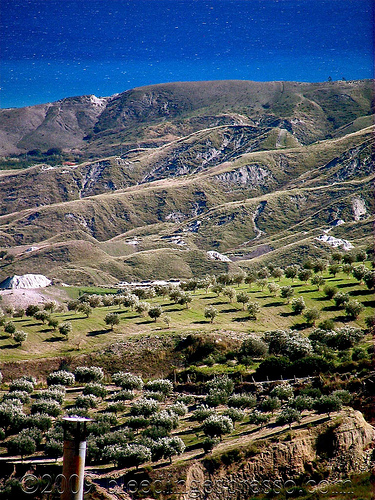 I am so excited to be guest posting on Bleeding Espresso! Here I am to talk about Mediterranean cooking on a budget.
I’ve been lucky enough to make three separate trips to the Mediterranean. Every time I come home, I look around and wonder how I can bring something of the Mediterranean lifestyle into my American living. It’s not an easy thing to do since in a lot of ways the culture couldn’t be more different, but there are some things I’ve been able to manage.
For me, food was the easiest change to make. Mediterranean meals are based on fresh, local ingredients with smaller portions of meat, healthy fats, and lots of veggies. I loved the food when I was there, and I knew I could find ways to work it into my cooking. Following the Mediterranean diet (whole grains, healthy fats, lean proteins in small amounts, and tons of produce) helped me lose six pounds without ever having to measure a serving or count a calorie.
The problem came when the economy took a downturn and I changed my shopping style. Instead of shopping from a preplanned list, I’ve started clipping coupons and shopping sales. It saves us a lot of money, but makes it tough to purchase particular items for specific recipes. Saving money meant changing the way I thought about incorporating the Mediterranean mindset.
Instead of searching for Italian or Greek inspired recipes, I’ve started shopping at local farmers markets. I spend a lot of time putting together recipes from whatever I’ve got in the pantry (lots of canned fruits, veggies, and beans) and whatever produce I am able to grab from the local stands. I am trying to embrace the fact that it’s not olives, capers, or lamb that make a meal Mediterranean. I am learning to embrace the Mediterranean mindset of using what’s fresh and local instead of trying to incorporate specific ingredients.
 Last week’s attempt resulted in two extremely good dinners made from local ingredients and pantry leftovers. My first experiment was born from the need to use up two pounds of plums before they rotted. I peeled and pitted all of the plums, then put them in a skillet with:
- A clove of minced garlic
- 1 ¾ cups of sugar
- ¾ cup cider vinegar
- ½ tablespoon ground mustard
- 1 teaspoon cinnamon
- 1 teaspoon chili powder
- ¼ teaspoon ground cloves
I boiled it all down, using a spoon to crush the plums a bit better, and waited for it to reduce. It took maybe a half hour total. I used the sauce to top some cooked chopped chicken I had in the freezer, and put it all over some ziti. It turned out really well, and went great with a simple side of sautéed zucchini.
Experiment two was even more adventurous. I sautéed the rest of the zucchini in a little bit of olive oil and garlic. I boiled some penne pasta while the zucchini cooked. After I took the zucchini out of the pan, I tossed in a little more olive oil and a can of sardines I’ve had sitting around forever. The sardines (I chopped them first) cooked down nicely until they were just crisp salty bits, and I tossed in some bread crumbs to soak up the leftover oil. Once that was all done, I tossed the zucchini and pasta into the pan just so it could all warm up together. It was really good and so easy!
Now I feel confident that I can get whatever is fresh at the farmers market every weekend and just make it work with what I’ve got at home. I try to keep some basics like olive oil, lemon juice and capers on hand, and just toss in whatever else I have. It takes some courage, and lots of experimentation, but eventually you’ll find your own style using things you can get inexpensively and creating quick, easy meals that are reasonably healthy.
I know these ideas don’t compare to the amazing recipes featured here on Bleeding Espresso [so NOT true, Heather!], but they’ve been a hit at my house!
—–
Heather Hurd is a freelance writer and blogger. She writes about food and wine for Examiner.com and blogs at Yummy Sushi Pajamas about raising a family and enjoying the good things in life.
—–
They sound delicious!
How have you been saving money on food lately?
Do you enjoy the Mediterranean Diet?
7 Habits of Highly Effective Expats in Italy
 Today we have a guest blogger, and she comes from just down the road in Catanzaro. Welcome back Cherrye of My Bella Vita!
7 Habits of Highly Effective Expats in Italy
The reasons people move to Italy vary-some came to retire in the land of their fathers, others were pulled by Italy’s charm and yes, some of us came here for romance-or to say it like my mom would-we came here for a boy.
Regardless of our motives, we all left our homeland and entered the world of Expats in Italy. Over the 3+ years I’ve been here, I’ve noticed there are two distinct categories of expats-Effective Expats, or those who are happy, successful and grounded and Miserable Expats, the ones who can’t wait to leave.
Just so you know if you are considering a move to Italy … you want to be the first type. Just to be sure here are the seven habits of highly effective expats in Italy.
1. They research.
Most people plan for months for their Italian vacation so why wouldn’t they do the same when they are considering a move? Expats can adapt more quickly to their new country when they have done research, read other expat experiences or joined an expat forum. The Internet is full of information on moving to Italy. So fire up your laptop and get reading.
2. They can adjust to change.
Successful expats know where the best laid plans go and are able to adjust to changes as they come. Being able to go with the flow and adjust to those changes, rather than getting disgruntled and negative is one of the major differences between those two groups of expats I listed above.
3. They don’t focus on the differences.
This is one of the hardest habits to attain, but happy expats don’t focus on the differences between their home country and Italy. Learning to appreciate the differences instead of obsess over them makes expat life easier to enjoy.
4. They work hard to acclimate to life in Italy.
If you move to a new city in Any State, USA and lock yourself at home, you won’t be very happy. The same goes for living in Italy. Happy expats take a risk, get out and meet new people and work hard at acclimating to their new lives.
5. They are interested in the world around them.
And by that, I mean effective expats want to learn more about the people, places and things around them. We want to know how they do things, how they did them ‘back in the day’ and why.
6. They have honed their stress-management techniques.
There is no other way to say it, moving to Italy is stressful. Whether you get crushed by the stress of your new life or learn to adjust to the changes depends on how well you handle stress. Successful expats are good stress-managers.
7. They remember who they are.
The most successful expats remember who they are, or more importantly, who they were back home, and don’t alter their behaviors just because they are on foreign land. Some young or temporary expats might find themselves partaking in activities they would have never considered back home.
Opening your mind is a good thing, losing yourself is another. If you aren’t sure what I am referring to – think Amanda Knox.
—
Cherrye Moore a freelance writer and B&B owner living in Calabria, Italy. She writes about expat life for Affordable Calling Cards where they sell calling cards to Italy and about living and traveling in Calabria at My Bella Vita.
—
Thanks Cherrye!
What do you think are some habits of highly effective expats?
 Michelle Kaminsky is an American attorney-turned-freelance writer who lived in her family's ancestral village in Calabria, Italy for 15 years. This blog is now archived.
Calabria Guidebook
Recipes


